
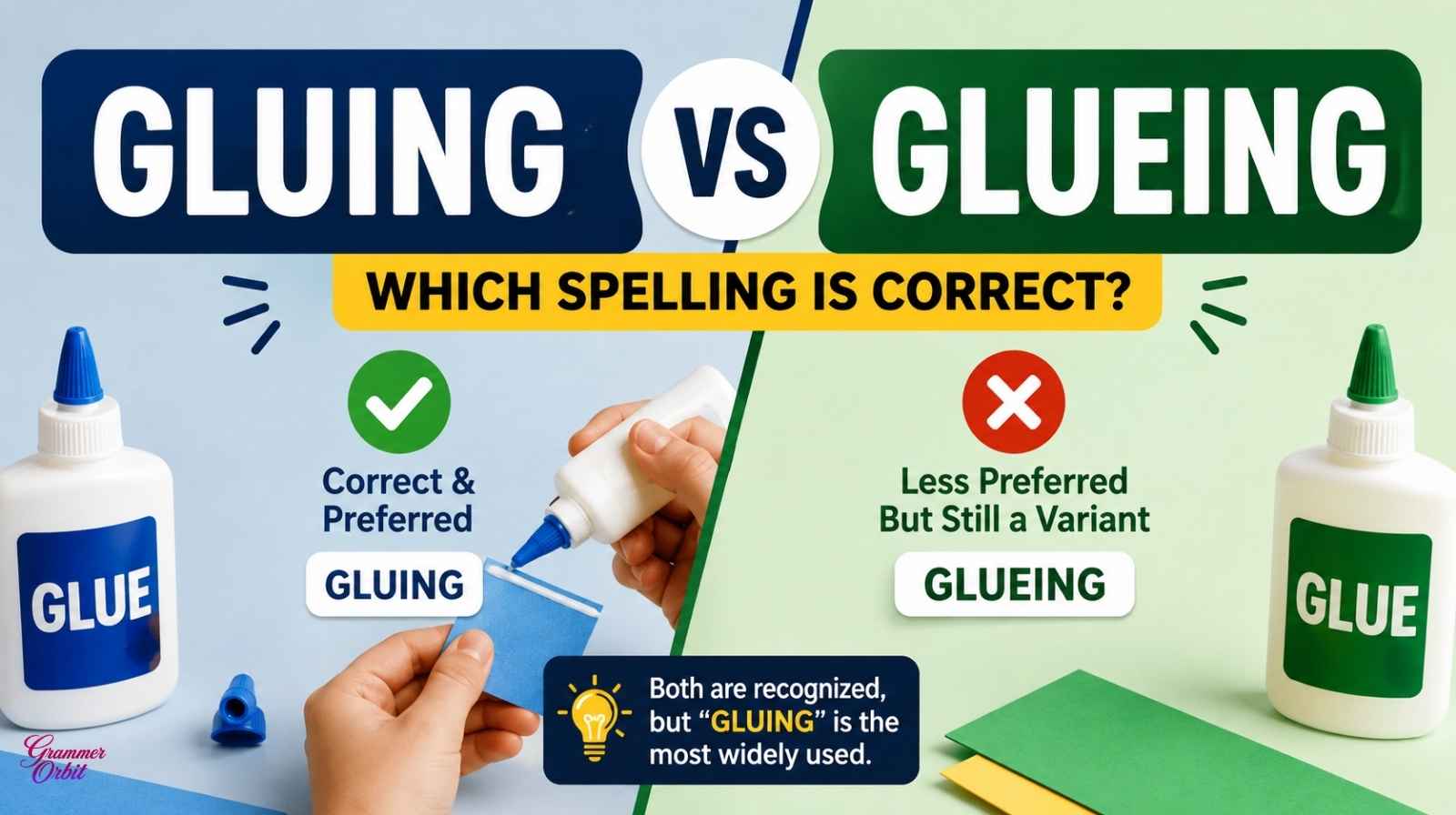
If you have ever wondered whether gluing vs glueing is the correct spelling, you are not alone. At first glance, glueing looks perfectly logical because the base verb is glue. However, English spelling rules can be surprisingly inconsistent.
The good news is that the answer is straightforward: gluing is the standard spelling you should normally use, especially in modern writing. However, glueing is also recorded as a variant by some major dictionaries, so calling it simply a spelling error would be too strong. Merriam-Webster lists “gluing” and also gives “glueing” as a variant, while Cambridge lists both forms for the present participle.
So, why does gluing usually look more natural, and when might you encounter glueing? Let’s break it down.
Gluing vs Glueing: The Quick Answer

Is Gluing or Glueing Correct?
Gluing is the spelling I recommend for most modern English writing.
Glueing is not simply meaningless or impossible, though. Major dictionaries such as Merriam-Webster and Cambridge record it as a variant.
| Spelling | Status | Recommendation |
|---|---|---|
| Gluing | Standard/common form | ✅ Use this |
| Glueing | Dictionary-recorded variant | Acceptable, but less preferred |
| Glued | Past tense/past participle | ✅ Correct |
| Glue | Base verb | ✅ Correct |
For everyday writing, school assignments, websites, professional documents, and SEO content, gluing is the safest and most familiar choice.
What Does Gluing Mean?
Gluing is the present participle or gerund form of glue. It means joining or sticking something to another object by using glue.
For example:
- She is gluing the pieces together.
- He spent the afternoon gluing photographs into a scrapbook.
- The children are gluing colored paper to the cardboard.
Cambridge defines glue as joining things together with a sticky substance, and it lists both glueing and gluing as present-participle forms.
See also Icycle vs Icicle: Differences, Meaning & Correct Usage
Why Is “Gluing” Usually Preferred?
The Silent-E Spelling Pattern
One reason gluing looks more natural is the common English pattern in which a final silent e is removed before adding -ing.
Consider:
- make → making
- bake → baking
- move → moving
- hope → hoping
- use → using
Following this familiar pattern gives:
glue → gluing
This is why many writers instinctively choose gluing.
However, English spelling rules have exceptions and variations. The spelling glueing has been recorded in reputable dictionaries, so the situation is more nuanced than simply saying, “Remove the e and you’re always correct.” Merriam-Webster explicitly lists glueing as a variant, while Cambridge gives both forms.
Why Does “Glueing” Look Reasonable?
The confusion comes from the unusual appearance of the word.
When people see:
glue + ing
they may naturally write:
glueing
After all, the word glue already contains a vowel combination, and keeping the final e can feel necessary.
Compare:
glue + ing → glueing
with:
glue → gluing
The second version looks shorter and follows the spelling pattern many readers are accustomed to.
A Useful Memory Trick
Think:
GLUE + ING = GLUING
The final e is dropped in the preferred spelling.
A simple way to remember it is:
“Use glue, but start gluing.”
That little distinction can make the spelling easier to remember.
Gluing vs Glueing in Real Sentences
Examples With “Gluing”
Here are some natural examples:
- I am gluing the broken pieces of the model together.
- She was gluing pictures into her notebook.
- The students spent an hour gluing paper shapes onto the poster.
- He is gluing the wooden pieces together.
- Be careful while gluing the cardboard.
- They were gluing labels onto the boxes.
In each sentence, gluing describes an action happening now or an activity.
Examples With “Glueing”
You may also encounter sentences such as:
- She was glueing the pieces together.
- The children were glueing paper onto the board.
These are understandable, and major dictionaries do record glueing as a variant.
Nevertheless, if you are choosing one spelling for modern general-purpose writing, gluing is the better default.
Gluing vs Glueing: Which One Should You Type?
If you’re writing an article, essay, email, school assignment, product description, or website content, choose:
✅ gluing
rather than:
⚠️ glueing
This isn’t because readers cannot understand glueing. Rather, gluing is the more conventional form and is likely to look more familiar to modern readers.
Is “Glueing” a Spelling Mistake?
The Answer Is More Complicated Than “Yes”
Calling glueing an outright mistake isn’t completely accurate.
This is important because dictionary evidence matters. Merriam-Webster’s current entry for glue gives “glued; gluing also glueing,” explicitly recognizing glueing as a variant.
Cambridge is similarly useful because its dictionary entry gives the present participle as “glueing or gluing.”
Therefore:
Gluing = preferred standard form
Glueing = recognized variant
That distinction is more accurate than saying one is “correct” and the other is always “wrong.”
Why This Matters for Writers
If you are proofreading a professional document and see glueing, you don’t necessarily need to treat it as a serious grammatical error.
However, consistency matters.
If your document uses gluing throughout, changing isolated instances of glueing to gluing can make the writing look cleaner and more consistent.
For SEO content, educational writing, and general web publishing, I would also recommend gluing because it is the more familiar form.
Gluing vs Glueing: A Real-Life Writing Example

A Practical Editing Scenario
Imagine a teacher preparing instructions for an elementary-school art project.
The original instructions say:
“Students will begin glueing the colored shapes onto the paper.”
See also Meating vs Meeting: Difference, Meaning, And Correct Usage
At first glance, nothing appears seriously wrong. The meaning is completely clear, and readers know exactly what action the students should perform.
Now suppose the teacher checks a dictionary and finds that gluing is also listed and is the more familiar modern form.
The sentence can become:
“Students will begin gluing the colored shapes onto the paper.”
The meaning hasn’t changed. The improvement is primarily one of spelling consistency and conventional usage.
This is especially useful when preparing educational material for a broad audience. A teacher may want students to learn the spelling pattern glue → gluing, while an editor may want a document to follow the most familiar contemporary form.
The important lesson is that glueing isn’t a completely nonsensical construction. Reputable dictionaries document it. Merriam-Webster specifically identifies it as a variant, while Cambridge includes it alongside gluing.
Therefore, an editor shouldn’t automatically assume that every occurrence of glueing represents careless writing. Instead, the better approach is to consider the publication’s style, audience, and preferred spelling conventions. For most general modern English content, choosing gluing provides a simple and recognizable solution.
What Current Dictionary Evidence Says
2025–2026 Evidence Check
Rather than inventing a percentage showing which spelling is “more popular,” it is better to rely on authoritative dictionary evidence.
As of the current 2025–2026 reference material:
- Merriam-Webster lists gluing and gives glueing as a variant.
- Cambridge Dictionary lists glueing or gluing as the present participle.
- Merriam-Webster’s 2026 dictionary material continues to show the same treatment of the two forms.
This gives us a much more reliable conclusion than an unsupported claim such as “99% of people use gluing.”
Why Search-Volume Numbers Can Be Misleading
Google Trends can compare search terms, but Google itself explains that Trends does not necessarily return results for misspellings, spelling variations, synonyms, plurals, or singular forms in the same way.
Therefore, it would be misleading to present an invented 2025 or 2026 search-percentage comparison between gluing and glueing.
For this particular spelling question, dictionary evidence is more useful than fabricated frequency statistics.
Gluing vs Glueing: Quick Comparison Guide

The Simple Decision Rule
Use this checklist when you’re unsure:
- Need the safest modern spelling? → Use gluing
- Writing for school or professional content? → Use gluing
- Editing a document for consistency? → Prefer gluing
See also Prooving vs Proving: What’s The Correct Spelling?
- Found “glueing” in an older text? → It may be a legitimate variant
- Wondering whether “glueing” has meaning? → Yes, dictionaries record it
- Want one spelling to remember? → Remember gluing
Side-by-Side Examples
| Situation | Recommended Form | Example |
|---|---|---|
| Present action | gluing | She is gluing the pieces. |
| Gerund | gluing | Gluing requires patience. |
| Past tense | glued | She glued the pieces yesterday. |
| Base verb | glue | Please glue the paper here. |
| Variant encountered in text | glueing | The manual uses “glueing.” |
FAQs
Q1: Is “Gluing” the Correct Spelling?
A: Yes. Gluing is the preferred spelling for most modern English writing. Major dictionaries also record glueing as a variant, so it is more accurate to describe gluing as the standard or preferred form rather than claiming glueing is universally invalid.
Q2: Is “Glueing” Grammatically Correct?
A: Glueing is a recognized variant spelling. Cambridge lists both glueing and gluing, while Merriam-Webster lists glueing as a variant. However, gluing is generally the better choice when you want the most familiar modern form.
Q3: Why Is It “Gluing” Instead of “Glueing”?
A: The preferred spelling follows the common pattern of removing a final silent e before adding -ing:
glue → gluing
This is similar to:
make → making
and
move → moving
English has exceptions, however, which is why dictionary evidence is useful.
Q4: Is Glueing an American or British Spelling?
A: It would be misleading to treat glueing simply as the British version and gluing as the American version. Cambridge and Merriam-Webster both record the two forms, so this is not a straightforward American-versus-British spelling difference.
Q5: Should I Use Gluing in Formal Writing?
A: Yes. Gluing is an excellent choice for formal writing, academic work, professional documents, websites, and general-purpose content.
Q6: What Is the Past Tense of Glue?
A: The past tense and past participle are glued.
For example:
- She glued the pieces together.
- The paper was glued to the cardboard.
Q7: What Is the Present Participle of Glue?
A: The present participle is commonly written gluing. Cambridge also records glueing as a variant.
Q8: Is “Gluing” the Same as “Glueing”?
A: Yes, they refer to the same action: joining something with glue. The main difference is spelling preference and convention, not meaning.
Final Verdict
So, gluing vs glueing which spelling should you use?
The best answer is gluing.
It is the spelling I recommend for modern articles, schoolwork, professional writing, websites, and everyday communication. At the same time, glueing should not automatically be labeled a completely incorrect spelling, because reputable dictionaries such as Merriam-Webster and Cambridge record it as a variant.
The easiest form to remember is:
Glue → Gluing
When you need a single spelling that is clear, familiar, and suitable for most modern English contexts, choose gluing.
If this guide helped clear up the gluing vs glueing confusion, keep it bookmarked for the next time English spelling gets unexpectedly sticky!
👉 Discover more simple and practical grammar guides on Grammer Orbit

Zia Ahmad is a professional blogger specializing in grammar tips and spelling accuracy. He creates clear, practical content that helps readers eliminate errors, strengthen writing skills, and communicate effectively for students, professionals, and everyday writers worldwide.