
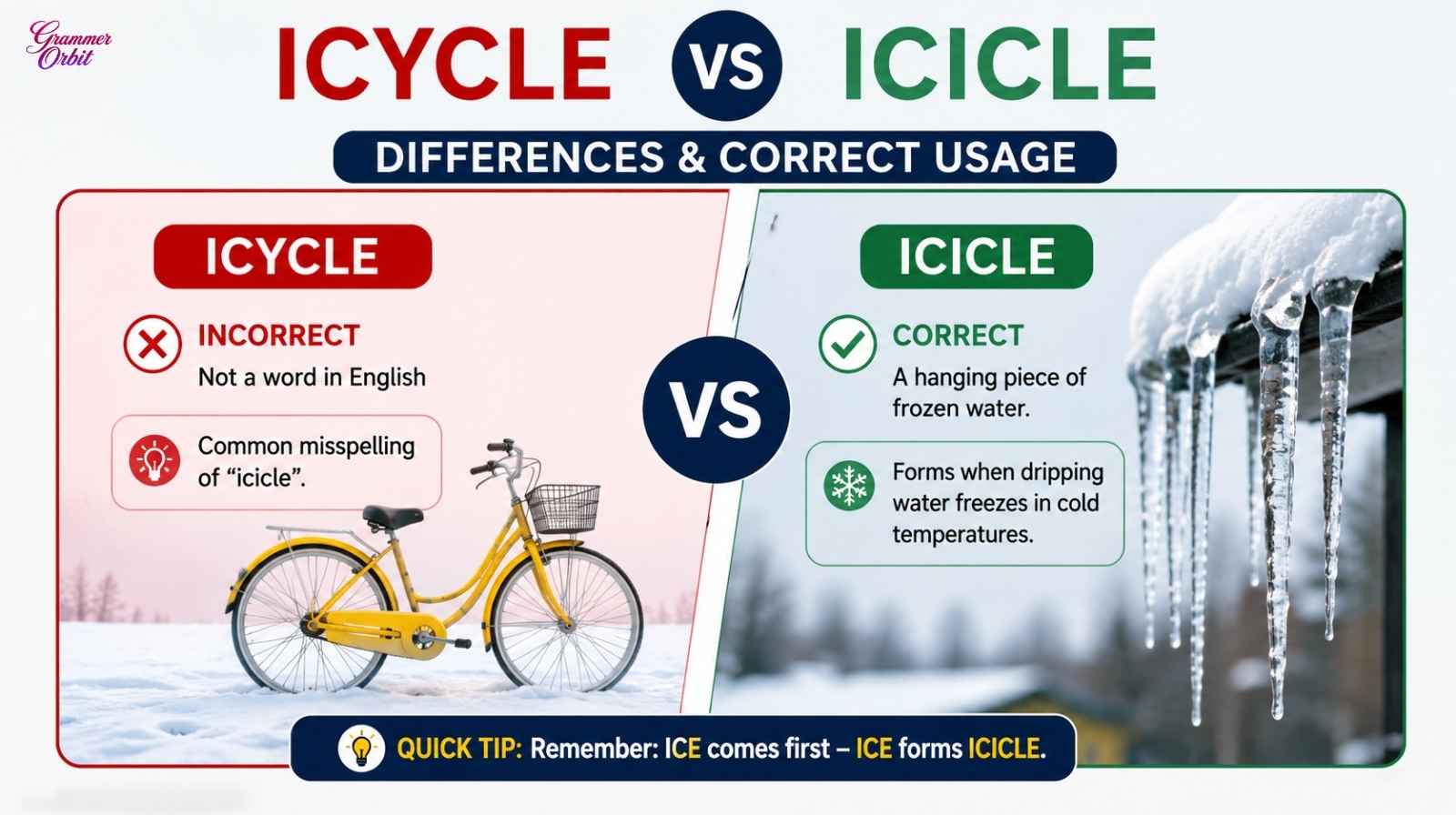
Have you ever seen someone write “icycle” instead of “icicle” and wondered which one is actually correct? You’re not alone. English spelling can be confusing, especially when words sound almost identical.
The truth is simple: “icicle” is the correct English word, while “icycle” is a common misspelling. Many learners accidentally replace the second “i” with a “y” because of pronunciation, typing habits, or assumptions about English spelling.
In this guide, you’ll learn the difference between Icycle vs Icicle, discover why the mistake happens, see real-world examples, and learn easy tricks to remember the correct spelling forever.
What Is the Difference Between Icycle vs Icicle?
The biggest difference is straightforward:
| Word | Correct? | Meaning |
|---|---|---|
| Icicle | ✅ Yes | A hanging piece of frozen water (ice) formed when dripping water freezes. |
| Icycle | ❌ No | Not an accepted English word; simply a misspelling of icicle. |
If you’re writing in school, business, or online, you should always use icicle.
Why Do People Write “Icycle”?
There are several reasons this spelling appears:
- It sounds similar when spoken.
- English spelling isn’t always phonetic.
- The ending “-cycle” is familiar from words like bicycle and motorcycle.
- Autocorrect may not immediately catch the mistake if typed quickly.
See also Investor vs Investee: How Are These Words Connected?
What Does “Icicle” Mean?
An icicle is a narrow piece of ice that forms when water drips and freezes in cold temperatures.
Definition
According to standard English dictionaries:
Icicle (noun): A hanging spike of ice formed by freezing dripping water.
You’ll commonly see icicles hanging from:
- Roof edges
- Tree branches
- Gutters
- Mountain cliffs
- Fences
Example Sentences
- Large icicles hung from the roof after the snowstorm.
- Be careful the icicle above the doorway could fall.
- Children admired the sparkling icicles on the trees.
Why “Icycle” Is Incorrect
Although many people search for “icycle”, dictionaries do not recognize it as a valid English word.
Common Causes of the Mistake
Pronunciation Confusion
When spoken quickly, icicle may sound like “eye-cycle.”
Typing Errors
The letters i and y are often substituted accidentally.
Pattern Recognition
English contains many words ending in -cycle, such as:
- bicycle
- tricycle
- motorcycle
- recycle
Because of these familiar spellings, writers sometimes assume icycle follows the same pattern.
Icicle Meaning and Usage in Everyday English
The word icicle appears in weather reports, books, news articles, classrooms, and conversations during winter.
Everyday Examples
- Snow melted during the afternoon and formed icicles overnight.
- The cabin roof was covered with long icicles.
- Workers removed dangerous icicles from the building.
Figurative Usage
Writers also use icicle metaphorically.
Examples:
- His voice was as cold as an icicle.
- She gave him an icicle-like stare.
These expressions describe someone as emotionally cold or unfriendly.
Icycle vs Icicle: Common Mistakes to Avoid
Many English learners make predictable spelling mistakes.
Incorrect Examples
❌ The roof had beautiful icycles.
See also Kick Rocks Meaning: Origins, Uses & 25 Strong Alternatives
❌ A giant icycle fell from the tree.
❌ Watch out for falling icycles.
Correct Examples
✅ The roof had beautiful icicles.
✅ A giant icicle fell from the tree.
✅ Watch out for falling icicles.
How to Remember the Correct Spelling

Fortunately, remembering icicle is easy once you know a few tricks.
Memory Trick 1
Think of ICE at the beginning.
ICE + ICLE = ICICLE
Since an icicle is made entirely of ice, the spelling starts with ice.
Memory Trick 2
Remember this sentence:
Ice creates icicles.
Both words begin with ice, making the spelling easier to recall.
Memory Trick 3
Whenever you see icycle, pause and ask yourself:
“Is this related to bicycles?”
If not, you probably mean icicle.
Real-Life Example: How a Simple Spelling Error Changed a School Project
A middle school student was preparing a science presentation about winter weather. While creating slides, they repeatedly typed “icycle formation” instead of “icicle formation.” Because the word looked reasonable and sounded similar when spoken aloud, the mistake went unnoticed throughout the drafting process.
When the teacher reviewed the project, they pointed out that “icycle” isn’t a recognized English word. The student corrected every instance to “icicle” before presenting the assignment. More importantly, they learned why the spelling matters. During the presentation, classmates also admitted they had assumed “icycle” was correct because it resembled familiar words like bicycle and tricycle.
This small correction became an important lesson about English spelling patterns. Similar-looking words are not always built using the same rules, and relying only on pronunciation can lead to mistakes. Afterward, the student began proofreading more carefully and using reliable dictionaries whenever unsure about uncommon spellings. This simple habit improved not only their science reports but also their overall writing accuracy.
Data and Language Trends (2025–2026)
See also Unenroll vs Disenroll: Which One Is Correct?
Language-learning platforms and search trend analyses continue to show that spelling confusion remains one of the most common writing challenges. During 2025–2026, educational websites reported consistent searches for commonly misspelled English words, including terms like “icycle,” “definately,” and “seperate.”
Several factors contribute to these errors:
- Mobile typing increases spelling mistakes.
- Pronunciation often differs from spelling.
- English contains many irregular spelling patterns.
- Spell-check tools help but don’t catch every contextual mistake.
These trends highlight the importance of verifying unfamiliar words with trusted dictionaries instead of relying solely on pronunciation or autocorrect.
Tips to Avoid Similar Spelling Mistakes
Read More
Regular reading helps you become familiar with correct spellings naturally.
Use a Dictionary
Verify unfamiliar words before publishing or submitting your writing.
Proofread Slowly
Many spelling mistakes become obvious during a second reading.
Don’t Trust Pronunciation Alone
English spelling often differs from the way words sound.
Practice Frequently
The more you write correctly, the easier accurate spelling becomes.
FAQs
Q1: Is “icycle” a real word?
A: No. Icycle is not recognized in standard English dictionaries. The correct spelling is icicle.
Q2: What does icicle mean?
A: An icicle is a hanging piece of frozen water that forms when dripping water freezes.
Q3: Why do people spell icicle as icycle?
A: Because the pronunciation sounds similar, and many English words end with -cycle, making the incorrect spelling seem logical.
Q4: Is icicle a noun?
A: Yes. Icicle is a common noun referring to a natural formation of frozen water.
Q5: Can spell-check detect “icycle”?
A: Most modern spell-checkers flag it as incorrect, but it’s still best to proofread your work carefully.
Q6: How can I remember the correct spelling?
A: Think of the phrase “Ice creates icicles.” Since an icicle is made of ice, the word begins with ICE.
Conclusion
Understanding the difference between Icycle vs Icicle is easier than it first appears. Icicle is the only correct spelling and refers to a hanging piece of frozen water formed when dripping water freezes. Icycle, on the other hand, is simply a common misspelling caused by pronunciation and familiar spelling patterns like bicycle or tricycle.
Whenever you’re writing about winter weather, frozen water, or seasonal scenery, remember to use icicle. Taking a moment to verify spellings with a trusted dictionary can improve your writing accuracy and help you avoid common English mistakes. The more you practice using the correct form, the more natural it will become.
👉 Discover more simple and practical grammar guides on Grammer Orbit

Zia Ahmad is a professional blogger specializing in grammar tips and spelling accuracy. He creates clear, practical content that helps readers eliminate errors, strengthen writing skills, and communicate effectively for students, professionals, and everyday writers worldwide.