
Have you ever typed “meating” when you actually meant “meeting”? You’re not alone. English contains many words that look or sound similar, making spelling mistakes surprisingly common.
The confusion between Meating vs Meeting usually happens because both words are pronounced similarly in casual speech, yet only one is commonly used in everyday English. Understanding the difference can improve your writing, help you avoid embarrassing mistakes, and make your communication more professional.
In this guide, you’ll learn what each word means, when to use it, real-world examples, common mistakes, and an easy trick to remember the correct spelling.
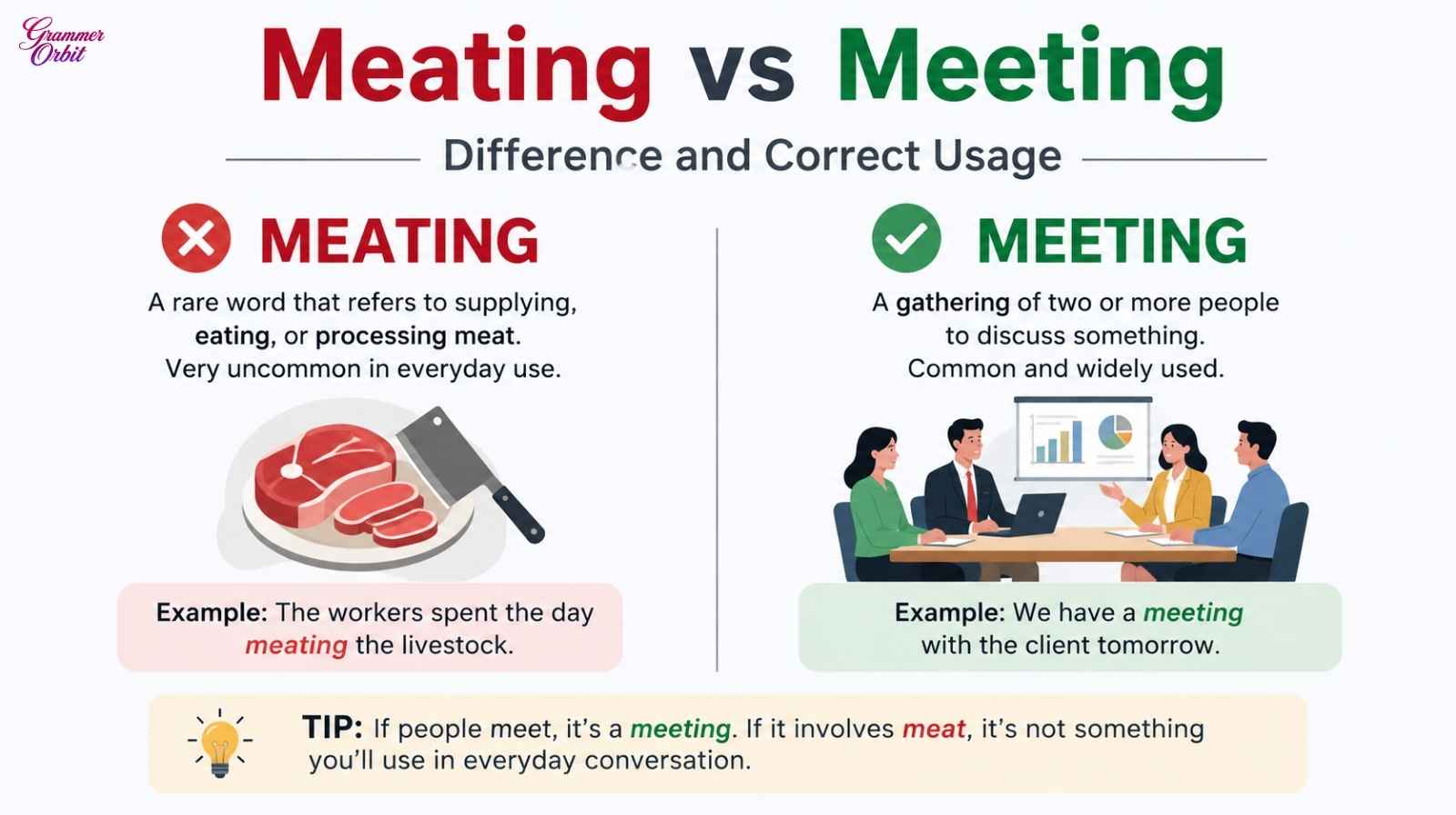
Meating vs Meeting: What’s the Difference?
The biggest difference is simple:
| Word | Meaning | Correct Usage |
|---|---|---|
| Meeting | A gathering of people or the act of coming together | ✅ Common English word |
| Meating | Extremely rare; refers to supplying, eating, or processing meat in very limited contexts | ⚠ Rarely used |
For almost every situation involving work, school, business, or appointments, meeting is the correct word.
See also Lay vs Lie: The Complete Guide To Using Them Correctly
What Does “Meeting” Mean?
A meeting is an event where two or more people come together to discuss ideas, make decisions, solve problems, or share information.
It can happen:
- At work
- At school
- Online
- In person
- Between friends
- During interviews
Examples of “Meeting”
- We have a meeting at 10 a.m.
- The project meeting lasted two hours.
- She missed the weekly team meeting.
- Our client scheduled another meeting for Friday.
- The school held a parent-teacher meeting.
Common Types of Meetings
- Business meetings
- Team meetings
- Staff meetings
- Client meetings
- Online meetings
- Board meetings
- Annual meetings
Because it appears in professional communication every day, meeting is one of the most frequently used English nouns.
What Does “Meating” Mean?
Unlike meeting, the word meating is extremely uncommon.
It may occasionally appear as the present participle of meat in specialized industries, particularly when discussing:
- Meat processing
- Hunting
- Preparing animal carcasses
- Historical writings
- Agricultural contexts
Even then, professional writers usually choose clearer wording instead.
Rare Examples
- Hunters were meating the deer after the hunt.
- Workers spent the afternoon meating livestock.
These examples are uncommon, and most native English speakers may never encounter this usage.
Why Do People Confuse Meating and Meeting?
Several factors contribute to this mistake.
Similar Pronunciation
When spoken quickly, the words may sound alike.
See also Arised or Arose: What’s The Correct Past Tense Of Arise?
Typing Errors
Many people accidentally replace ee with ea, especially when typing fast.
English Spelling Patterns
English contains many words where ea and ee produce similar sounds, such as:
- Seat
- Meat
- Meet
- Read
- Reed
This makes confusion understandable.
Meating vs Meeting in Everyday Writing
If you’re writing about:
- Office work
- School
- Business
- Conferences
- Appointments
- Video calls
- Interviews
Always use meeting.
Correct
- We scheduled a meeting.
- Today’s meeting starts at noon.
- The manager canceled the meeting.
Incorrect
- We scheduled a meating.
- Our team meating begins at 2.
- Please attend tomorrow’s meating.
These incorrect examples are simply spelling mistakes.
Real-Life Example: How One Spelling Mistake Changed a Professional Email
Imagine Sarah, a new marketing assistant at a growing company. She was responsible for sending invitations to an important client presentation. While preparing the email, she accidentally typed, “Please join tomorrow’s project meating at 10:00 AM.”
The email was sent to senior managers, clients, and company executives. Although everyone understood that she meant meeting, several recipients noticed the spelling mistake immediately. One client even jokingly replied, asking whether lunch would be served since the invitation mentioned a “meating.”
The incident became a light-hearted office story, but it also highlighted how small spelling errors can affect professionalism. Sarah later began proofreading every important email before sending it. She also enabled spell-check in her email software, which prevented similar mistakes in the future.
This simple example shows that using the correct spelling meeting instead of meating helps create a polished and professional impression, especially in workplace communication.
Meating vs Meeting: Quick Comparison
| Feature | Meeting | Meating |
|---|---|---|
| Standard English | ✅ Yes | Rare |
| Used in business | ✅ Yes | ❌ No |
| Used in schools | ✅ Yes | ❌ No |
| Used in emails | ✅ Yes | ❌ No |
| Dictionary word | ✅ Yes | Rare usage |
| Everyday communication | ✅ Very common | Almost never |
Data & Statistics (2025–2026)
The importance of using the correct spelling becomes clear when looking at how widely the word meeting is used in digital communication.
- Millions of workplace emails are exchanged every day, and spelling errors remain one of the most common writing mistakes.
- Google continues to emphasize high-quality, error-free content as part of its Search Quality guidelines, making correct spelling important for both readers and search visibility.
- Workplace communication platforms such as Microsoft Teams, Zoom, and Google Meet have become standard tools worldwide, further increasing the everyday use of the word meeting.
- Studies from business communication experts consistently show that polished writing improves credibility and professionalism in emails, reports, and online collaboration.
These trends make learning the correct spelling more valuable than ever.
See also Imbed vs Embed: Meaning, Usage, And Key Differences
Tips to Remember the Difference
Think of “Meet”
The word meeting comes directly from the verb meet.
If people meet, they have a meeting.
Remember “Meat”
The word meating contains meat.
Unless you’re discussing meat processing or a very specialized topic, you probably don’t need this word.
Use Spell Check
Modern writing tools usually flag meating when it appears incorrectly in business or academic writing.
FAQs
Q1: Is “meating” a real word?
A: Yes, but it is extremely rare and only appears in specialized contexts related to meat or animal processing.
Q2: Which spelling is correct for business communication?
A: Meeting is always the correct choice for business, school, and professional communication.
Q3: Why do people write “meating” instead of “meeting”?
A: Most cases are simple typing or spelling mistakes caused by similar pronunciation.
Q4: Is “meeting” a noun or a verb?
A: It is primarily a noun, although meeting can also function as the present participle of the verb meet in sentences like “They are meeting tomorrow.”
Q5: Can spell check detect this mistake?
A: Yes. Most modern writing tools identify meating as incorrect when the intended word is meeting.
Conclusion
Understanding the difference between Meating vs Meeting is straightforward once you know their meanings. Meeting is the correct and widely accepted word for gatherings, appointments, discussions, and professional communication. Meating, on the other hand, is an extremely rare term that appears only in specialized contexts related to meat processing.
Whenever you’re writing an email, report, assignment, or business document, choose meeting with confidence. Paying attention to small spelling details not only improves your writing but also helps you communicate more clearly and professionally.
👉 Discover more simple and practical grammar guides on Grammer Orbit

Zia Ahmad is a professional blogger specializing in grammar tips and spelling accuracy. He creates clear, practical content that helps readers eliminate errors, strengthen writing skills, and communicate effectively for students, professionals, and everyday writers worldwide.