
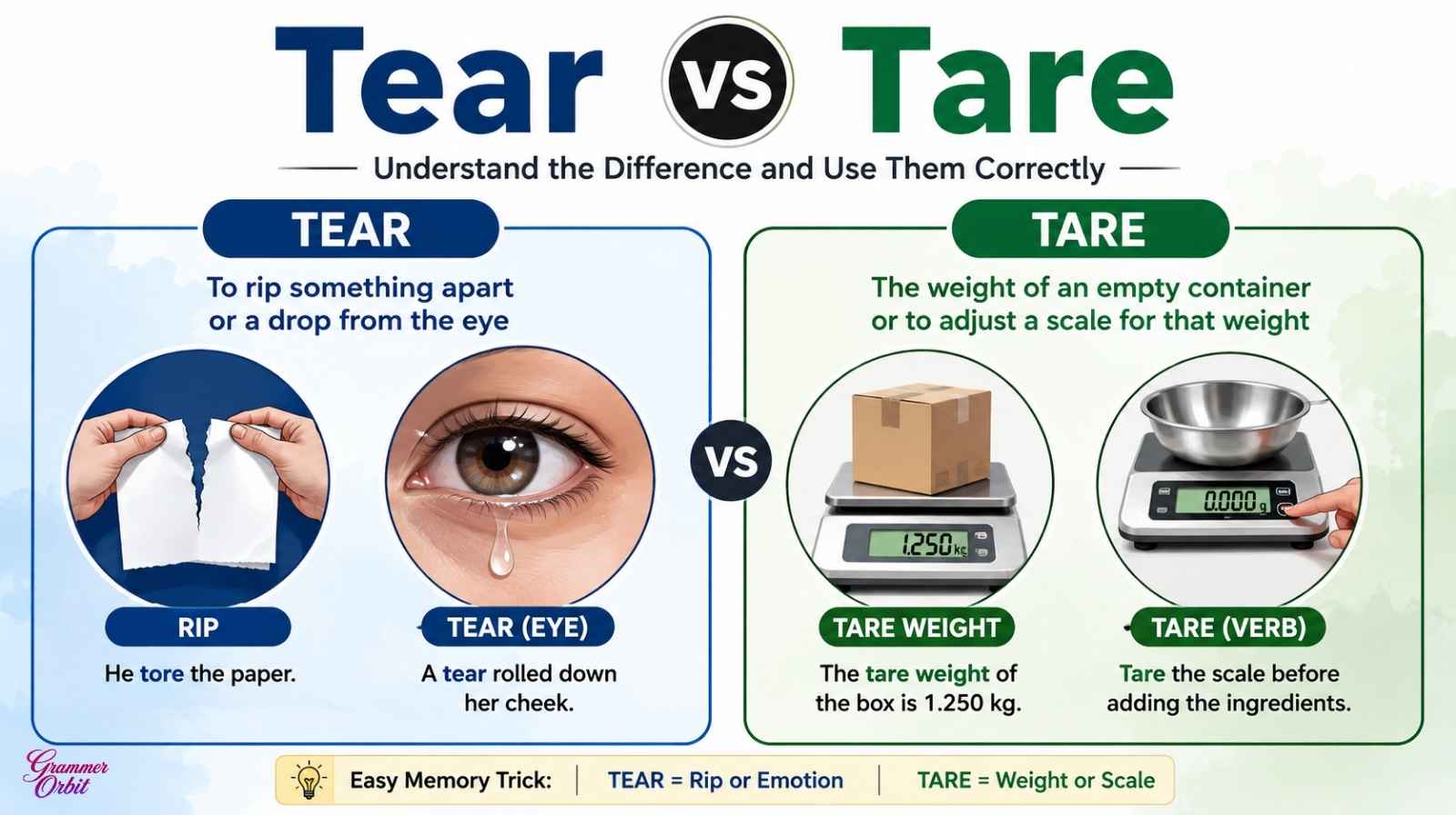
Have you ever wondered whether you should write tear vs tare? These two words sound alike when tear means to rip, but their meanings are completely different. Understanding tear vs tare becomes much easier once you connect each spelling with its specific context.
Tear can mean to rip or pull something apart, or it can refer to the drop of liquid that comes from your eye when you cry. Tare, on the other hand, is mainly used when talking about the weight of an empty container, vehicle, or package. Cambridge defines tare as the weight of a vehicle or container when empty, while tear can mean pulling something apart.
The good news is that you do not need to memorize complicated grammar rules. By the end of this guide, you will know exactly when to use tear and tare, how they differ, how they are pronounced, and how to avoid common mistakes.
What Is the Difference Between Tear vs Tare?
The simplest way to remember tear vs tare is this:
- Tear = to rip something, a rip in something, or a drop from the eye.
- Tare = the weight of an empty container or vehicle, or the act of adjusting a scale for that weight.
Although they may sound alike in one pronunciation, they are different words with different meanings.
Tear Meaning and Definition
Tear has several common meanings.
As a verb, tear means to pull something apart or damage it by pulling.
Please don’t tear the page.
Its past tense is tore, and its past participle is torn.
She tore the paper in half.
He has torn his old jacket.
Tear is also a noun when it refers to a hole or damaged area created by ripping.
There is a tear in my shirt.
There is another tear pronounced differently. It means a drop of liquid produced by the eye, especially because of emotion, pain, or crying.
A tear rolled down her cheek.
Cambridge lists both the “rip” meaning and the eye-fluid meaning as established uses of tear.
Tare Meaning and Definition
Tare is primarily a measurement and weighing term.
As a noun, it refers to the weight of an empty container, package, or vehicle. That weight is deducted from the gross weight to determine the weight of the actual contents.
For example:
The tare weight of the container is 500 kg.
Tare can also be used as a verb.
Tare the scale before adding the flour.
In this situation, to tare a scale means to account for the container’s weight so the scale measures only the contents.
Merriam-Webster specifically defines tare as both a deduction from gross weight and a verb meaning to determine or adjust for that tare.
Tear vs Tare: Meaning, Spelling, and Pronunciation
The words become much easier when you compare them side by side.
Tear vs Tare in One Quick Table
| Word | Main Meaning | Common Context | Example |
|---|---|---|---|
| Tear | Rip or pull apart | Paper, clothing, objects | Don’t tear the paper. |
| Tear | Drop from the eye | Emotion, crying | A tear fell from her eye. |
| Tare | Empty container weight | Shipping, packaging, weighing | The tare weight is 2 kg. |
| Tare | Adjust a weighing scale | Kitchen, laboratory, business | Tare the scale before weighing. |
The important point is that tear and tare are not interchangeable.
How to Pronounce Tear and Tare
There is an extra pronunciation challenge with tear because it has two common pronunciations.
When tear means to rip, it is pronounced like “tair”, which sounds like tare.
Tear the paper.
Tare the scale.
When tear means a drop from your eye, it is pronounced like “teer.”
A tear rolled down her face.
Cambridge gives the eye-fluid pronunciation separately from the pronunciation of tear meaning “pull apart.”
See also Unaffected vs Uneffected: Which Word To Use Correctly?
Tear vs Tare: The Easy Memory Trick
Try this simple trick:
Tear = damage or emotion.
Think of tear as something you can rip or something that can fall from your eye.
Tare = accounting for weight.
Think of tare as a scale setting or container weight.
For example:
Tear the wrapping.
Tare the scale.
If the sentence involves ripping, crying, paper, clothing, or damage, choose tear.
If it involves scales, containers, cargo, packaging, or weight, choose tare.
How to Use Tear Correctly in a Sentence
Because tear has several meanings, context is especially important.
Tear as a Verb: To Rip
Use tear when someone or something pulls material apart.
Examples:
Be careful not to tear the envelope.
The dog tore my favorite shirt.
She tore the letter into small pieces.
The verb is irregular:
tear → tore → torn
So avoid writing:
❌ She teared the paper yesterday.
Instead:
✅ She tore the paper yesterday.
And:
✅ She has torn the paper.
Tear as a Noun: A Rip
Tear can describe the damaged opening itself.
There is a tear in my jeans.
The curtain has a small tear.
I noticed a tear in the corner of the page.
Here, tear is pronounced like “tair.”
Tear as a Noun: A Drop From the Eye
When tear means a drop of liquid from the eye, its pronunciation changes.
One tear rolled down his cheek.
She wiped away her tears.
The movie brought tears to my eyes.
This meaning is common in personal, emotional, and literary writing.
How to Use Tare Correctly in a Sentence
Tare is most useful in situations involving measurement.
You may encounter it in shipping, logistics, grocery stores, laboratories, kitchens, manufacturing, and other settings where accurate weight matters.
See also Emersion vs Immersion: Differences, Meaning & Correct Usage
Tare Weight
Tare weight is the weight of an empty container, vehicle, or package. It can be subtracted from gross weight to calculate the net weight of the contents.
For example:
The truck’s tare weight is 8,000 kg.
If a loaded truck weighs 25,000 kg and its tare weight is 8,000 kg, the cargo weighs:
25,000 kg − 8,000 kg = 17,000 kg
So:
Gross weight − Tare weight = Net weight
This is why tare is particularly important in transportation and commercial weighing.
Tare as a Verb
Tare can also describe adjusting a scale.
Imagine putting an empty bowl on a kitchen scale. The bowl weighs 300 grams. You want to measure only the flour.
You can tare the scale so the display returns to zero.
Then:
Tare the scale before adding the ingredients.
Merriam-Webster specifically includes this use of tare for adjusting a scale after placing an empty container on it. (Merriam-Webster)
Common Tare Examples
Here are some natural examples:
The tare weight of the box is 200 grams.
Please tare the kitchen scale before adding the rice.
The shipping document lists the container’s tare weight.
The laboratory technician tared the balance before measuring the sample.
These sentences all involve weight or measurement, so tare is the correct choice.

Tear vs Tare: Common Mistakes to Avoid
Because both words can sound the same, spell-check software may not catch the mistake. Both tear and tare are legitimate English words, so context determines which one is correct.
Mistake 1: “Tear the Scale”
❌ Tear the scale before weighing the flour.
This suggests physically ripping or damaging the scale.
The correct sentence is:
✅ Tare the scale before weighing the flour.
Mistake 2: “Tare in Her Eye”
❌ A tare rolled down her cheek.
This is incorrect because the word for liquid coming from the eye is tear.
✅ A tear rolled down her cheek.
Mistake 3: “Tear Weight”
❌ What is the tear weight of the container?
Use tare weight because you are referring to the weight of the empty container.
✅ What is the tare weight of the container?
Mistake 4: “Tare the Paper”
❌ She tared the paper in half.
If you mean pulling the paper apart, the correct word is tear.
✅ She tore the paper in half.
A Simple Step-by-Step Guide to Choosing Tear or Tare

When you are unsure, use this quick process.
Step 1: Identify the Context
Ask yourself what the sentence is talking about.
Is it about:
- ripping?
- damage?
- crying?
- an emotional reaction?
If yes, you probably need tear.
Is it about:
- weight?
- a container?
- packaging?
- cargo?
- a weighing scale?
If yes, you probably need tare.
Step 2: Look at the Words Around It
Certain words provide strong clues.
Words that often point to tear:
paper, shirt, rip, cry, eye, cheek, letter, fabric
See also Quantify vs Qualify: Differences And Correct Usage Explained
Words that often point to tare:
scale, weight, container, cargo, package, truck, gross, net
Step 3: Check the Meaning
Try replacing the word with a synonym.
If rip makes sense:
Tear the paper.
If empty-container weight makes sense:
Tare weight.
This quick substitution can prevent many spelling mistakes.
2025–2026 Data and Usage Snapshot
There is no reliable public statistic that gives a precise percentage of everyday English writers who confuse tear and tare. Rather than inventing a frequency figure, it is more useful to examine current authoritative dictionary data.
What Current Dictionary Data Shows
As of 2026:
- Merriam-Webster lists tare as both a noun and verb, including the meanings related to container weight, counterweights, and adjusting a scale. Its entry records the first known use of the word in the 14th century for one sense and later historical development for the weighing sense.
- Cambridge Dictionary identifies tare weight as the empty weight of a vehicle or container and explains how it is used to calculate the net weight of goods.
- Current 2026 dictionary material continues to distinguish tear as both the verb meaning “pull apart” and the noun referring to liquid from the eye.
This snapshot matters because it confirms that tare remains a valid modern English word, even though it appears in more specialized contexts than the everyday word tear.
The practical lesson is simple: don’t treat tare as a misspelling of tear. It is a legitimate word with a specific measurement-related meaning.
Real-Life Case Study: Using Tear and Tare in a Kitchen
Imagine someone preparing a large recipe in a professional kitchen. They place an empty metal bowl on a digital scale. The bowl weighs 450 grams, but the chef wants to measure exactly 1,000 grams of flour.
The chef places the bowl on the scale and presses the tare button. The scale resets to zero because the weight of the empty bowl has been accounted for. The chef then adds flour until the display reaches 1,000 grams.
Here, tare is the correct word because the situation involves measuring the contents without counting the container.
Now imagine that the chef notices a small hole in the paper flour bag. The bag has been damaged, so the chef says:
“The bag has a tear in it.”
That is tear, not tare, because the word describes damage caused by ripping.
Later, while preparing a meal for a special event, the chef becomes emotional after receiving an unexpected message from a family member. A tear forms in the chef’s eye.
Notice how the same short pair of words can appear naturally in completely different situations:
- Tare the scale.
- The bag has a tear.
- A tear fell from her eye.
The spelling changes with the meaning. Once you connect tare with weight and tear with ripping or emotion, the distinction becomes much easier to remember.
Tear vs Tare: Quick Comparison Checklist
- Tear means to rip or pull something apart.
- Tear can mean a hole or damaged area.
- Tear can mean liquid from the eye.
- Tear → tore → torn when used as the verb meaning “rip.”
- Tare means the weight of an empty container or vehicle.
- Tare can mean to adjust a scale for the container’s weight.
- Tare weight is commonly used in shipping, logistics, packaging, and measurement.
- Use tear for physical damage or emotion.
- Use tare for weighing and measurement.
FAQs
Q1: Is “tare” a correct English word?
A: Yes. Tare is a legitimate English word. It commonly refers to the weight of an empty container, wrapper, or vehicle, and it can also be used as a verb for determining or adjusting for that weight.
Q2: What is the difference between tear and tare?
A: Tear usually refers to ripping something apart, a rip in something, or a drop from the eye. Tare refers primarily to the weight of an empty container or the adjustment made on a weighing scale.
Q3: Is “tear weight” or “tare weight” correct?
A: Tare weight is correct when you mean the weight of an empty container, vehicle, or package.
The tare weight of the truck is 7,500 kg.
Q4: Is it “tear the scale” or “tare the scale”?
A: The correct expression is “tare the scale” when you mean adjusting the scale to remove the weight of a container.
Tare the scale before adding the ingredients.
Q5: Are tear and tare homophones?
A: In the pronunciation where tear means “rip,” tear and tare sound the same or very similar. However, tear has another pronunciation when it means a drop from the eye. That is why context is especially important.
Q6: What is the past tense of tear?
A: When tear means “rip,” its past tense is tore.
She tore the paper.
Its past participle is torn.
She has torn the paper.
Do not use tared for this meaning.
Q7: How can I easily remember tear vs tare?
A: Use this memory trick:
Tear = rip or emotion.
Tare = scale and weight.
If you can associate the word with a weighing scale, choose tare. If you are talking about ripping something or crying, choose tear.
Q8: Can “tare” be used as a verb?
A: Yes. Tare can be a verb meaning to determine or account for the weight of a container. For example:
Tare the bowl before adding the flour.
Merriam-Webster includes this verb use in its current dictionary entry.
Conclusion: Tear vs Tare Made Simple
The difference between tear vs tare is easier than it first appears.
Use tear when you mean to rip, damage, or describe a drop from the eye. Use tare when you are talking about container weight, cargo, packaging, or adjusting a weighing scale.
Remember the simplest rule:
Tear = rip or emotion.
Tare = weight or scale.
For example, you can tear a piece of paper, experience a tear in your eye, or tare a kitchen scale before weighing ingredients.
Once you connect each spelling with its context, these confusing words become much easier to use correctly.
Want to improve your English further? Keep exploring common word pairs, confusing spellings, and practical grammar differences so you can write with greater accuracy and confidence.
👉 Discover more simple and practical grammar guides on Grammer Orbit

Zia Ahmad is a professional blogger specializing in grammar tips and spelling accuracy. He creates clear, practical content that helps readers eliminate errors, strengthen writing skills, and communicate effectively for students, professionals, and everyday writers worldwide.