
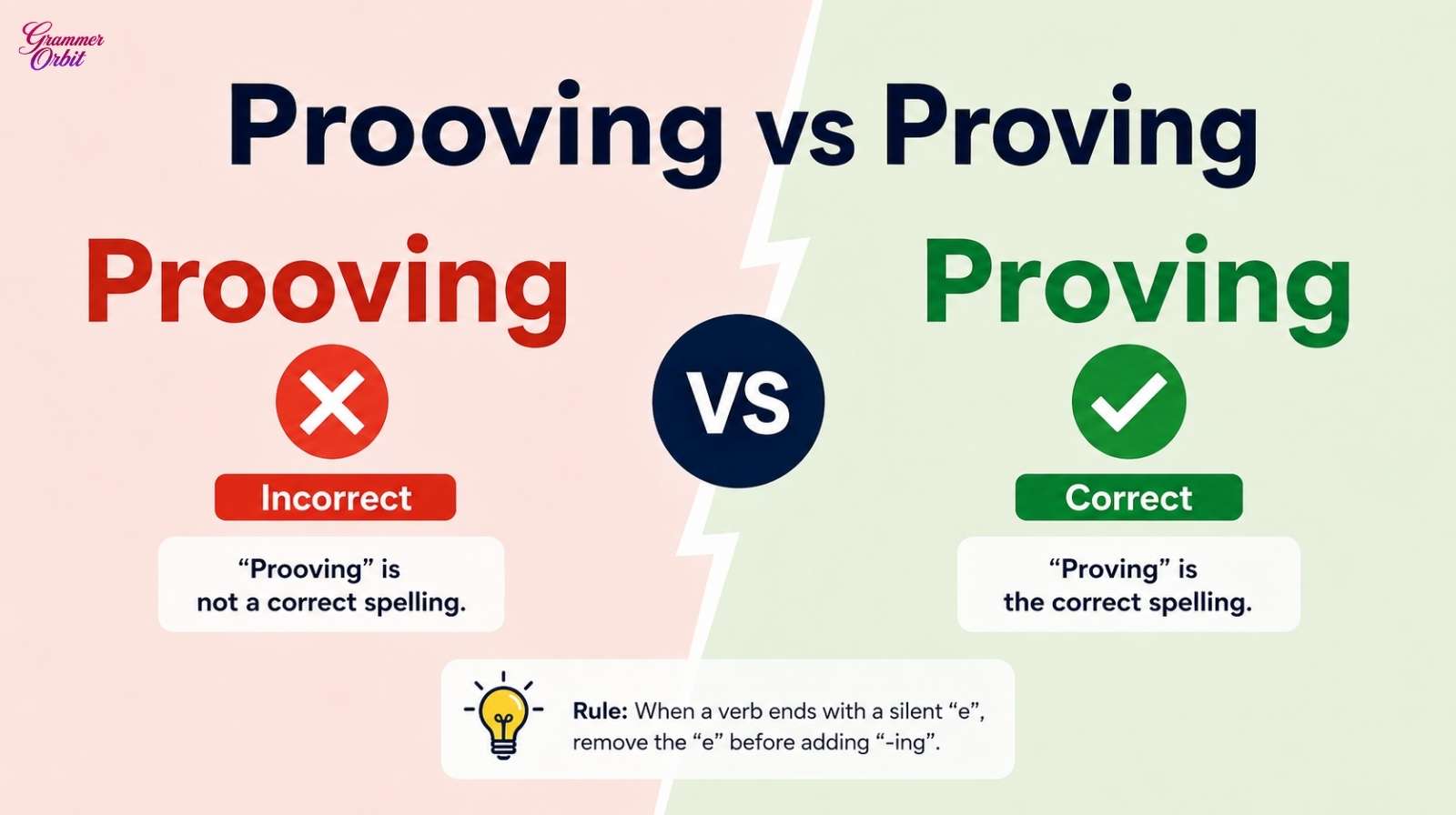
Have you ever stopped while writing because you weren’t sure whether “prooving” vs “proving” was the correct spelling? If so, you’re not alone. This is a common mistake that many English learners, students, writers, and even fluent speakers make because English spelling rules can sometimes be confusing.
The correct spelling is actually quite simple once you understand the rule. In this article, we’ll break down the difference between Prooving vs Proving, explain why the confusion happens, and show you the correct grammar rule with clear examples. By the end, you’ll know which spelling to use, how to avoid this common mistake, and feel more confident in your everyday writing.
Is It Prooving or Proving?
The correct spelling is proving.
❌ Prooving Incorrect
✅ Proving Correct
Proving is the present participle and gerund form of the verb prove.
Quick Answer
| Word | Correct? | Meaning |
|---|---|---|
| Proving | ✅ Yes | Demonstrating that something is true |
| Prooving | ❌ No | Incorrect spelling |
Why Do People Write “Prooving”?
See also Unphased or Unfazed Explained: Avoid Common Mistakes
The confusion comes from English spelling patterns.
Many words ending in -oo keep both vowels when adding -ing, so people naturally assume prove should become prooving.
However, English has a spelling rule for verbs ending in silent e.
The Rule
When a verb ends with a silent e, remove the e before adding -ing.
Examples:
| Base Verb | + ing | Correct Form |
|---|---|---|
| Prove | ing | Proving |
| Make | ing | Making |
| Write | ing | Writing |
| Come | ing | Coming |
| Take | ing | Taking |
Notice that prove loses only the silent e, not the o.
What Does “Proving” Mean?
Proving means showing that something is true through evidence, facts, actions, or results.
It can be used in many situations, including:
Academic Writing
Researchers are proving a new scientific theory.
Business
The company is proving its value to customers.
Everyday Conversation
She is proving everyone wrong.
Sports
The young athlete is proving that hard work pays off.
Examples of Proving in Sentences
Here are some natural examples.
- She is proving her skills every day.
- The scientist is proving the hypothesis through experiments.
- They are proving that teamwork improves productivity.
- He keeps proving himself at work.
- The lawyer is proving the client’s innocence.
- Practice is proving more effective than theory.
- This experience is proving valuable.
- The new software is proving reliable.
Each sentence uses proving correctly.
Common Mistakes to Avoid
Many writers accidentally create spelling errors because they apply incorrect patterns.
Avoid these mistakes:
❌ Prooving
✅ Proving
❌ She is prooving her point.
✅ She is proving her point.
❌ They kept prooving the results.
✅ They kept proving the results.
A quick spell-check usually catches this mistake, but understanding the grammar helps you avoid it entirely.
Prooving vs Proving: Side-by-Side Comparison
| Feature | Prooving | Proving |
|---|---|---|
| Correct English spelling | ❌ No | ✅ Yes |
| Found in dictionaries | ❌ No | ✅ Yes |
| Accepted in academic writing | ❌ No | ✅ Yes |
| Used in professional documents | ❌ No | ✅ Yes |
| Grammarly approved | ❌ No | ✅ Yes |
The Grammar Rule Behind “Proving”
See also Hoping or Hopeing: Which Spelling Is Correct?
Drop the Silent “E”
Most English verbs ending with a silent e follow this rule.
Examples:
- hope → hoping
- save → saving
- improve → improving
- believe → believing
- prove → proving
The silent e disappears before adding -ing.
When the Rule Doesn’t Apply
Some verbs keep the e for pronunciation reasons.
Examples include:
- seeing
- agreeing
- dyeing
These are exceptions rather than the rule.
Real-Life Example: A Student’s Common Writing Mistake
Sarah, a university student preparing her final research paper, frequently wrote “prooving” because she assumed the double “o” in prove should remain unchanged. Although her arguments were well-supported, her professor repeatedly highlighted the spelling mistake throughout the document.
After reviewing English spelling rules, Sarah discovered that verbs ending with a silent e usually drop the e before adding -ing. She practiced with similar words such as making, taking, writing, and proving until the pattern became natural.
In her next assignment, she used proving correctly every time. Her writing appeared more polished, and she gained greater confidence in her grammar. This small correction improved the professionalism of her academic work and reduced avoidable editing comments. It’s a reminder that mastering even one spelling rule can significantly improve your writing quality.
Why Correct Spelling Matters
Correct spelling isn’t just about grammar.
Using the right word helps you:
- Build credibility.
- Improve academic writing.
- Create professional business documents.
- Strengthen SEO content quality.
- Increase reader trust.
- Avoid unnecessary proofreading corrections.
Whether you’re writing blog posts, emails, reports, or essays, accurate spelling reflects attention to detail.
See also Natzi or Nazi: What’s Correct And Why It Matters
Recent Language and Writing Trends (2025–2026)
Recent reports from educational technology platforms and digital writing tools show that spelling accuracy remains one of the most common challenges for English learners.
- Grammar-checking platforms continue to identify spelling mistakes among the most frequent writing errors in English.
- Search interest for grammar-related questions, including spelling differences like Prooving vs Proving, has remained strong as more learners rely on online writing resources.
- Educational experts recommend learning spelling patterns rather than memorizing individual words because rule-based learning improves long-term accuracy.
These trends highlight why understanding spelling rules is more effective than relying solely on autocorrect.
Best Tips to Remember the Correct Spelling
Think of the Base Word
Start with prove.
Remove the silent e.
Add -ing.
Result:
Proving
Remember Similar Words
- Make → Making
- Save → Saving
- Believe → Believing
- Improve → Improving
- Prove → Proving
The pattern stays consistent.
Read Your Writing Aloud
If a word looks unusual, pause and check it in a trusted dictionary before publishing.
FAQs
Q1: Is Prooving a real word?
A: No. Prooving is an incorrect spelling and does not appear in standard English dictionaries.
Q2: Which spelling is correct: Prooving or Proving?
A: Proving is the correct spelling.
Q3: Why isn’t it spelled Prooving?
A: Because verbs ending in a silent e usually drop the e before adding -ing.
Q4: Is proving used as a noun?
A: Yes. Proving can function as a gerund, which acts as a noun.
Example:
Proving your skills takes patience.
Q5: Is proving a verb?
A: Yes. It is the present participle of the verb prove.
Q6: Can I use Prooving in formal writing?
A: No. It is considered a spelling mistake in academic, professional, and everyday English.
Conclusion
When comparing Prooving vs Proving, the answer is straightforward: proving is the only correct spelling. The confusion happens because English spelling rules can seem inconsistent, but this word follows a common pattern drop the silent e from prove before adding -ing.
Remember the simple formula:
Prove → Proving
Using the correct spelling will make your writing more professional, improve readability, and help you communicate with confidence. Whenever you’re unsure, think of other verbs like making, saving, or writing the same rule applies. Mastering this small grammar point can make a noticeable difference in the overall quality of your English writing.
👉 Discover more simple and practical grammar guides on Grammer Orbit

Zia Ahmad is a professional blogger specializing in grammar tips and spelling accuracy. He creates clear, practical content that helps readers eliminate errors, strengthen writing skills, and communicate effectively for students, professionals, and everyday writers worldwide.