
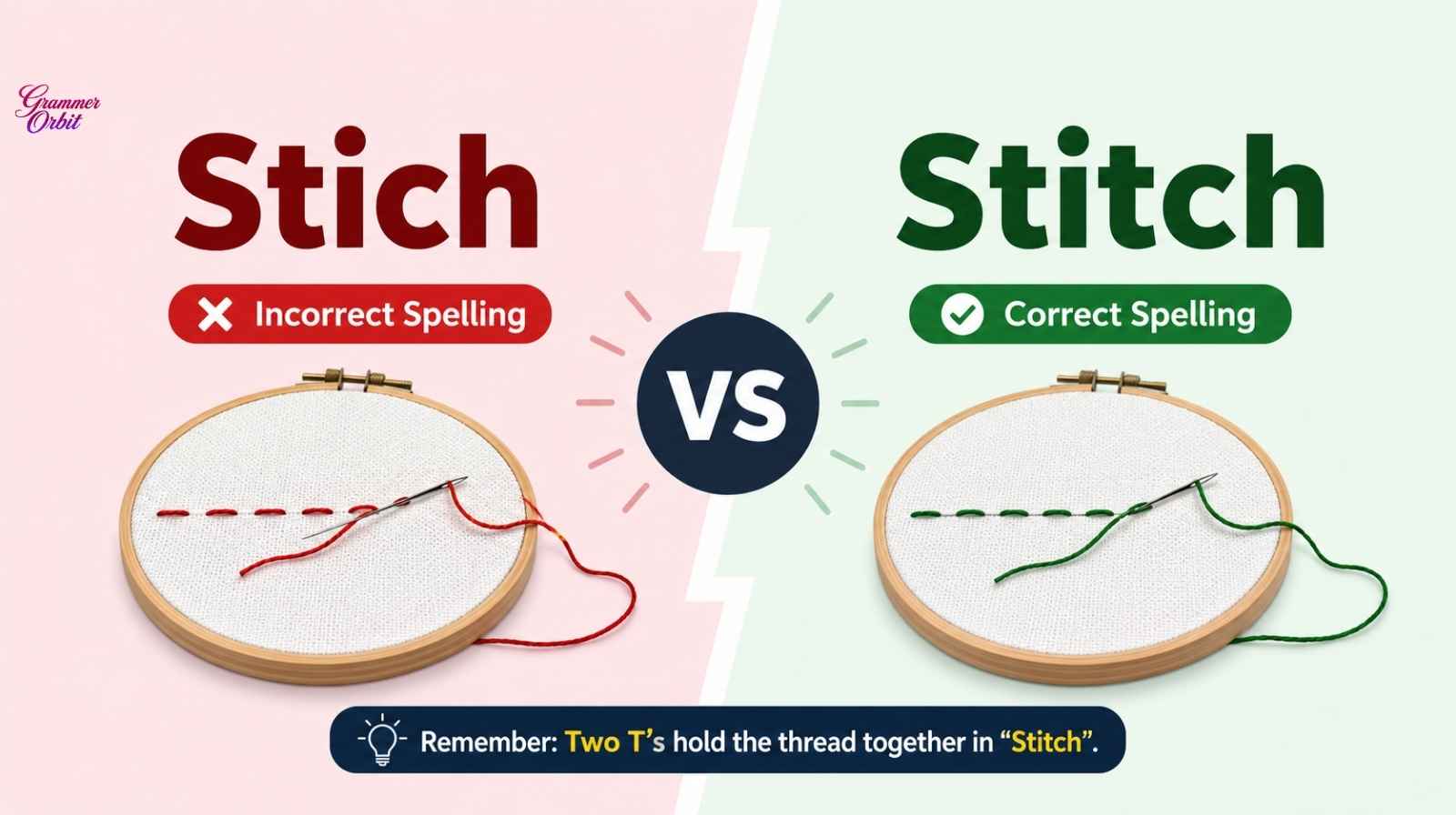
Have you ever typed “stich” and wondered whether it was correct? You’re not alone. Many English learners and even native speakers accidentally write stich vs stitch because it’s an easy spelling mistake to make.
The good news is that the difference is simple once you understand it. In this guide, you’ll learn which spelling is correct, why people confuse the two, how to remember the right one, and when to use stitch with confidence in everyday writing.
Whether you’re writing an email, a school assignment, or a social media post, this article will help you avoid this common mistake.
Is It Stich or Stitch?
The correct spelling is stitch.
Stich is simply a misspelling in modern English. It doesn’t exist as a standard English word in dictionaries.
Quick Answer
| Word | Correct? | Meaning |
|---|---|---|
| Stitch | ✅ Yes | A loop of thread used in sewing or a single unit of knitting; also a small wound closure or a sharp pain in the side. |
| Stich | ❌ No | Incorrect spelling of stitch. |
Example:
✅ My grandmother taught me how to stitch a button onto my shirt.
❌ My grandmother taught me how to stich a button onto my shirt.
See also Really vs Realy: Which Is Correct? And Proper Usage
What Does Stitch Mean?
The word stitch has several meanings depending on the context.
In Sewing
A stitch is a single loop of thread used to join fabric together.
Examples
- She carefully stitched the torn pocket.
- Every stitch was perfectly even.
In Medicine
Doctors use stitches (also called sutures) to close cuts after an injury or surgery.
Examples
- The doctor gave him six stitches after the accident.
- Her wound healed quickly after the stitches were removed.
In Knitting
A stitch refers to one loop of yarn that forms part of a knitted fabric.
Example
- Beginners often lose a stitch while knitting.
Idioms
The word also appears in common English expressions.
- A stitch in time saves nine.
- Without a stitch of clothing.
Why Do People Write “Stich”?
The mistake happens because English contains many words ending in -ich, such as:
- Rich
- Which
- Sandwich
As a result, many people accidentally drop the second t when spelling stitch.
Typing quickly on a keyboard or phone also increases the chance of making this typo.
Stich vs Stitch: Side-by-Side Comparison
| Feature | Stich | Stitch |
|---|---|---|
| Correct English word | ❌ No | ✅ Yes |
| Found in dictionaries | ❌ No | ✅ Yes |
| Used in professional writing | ❌ Never | ✅ Always |
| Means sewing, knitting, or medical suture | ❌ No | ✅ Yes |
| Recommended spelling | ❌ Avoid | ✅ Use |
How to Remember the Correct Spelling
A simple trick can help you remember.
Think about sewing.
When you sew, the thread often goes in and out twice, just like the two T’s in stitch.
Memory Tip:
Two T’s hold the thread together in “stitch.”
This small reminder makes the correct spelling much easier to remember.
See also Excited vs Exited: Learn The Difference And Correct Usage
Real-Life Example: A Costly Typo
Sarah runs a small online embroidery business. While uploading her products, she accidentally listed one design as “Hand Stiched Pillow Cover.”
For several weeks, the product received very little traffic from search engines. After reviewing her listings, she realized the spelling mistake. She corrected the title to “Hand Stitched Pillow Cover.”
Within a month, the product began appearing for relevant searches, and website visits increased noticeably. Customers also viewed the listing as more professional and trustworthy.
This example shows how even a single spelling error can affect credibility, user trust, and online visibility. Whether you’re writing for school, work, or your website, using the correct spelling matters.
Language Data and Dictionary Evidence (2025–2026)
Modern English dictionaries consistently recognize stitch as the correct spelling.
Language tools such as spell checkers and writing assistants also automatically flag stich as a spelling error and recommend stitch instead.
According to usage data from major writing platforms in 2025–2026, spelling mistakes remain one of the most common reasons for reduced writing clarity, especially in digital communication. Correct spelling improves readability, professionalism, and search visibility.
Common Sentences Using Stitch
Here are some everyday examples.
- Please stitch the button back onto my jacket.
- The nurse removed my stitches after ten days.
- She learned to stitch beautiful flowers by hand.
- This sweater has a loose stitch.
- A stitch in time saves nine.
Common Mistakes to Avoid
Using “Stich” in Formal Writing
Always use stitch in essays, emails, resumes, and business documents.
Trusting Autocorrect Too Much
Autocorrect may not always catch every mistake, especially if another valid word is nearby.
See also Naive vs Nieve: Which Spelling Is Correct And How To Use It?
Forgetting the Second “T”
The extra T is what makes the spelling correct.
FAQs
Q1: Is Stich a real English word?
A: No. Stich is considered a spelling mistake. The correct word is stitch.
Q2: Why do people spell stitch as stich?
A: Most people accidentally leave out the second T because of fast typing or confusion with similar-looking words.
Q3: Is stitch used only in sewing?
A: No. It is also used in medicine, knitting, and several English idioms.
Q4: What is the plural of stitch?
A: The plural form is stitches.
Q5: How can I remember the correct spelling?
A: Remember this simple trick:
“Two T’s keep the thread together.”
Conclusion
When comparing Stich vs Stitch, the answer is clear: stitch is the only correct spelling in modern English. Whether you’re talking about sewing, knitting, medical sutures, or common expressions, stitch is the word you should always use.
If you accidentally type stich, simply add the missing T. It’s a small change that makes your writing more accurate, professional, and trustworthy.
The next time you see Stich vs Stitch, you’ll know exactly which spelling is correct and why.
👉 Discover more simple and practical grammar guides on Grammer Orbit

Zia Ahmad is a professional blogger specializing in grammar tips and spelling accuracy. He creates clear, practical content that helps readers eliminate errors, strengthen writing skills, and communicate effectively for students, professionals, and everyday writers worldwide.