
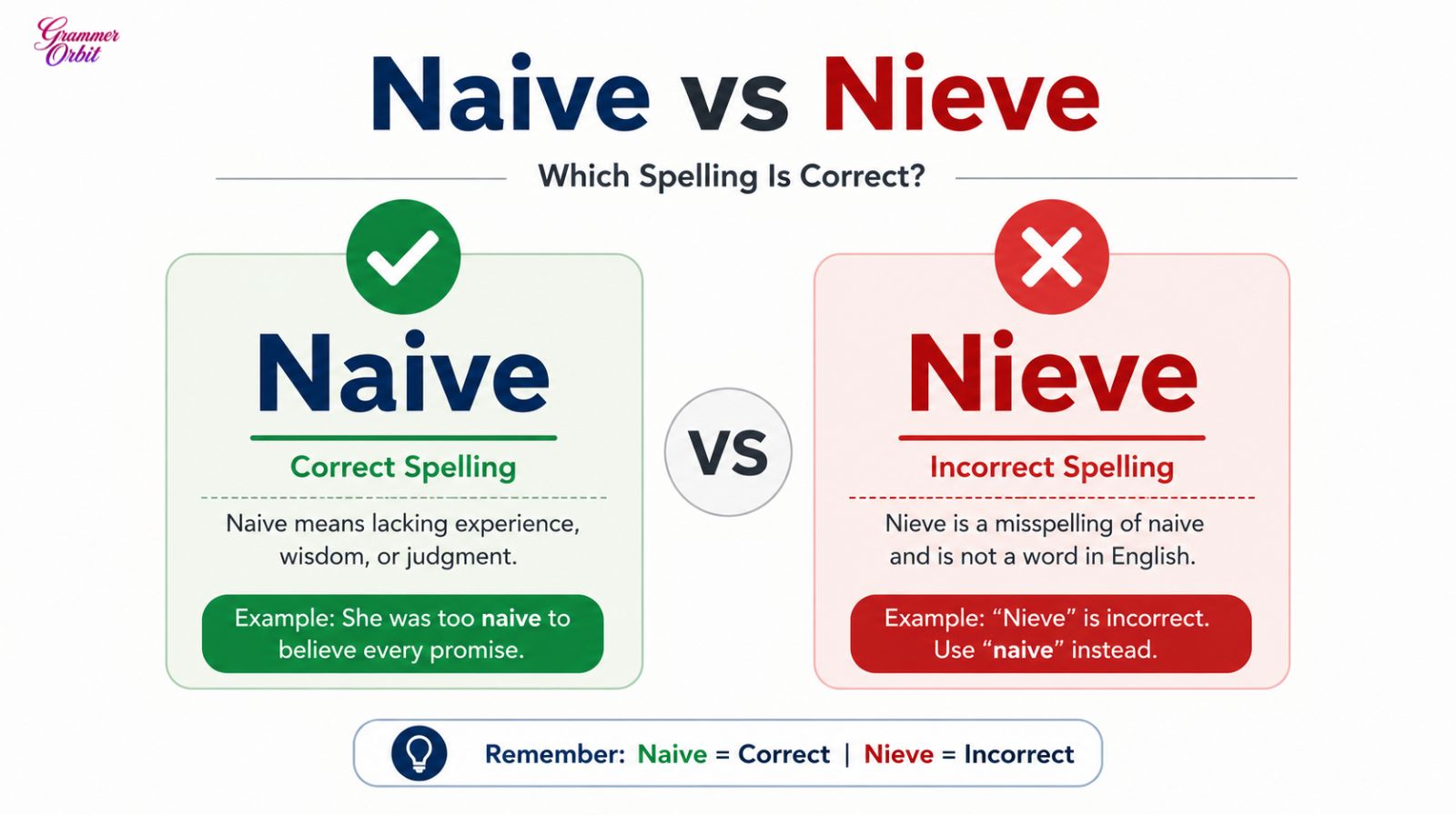
Have you ever written “nieve” and wondered whether it was correct? You’re not alone. Many English learners and even native speakers confuse naive vs nieve because the words look similar and sound nearly identical when spoken quickly.
However, only one of these spellings is correct in standard English. Using the wrong version can make your writing appear less professional and may create confusion for readers.
In this guide, you’ll learn the difference between naive and nieve, discover the correct spelling, understand why the confusion happens, and see real examples that help you remember the right form every time.
What Is the Difference Between Naive and Nieve?
The difference is simple:
| Word | Correct? | Meaning |
|---|---|---|
| Naive | ✅ Yes | Lacking experience, wisdom, or judgment |
| Nieve | ❌ No | Misspelling of naive in English |
Quick Answer
If you’re writing in English, naive is the correct spelling.
The word describes someone who is innocent, trusting, or inexperienced.
Examples:
- She was too naive to believe every promise she heard.
- It would be naive to assume the project will finish without challenges.
- His naive view of business changed after gaining experience.
The spelling nieve is considered an error in English writing.
See also Excited vs Exited: Learn The Difference And Correct Usage
What Does Naive Mean?
Definition of Naive
The adjective naive refers to a person who lacks experience, sophistication, or practical understanding.
It often suggests innocence and trust, though the tone can be positive or negative depending on context.
Common Characteristics of a Naive Person
- Trusts others easily
- Has limited real-world experience
- Believes things without questioning them
- Sees situations in a simple way
Example Sentences
- The young investor was naive about financial risks.
- I was naive enough to think everything would go perfectly.
- Her naive optimism inspired the entire team.
Synonyms of Naive
- Innocent
- Gullible
- Trusting
- Unsophisticated
- Inexperienced
- Unworldly
Why Do People Write “Nieve” Instead of “Naive”?
The confusion usually happens because of pronunciation and typing habits.
Similar Pronunciation
Many English speakers pronounce naive as:
nigh-EEV
Because of this sound, some writers mistakenly assume the word should be spelled nieve.
Common Typing Errors
The letter combination “ie” appears frequently in English words such as:
- Believe
- Piece
- Brief
- Field
As a result, writers sometimes instinctively type nieve instead of naive.
Influence from Other Languages
In some languages, words that resemble naive may use different spelling patterns. This can influence multilingual writers and lead to confusion.
How to Remember the Correct Spelling of Naive
Learning a simple memory trick can help prevent mistakes.
Memory Trick #1
Think of:
Naive = Native Innocence
Both words begin with “nai”.
Memory Trick #2
Remember this phrase:
“A naive person says ‘I believe everyone.'”
Notice that naive starts with “nai”, not “nie”.
Memory Trick #3
Whenever you’re unsure, ask yourself:
“Have I ever seen nieve in a dictionary?”
The answer is usually no.
Major dictionaries list naive, not nieve, as the standard English spelling.
Naive in Modern English Writing
The word naive appears frequently in:
Academic Writing
Researchers often describe assumptions as naive when they are overly simplistic.
Example:
The study identified several naive assumptions in earlier models.
Business Communication
Managers may refer to unrealistic expectations as naive.
Example:
It is naive to expect instant growth without investment.
Everyday Conversation
People commonly use the term to describe innocence or lack of experience.
Example:
When I started my first job, I was pretty naive.
Real-Life Example: How One Spelling Mistake Affected a Job Application
A career coach shared the experience of reviewing hundreds of resumes from recent graduates. One applicant wrote:
“I was nieve about workplace expectations during my internship.”
See also Laid or Layed: Which One Is Correct?
Although the sentence’s meaning was understandable, the misspelling immediately stood out. The recruiter later explained that spelling errors often create a negative first impression because they suggest a lack of attention to detail.
The candidate was otherwise qualified, but the mistake reduced the professionalism of the application. After receiving feedback, the applicant corrected the spelling to naive and updated all future documents.
This example highlights an important lesson: small spelling errors can influence how readers perceive your credibility. Whether you’re writing a resume, email, blog post, or academic paper, using the correct spelling helps build trust and professionalism.
Language Trends and Spelling Accuracy in 2025–2026
As digital communication continues to grow, spelling accuracy remains important. According to reports from educational technology platforms and writing-assistance tools, spelling mistakes remain among the most common writing errors found in emails, academic assignments, and workplace documents.
Recent language-learning trends in 2025 and 2026 show that commonly confused words generate millions of online searches every year. Users frequently search questions such as:
- Is naive spelled with IE or AI?
- What is the correct spelling of naive?
- Why do people write nieve?
The popularity of these searches demonstrates how often this confusion occurs and why understanding the correct spelling matters for effective communication.
Naive vs Nieve: Side-by-Side Comparison
| Feature | Naive | Nieve |
|---|---|---|
| Correct English spelling | ✅ Yes | ❌ No |
| Found in dictionaries | ✅ Yes | ❌ No |
| Accepted in formal writing | ✅ Yes | ❌ No |
| Means inexperienced or innocent | ✅ Yes | ❌ No |
| Recommended for professional writing | ✅ Yes | ❌ No |
Featured Snippet Answer
Naive is the correct English spelling. It means lacking experience, wisdom, or judgment. Nieve is a common misspelling and should be avoided in formal and informal writing.
Common Mistakes to Avoid
Mistake #1: Using Nieve in Professional Writing
❌ She was nieve about the risks.
✅ She was naive about the risks.
Mistake #2: Assuming Pronunciation Determines Spelling
Many English words are not spelled exactly as they sound.
Always verify the spelling through a reliable dictionary.
Mistake #3: Ignoring Spell Check Warnings
Modern writing tools often identify nieve as an error. Pay attention to those suggestions.
FAQs
Q1: Is naive or nieve correct?
A: Naive is correct. Nieve is a misspelling in English.
Q2: What does naive mean?
A: It means lacking experience, sophistication, or practical judgment.
Q3: Why do people spell naive as nieve?
A: The confusion usually comes from pronunciation and common English spelling patterns involving “ie.”
Q4: Is nieve a real English word?
A: No. It is generally considered a spelling mistake when the intended word is naive.
Q5: Can I use naive in formal writing?
A: Yes. The word is widely accepted in academic, professional, and everyday writing.
Q6: Is naive always negative?
A: Not necessarily. It can describe innocence and honesty in a positive sense, depending on context.
Q7: How do you pronounce naive?
A: Most speakers pronounce it as:
nigh-EEV (naɪˈiːv)
Conclusion
When comparing naive vs nieve, the answer is straightforward: naive is the correct spelling, while nieve is a common misspelling that should be avoided.
The word naive describes someone who is innocent, trusting, or inexperienced. Although many people accidentally write nieve, dictionaries and style guides consistently recognize naive as the proper English form.
The next time you’re unsure, remember the simple rule:
Naive = Correct
Nieve = Incorrect
Using the correct spelling will make your writing clearer, more professional, and more credible. Whether you’re writing an email, article, school assignment, or business document, choosing naive over nieve helps ensure accuracy and confidence in your communication.
References
- Merriam-Webster Dictionary
- Cambridge Dictionary
- Oxford Learner’s Dictionaries
👉 Discover more simple and practical grammar guides on Grammer Orbit

Zia Ahmad is a professional blogger specializing in grammar tips and spelling accuracy. He creates clear, practical content that helps readers eliminate errors, strengthen writing skills, and communicate effectively for students, professionals, and everyday writers worldwide.