
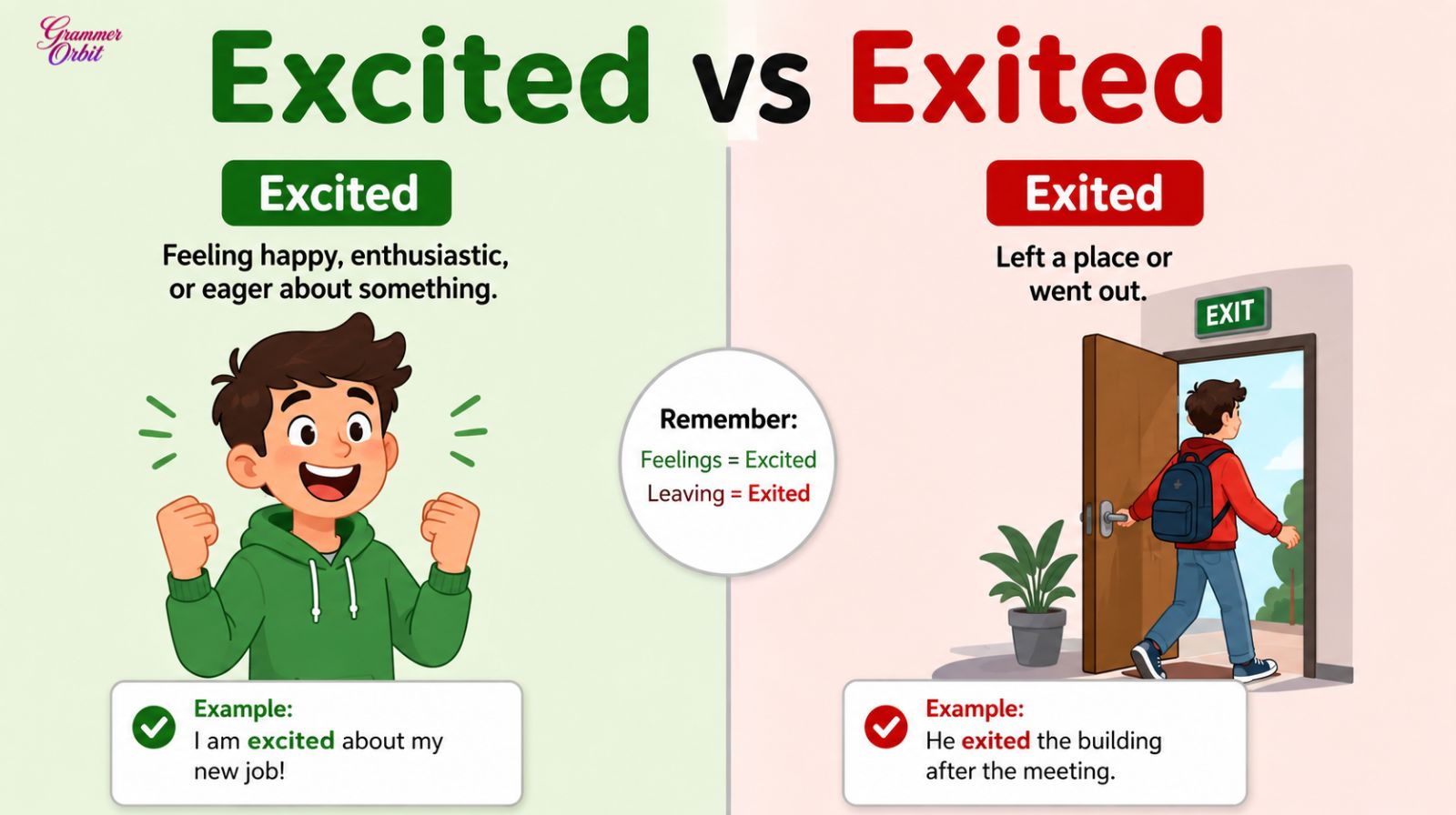
Have you ever written “I am exited about the trip” when you actually meant “I am excited”? If so, you’re not alone. These two words look very similar and are often confused by English learners and even native speakers.
Understanding the difference between excited vs exited is important because using the wrong word can completely change the meaning of your sentence. While one word describes a feeling of enthusiasm, the other refers to leaving a place.
In this guide, you’ll learn the meanings, differences, examples, common mistakes, and practical tips to use both words correctly every time.
What Is the Difference Between Excited and Exited?
The main difference is simple:
| Word | Meaning | Part of Speech |
|---|---|---|
| Excited | Feeling happy, enthusiastic, or eager | Adjective |
| Exited | Left a place or went out | Verb (past tense of exit) |
Quick Answer
Excited refers to an emotional state.
Exited refers to the action of leaving.
Example
✅ I am excited about my new job.
✅ She exited the building after the meeting.
❌ I am exited about my new job.
The last sentence is incorrect because “exited” means “left,” not “enthusiastic.”
Understanding the Meaning of Excited
The word excited describes a strong feeling of happiness, anticipation, enthusiasm, or interest.
When to Use Excited
Use excited when talking about emotions.
Examples of Excited
- I am excited for the concert tonight.
- The children were excited about the holiday.
- She felt excited before her first interview.
- We are excited to launch our new website.
Common Situations
People often feel excited about:
- Vacations
- Birthdays
- New jobs
- Special events
- Achievements
- Meeting someone important
Excited Synonyms
- Thrilled
- Enthusiastic
- Eager
- Delighted
- Overjoyed
Understanding the Meaning of Exited
The word exited is the past tense of the verb exit, which means to leave or go out of a place.
When to Use Exited
Use exited when someone leaves a location.
Examples of Exited
- The audience exited the theater quietly.
- She exited the room without saying a word.
- Employees exited the building during the fire drill.
- The driver exited the highway at the next ramp.
Exited Synonyms
- Left
- Departed
- Went out
- Moved out
- Vacated
Remember
If the sentence involves leaving somewhere, exited is usually the correct choice.
Excited vs Exited: Side-by-Side Comparison
Key Differences
| Feature | Excited | Exited |
|---|---|---|
| Meaning | Feeling enthusiasm | Left a place |
| Type | Adjective | Verb |
| Related To | Emotions | Movement |
| Example | I am excited. | He exited the room. |
| Synonyms | Thrilled, eager | Left, departed |
Easy Memory Trick
Think about the extra “c” in excited.
That “c” can remind you of:
- Celebration
- Cheerful
- Confidence
All of these relate to positive emotions.
Meanwhile, exited comes directly from exit, which means a way out.
Common Mistakes People Make
Many writers accidentally replace one word with the other because they differ by only one letter.
Mistake #1
❌ I am exited about my vacation.
✅ I am excited about my vacation.
Mistake #2
❌ The guests excited the building after the ceremony.
✅ The guests exited the building after the ceremony.
Mistake #3
❌ She was exited to start college.
See also Dysregulated vs Disregulated: Correct Usage Explained
✅ She was excited to start college.
Why This Happens
The words:
- Look nearly identical
- Sound somewhat similar
- Are often typed quickly
Proofreading carefully can prevent these errors.
Real-Life Example: How One Small Spelling Error Changed a Professional Email
A marketing assistant was preparing an announcement email for a company’s annual conference. The email included the sentence:
“We are exited to welcome all participants next month.”
The message was sent to hundreds of clients before anyone noticed the mistake.
Several recipients replied jokingly, asking where the company was leaving from. Although most readers understood the intended meaning, the typo reduced the professionalism of the email.
The team quickly corrected the message and resent it with:
See also Really vs Realy: Which Is Correct? And Proper Usage
“We are excited to welcome all participants next month.”
This simple example shows why understanding excited vs exited matters. A single missing letter can change the meaning of an entire sentence. In professional communication, academic writing, business emails, and website content, small spelling mistakes can affect credibility and clarity.
Taking a few extra seconds to proofread can help ensure your message communicates exactly what you intend.
Excited vs Exited in Modern Writing: 2025–2026 Language Trends
According to language-learning platforms and grammar-checking tools, confusion between similar-looking English words remains one of the most common writing issues reported by learners worldwide.
Recent educational studies and usage reports from grammar software providers show that homophone and near-homophone mistakes continue to rank among the top spelling errors in digital communication during 2025 and 2026.
Why These Errors Are Increasing
- Faster typing on mobile devices
- Increased online communication
- Autocorrect limitations
- Growing number of non-native English users
As a result, understanding commonly confused words like excited and exited has become increasingly important for effective communication.
How to Remember the Difference Between Excited and Exited
Method 1: Think About Feelings
If the sentence involves emotions, use excited.
Example:
- I am excited about graduation.
Method 2: Think About Leaving
If the sentence involves going out or departing, use exited.
Example:
- He exited the train station.
Method 3: Check the Context
Ask yourself:
“Am I talking about a feeling or an action?”
- Feeling → Excited
- Action → Exited
FAQs
Q1: Is excited or exited correct?
A: Both are correct words, but they have different meanings. Use excited for feelings and exited for leaving a place.
Q2: What does excited mean?
A: Excited means feeling enthusiastic, eager, happy, or thrilled about something.
Q3: What does exited mean?
A: Exited is the past tense of exit and means left or departed from a place.
Q4: Why do people confuse excited and exited?
A: They look very similar and differ by only one letter, making typing mistakes common.
Q5: Can exited describe emotions?
A: No. Exited refers only to leaving a place and does not describe emotions.
Q6: Is “I am exited” grammatically correct?
A: Only if you mean that you have left a location, which is uncommon. When expressing enthusiasm, use “I am excited.”
Q7: How can I remember the difference easily?
A: Remember that excited relates to excitement and emotions, while exited comes from the word exit, meaning to leave.
Conclusion
Understanding excited vs exited is easier once you remember their core meanings. Excited describes a feeling of enthusiasm, happiness, or anticipation, while exited means leaving a place.
Although the words differ by just one letter, using the wrong one can change the meaning of your sentence completely. By focusing on context and using the memory tricks shared in this guide, you can confidently choose the correct word every time.
The next time you’re writing an email, article, social media post, or school assignment, take a moment to check whether you’re talking about a feeling (excited) or an action (exited). That small detail can make your writing clearer, more professional, and more effective.
👉 Discover more simple and practical grammar guides on Grammer Orbit

Zia Ahmad is a professional blogger specializing in grammar tips and spelling accuracy. He creates clear, practical content that helps readers eliminate errors, strengthen writing skills, and communicate effectively for students, professionals, and everyday writers worldwide.