
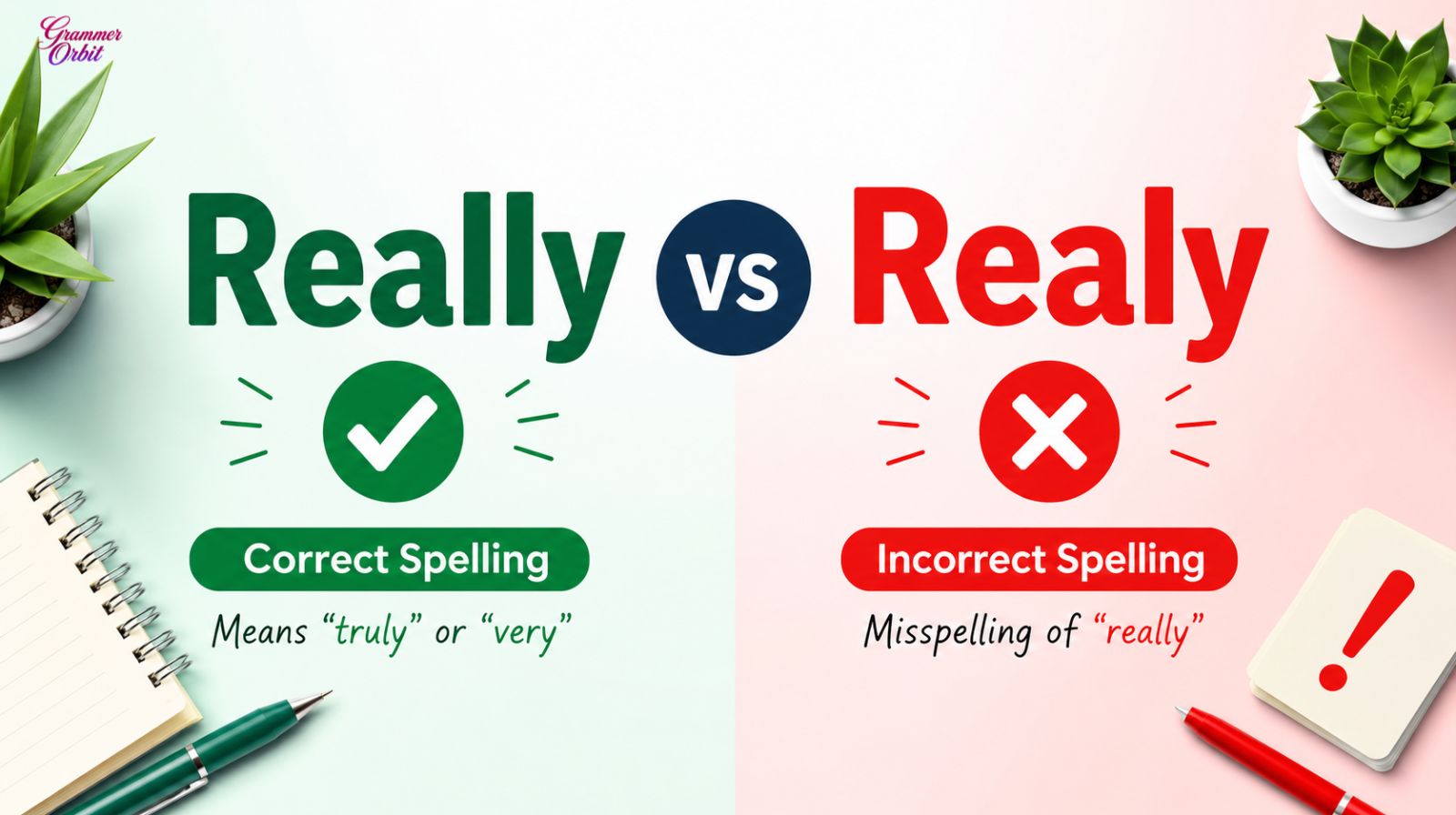
Have you ever typed “realy” and wondered whether it was correct? You’re not alone. Many English learners and native speakers occasionally misspell common words, especially when typing quickly.
The confusion between Really vs Realy is one of the most common spelling mistakes in English. While both may look similar, only one is considered correct in standard English writing.
In this guide, you’ll learn the correct spelling, why the mistake happens, real-world examples, grammar rules, and practical tips to avoid making this error in the future.
What Is the Difference Between Really and Realy?
The simple answer is:
| Word | Correct? | Meaning |
|---|---|---|
| Really | ✅ Yes | Used to emphasize something or express truth |
| Realy | ❌ No | Misspelling of “really” |
Really is the correct English word and appears in dictionaries, books, academic writing, and professional communication.
Realy is not recognized as a standard English word and is considered a spelling error.
Examples of Correct Usage
See also Anyway vs Anyways: The Real Difference Explained
- I am really excited about the trip.
- She really enjoys reading novels.
- Do you really believe that story?
Examples of Incorrect Usage
- I am realy happy today. ❌
- That was realy interesting. ❌
- Do you realy think so? ❌
Why Do People Misspell “Really” as “Realy”?
The mistake usually happens because English spelling rules can be confusing.
The Double “L” Rule
The word really comes from:
- Real
- ly
When adding -ly to real, the spelling becomes:
real + ly = really
Many people mistakenly remove one “l” and write realy, but the correct spelling keeps both letters.
Fast Typing Errors
Typing quickly on phones and keyboards often leads to:
- Missing letters
- Autocorrect issues
- Accidental spelling mistakes
Pronunciation Confusion
Since the word is pronounced smoothly, some writers assume only one “l” is needed. However, English spelling does not follow pronunciation perfectly in every case.
Really Meaning and Proper Usage
The word really is an adverb that can serve several purposes.
1. To Emphasize Something
Examples:
- This movie is really good.
- The weather is really hot today.
2. To Express Truth or Reality
Examples:
- Did that really happen?
- Is she really moving abroad?
3. To Show Surprise
Examples:
- Really? I didn’t know that!
- Really? That’s amazing news.
Really vs Very
Although both words add emphasis, they are not always interchangeable.
| Really | Very |
|---|---|
| Often adds stronger emphasis | Usually describes degree |
| Can express surprise | Cannot express surprise |
| More conversational | More formal |
Example:
- I’m really impressed.
- I’m very impressed.
Both are correct, but really often sounds more natural in everyday conversation.
Really vs Realy: Quick Comparison Table
Side-by-Side Comparison
| Feature | Really | Realy |
|---|---|---|
| Correct English spelling | ✅ | ❌ |
| Found in dictionaries | ✅ | ❌ |
| Accepted in academic writing | ✅ | ❌ |
| Accepted in professional emails | ✅ | ❌ |
| Standard grammar usage | ✅ | ❌ |
Featured Snippet Answer:
Really is the correct spelling and means “truly” or “very.” Realy is simply a misspelling and should be avoided in formal and informal writing.
Real-Life Example: How a Simple Spelling Mistake Can Affect Professional Writing
A freelance content writer was applying for a remote marketing position. During the application process, they submitted a cover letter containing phrases such as:
“I am realy interested in this opportunity.”
The hiring manager noticed the error immediately. While a single spelling mistake may seem minor, repeated misspellings can create an impression of carelessness.
The applicant later reviewed the document and found several occurrences of realy instead of really. After correcting the mistakes and using proofreading tools, future applications appeared more polished and professional.
This example highlights an important lesson: common spelling errors can affect credibility, especially in situations involving job applications, academic papers, business emails, or published content.
Even experienced writers make occasional mistakes. However, taking a few moments to proofread can significantly improve the quality of your writing. A correctly spelled word like really demonstrates attention to detail and helps readers focus on your message rather than your errors.
Whether you’re writing a blog post, sending an email, or posting on social media, using the correct spelling contributes to clearer and more professional communication.
Spelling Mistakes Online: What the Data Shows
Research from writing and grammar platforms continues to show that spelling errors remain one of the most common writing issues online.
Key Findings (2025–2026)
- Millions of spelling corrections are made daily through grammar-checking tools.
- Common adverb misspellings such as realy, definately, and seperate remain among frequently corrected errors.
- Employers consistently rank written communication as an important professional skill.
- Content with fewer grammar and spelling errors tends to appear more trustworthy to readers.
These trends highlight why understanding simple spelling distinctions like Really vs Realy remains valuable in both personal and professional communication.
How to Remember the Correct Spelling of Really
Remembering the correct spelling can be easy with a few tricks.
Think of the Base Word
Start with:
Real
Then add:
-ly
Result:
Really
Use This Memory Tip
Think:
“The word is really important, so it gets two Ls.”
Proofread Before Publishing
Before sending or publishing content:
✔ Check for repeated spelling errors
✔ Use spell-check tools
✔ Read your text aloud
✔ Review important emails and documents
Common Sentences Using Really
See also Laid or Layed: Which One Is Correct?
Everyday Conversation
- I really appreciate your help.
- That sounds really interesting.
- She was really tired after work.
Professional Writing
- We really value customer feedback.
- The team was really pleased with the results.
- I really look forward to discussing this project.
Academic Writing
- The findings were really significant for the study.
- Researchers were really interested in the outcome.
FAQs
Q1: Is Realy Ever Correct?
A: No. Realy is not recognized as a standard English word and should be corrected to really.
Q2: Why Does Really Have Two Ls?
A: Because it is formed from the word real plus the suffix -ly, resulting in really.
Q3: Is Realy Accepted in Informal Writing?
A: No. Even in casual messages, realy is considered a spelling mistake.
Q4: What Part of Speech Is Really?
A: Really is an adverb used to add emphasis, indicate truth, or express surprise.
Q5: Can Autocorrect Fix Realy?
A: In many cases, yes. Most modern spell-check and grammar tools automatically suggest really.
Q6: Is Really More Common Than Very?
A: Both are common, but really is frequently used in conversational English for emphasis.
Conclusion
When comparing Really vs Realy, the answer is straightforward: really is the correct spelling, while realy is a misspelling that should be avoided.
Understanding this difference helps improve your writing accuracy, professionalism, and confidence. Whether you’re writing emails, academic papers, blog posts, or social media updates, using really correctly ensures your message remains clear and credible.
The next time you’re unsure, remember this simple rule: real + ly = really. Using the correct spelling every time will make your writing look more polished and professional.
👉 Discover more simple and practical grammar guides on Grammer Orbit

Zia Ahmad is a professional blogger specializing in grammar tips and spelling accuracy. He creates clear, practical content that helps readers eliminate errors, strengthen writing skills, and communicate effectively for students, professionals, and everyday writers worldwide.