
Have you ever paused while writing a sentence and wondered whether you should use lay or lie? You’re not alone. These two verbs confuse native and non-native English speakers alike because they look similar, sound related, and even overlap in some forms.
Many people say things like “I’m going to lay down” when they actually mean “I’m going to lie down.” While this mistake is common in casual speech, using the wrong word in professional writing can make your communication seem less polished.
In this complete guide, you’ll learn the difference between lay and lie, understand their grammar rules, see real-world examples, avoid common mistakes, and gain confidence using both words correctly in everyday conversations and writing.
What Is the Difference Between Lay and Lie?
The main difference between lay and lie is simple:
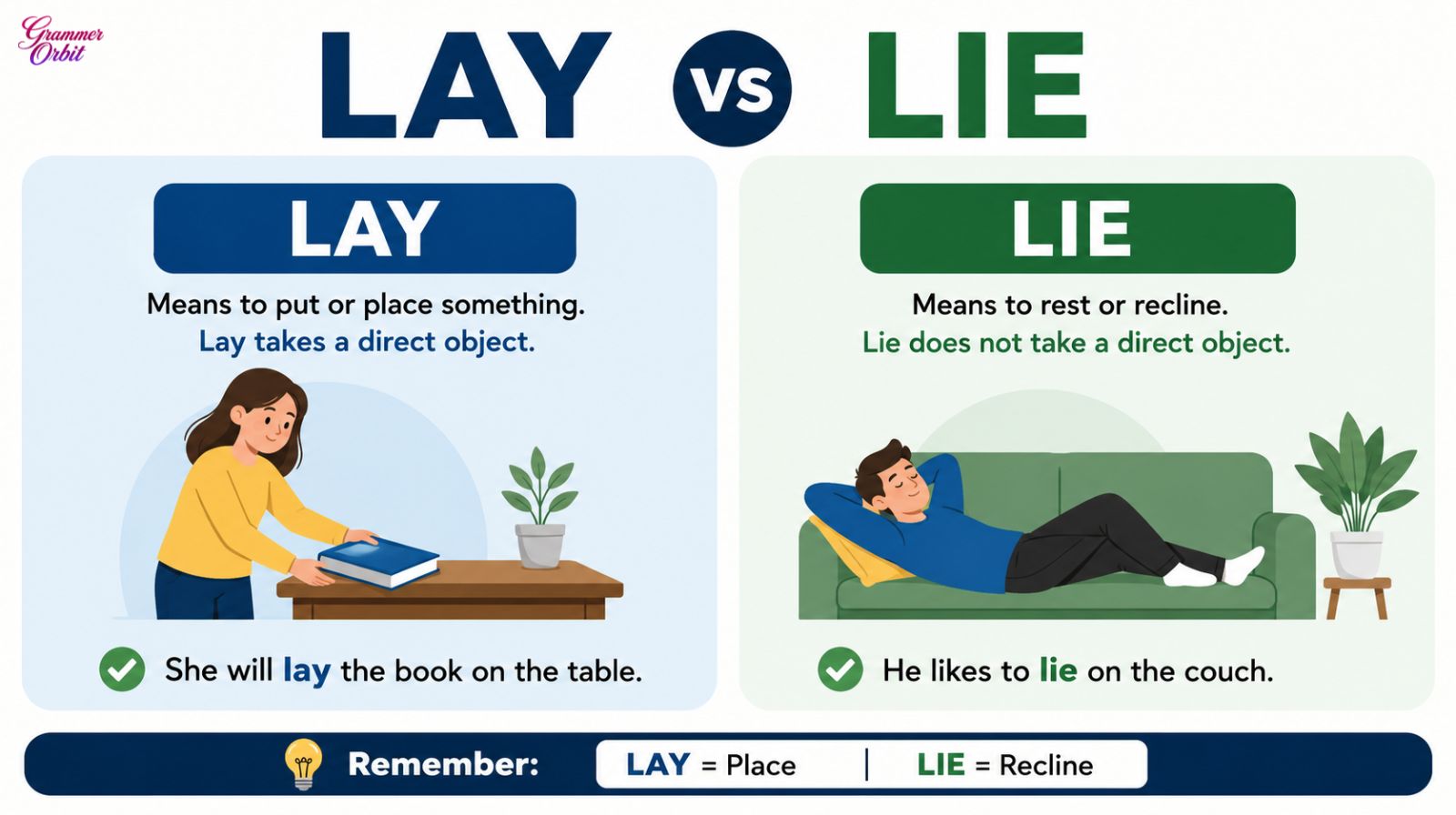
- Lay means to put or place something down.
- Lie means to rest or recline on a surface.
A quick way to remember this is:
Lay = Place
Lie = Recline
Lay Requires a Direct Object
When you use lay, something must receive the action.
Examples:
- Please lay the book on the table.
- She laid the blanket on the bed.
- They lay the documents on the desk every morning.
Notice that an object follows the verb:
- Lay the book
- Laid the blanket
- Lay the documents
Without an object, the sentence feels incomplete.
Lie Does Not Require a Direct Object
The verb lie describes what a person or thing does by itself.
Examples:
- I want to lie down.
- The cat is lying on the couch.
- He lay in bed all morning.
No object receives the action.
Quick Comparison
| Verb | Meaning | Needs Object? |
|---|---|---|
| Lay | To place something down | Yes |
| Lie | To recline or rest | No |
Understanding the Verb Forms of Lay and Lie
One reason people confuse these words is that their past forms overlap.
Forms of Lay
| Tense | Form |
|---|---|
| Present | Lay |
| Past | Laid |
| Past Participle | Laid |
| Present Participle | Laying |
Examples:
- I lay the keys on the counter.
- Yesterday I laid the keys there.
- I have laid the keys on the counter.
- I am laying the keys down carefully.
Forms of Lie
| Tense | Form |
|---|---|
| Present | Lie |
| Past | Lay |
| Past Participle | Lain |
| Present Participle | Lying |
Examples:
- I lie down after work.
- Yesterday I lay down for an hour.
- I have lain awake all night.
- I am lying on the sofa.
Why the Confusion Happens
Notice this important detail:
- Past tense of lie = lay
- Present tense of lay = lay
This overlap causes confusion even among experienced writers.
How to Use Lay Correctly in Sentences
The verb lay is used when someone places an object somewhere.
Lay Means “Put Something Down”
Examples:
- Lay your phone on the desk.
- She laid the baby in the crib.
- The waiter laid the menu on the table.
In every example, an object receives the action.
Common Situations Where Lay Is Used
Placing Objects
- Lay the pencil beside the notebook.
- Lay the package near the door.
Setting Things Down Carefully
- Lay the glass gently on the shelf.
- Lay the artwork flat to dry.
Producing Eggs
Birds and some animals also lay eggs.
Examples:
- Chickens lay eggs daily.
- The bird laid three eggs.
Easy Test for Lay
Ask yourself:
“What is being placed?”
If you can identify an object, lay is probably correct.
How to Use Lie Correctly in Sentences
The verb lie refers to resting, reclining, or being positioned somewhere.
See also Arised or Arose: What’s The Correct Past Tense Of Arise?
Lie Means “Rest”
Examples:
- I need to lie down.
- The dog lies under the table.
- They lie on the beach every summer.
Common Uses of Lie
Resting
- Lie on the sofa.
- Lie in bed.
- Lie on the floor.
Remaining Positioned
- The village lies near the river.
- The treasure lies beneath the sand.
Staying Motionless
- The papers lie untouched.
- Snow lies across the fields.
Easy Test for Lie
Ask:
“Is someone or something simply resting?”
If yes, lie is likely the correct choice.
Lay vs Lie: Side-by-Side Examples
Seeing both verbs together makes the distinction easier.
| Correct Sentence | Why It Is Correct |
|---|---|
| Lay the jacket on the chair. | Jacket receives action. |
| Lie on the couch and relax. | Subject is resting. |
| She laid the baby in the crib. | Baby receives action. |
| The baby lay peacefully in the crib. | Baby is resting. |
| Lay the papers on my desk. | Papers receive action. |
| The papers lie on the desk. | Papers are resting there. |
Example Pair #1
Correct:
- Lay the towel on the bed.
- The towel lies on the bed.
Explanation:
First sentence describes placing the towel.
Second sentence describes where the towel is resting.
Example Pair #2
Correct:
- He laid his backpack on the floor.
- His backpack lay on the floor all day.
Explanation:
One action places the backpack.
The other describes its position afterward.
Common Lay vs Lie Mistakes and How to Avoid Them
Many mistakes occur because people rely on how the words sound instead of how they function.
Mistake #1: “I’m Going to Lay Down”
Many people say:
❌ I’m going to lay down.
Correct:
✅ I’m going to lie down.
Why?
You are reclining yourself, not placing an object.
Mistake #2: Confusing Past Tense Forms
Incorrect:
❌ Yesterday I laid on the couch.
Correct:
✅ Yesterday I lay on the couch.
Reason:
Past tense of lie is lay.
Mistake #3: Forgetting the Object
Incorrect:
❌ Please lay down for a while.
Correct:
✅ Please lie down for a while.
Unless something is being placed somewhere, lay is incorrect.
Memory Trick
Remember:
Lay = Place
Lie = Recline
This simple trick solves most confusion instantly.
Real-Life Example: How a Professional Writer Fixed Repeated Grammar Errors
A content editor working for a digital marketing agency reviewed hundreds of blog posts every month. One recurring issue involved writers confusing lay and lie.
In one article about sleep habits, a writer repeatedly used sentences such as:
- “Lay down for eight hours.”
- “People should lay quietly before sleeping.”
Although the content was informative, these grammar mistakes weakened the article’s credibility. Readers often judge expertise based on language accuracy, especially in educational content.
The editor created a simple rule for the writing team:
- If something is being placed, use lay.
- If someone is resting, use lie.
The team also added a proofreading checklist specifically for commonly confused words.
Within a few months, editing time decreased significantly because writers became more confident with the distinction. More importantly, the articles appeared more professional and trustworthy to readers.
This example demonstrates how mastering a small grammar rule can improve writing quality, credibility, and reader experience.
Data and Trends: Why Grammar Accuracy Still Matters in 2025–2026
Even in an age of grammar-checking software, language accuracy remains important.
According to reports and educational studies published by major language-learning platforms and writing resources between 2025 and 2026, grammar-related searches continue to attract millions of monthly visits worldwide. Commonly confused word pairs such as lay vs lie, affect vs effect, and their vs there remain among the most searched grammar topics.
Key Insights
- Grammar-related search queries remain highly popular.
- Employers continue to value clear written communication.
- Professional writers rely on style guides for consistency.
- Readers often associate correct grammar with credibility.
Sources for language guidance include:
- Google Search documentation
- HubSpot content writing resources
- Purdue OWL grammar guides
The continued popularity of grammar questions shows that understanding fundamental rules still provides value in both academic and professional settings.
A Simple Step-by-Step Method to Choose the Correct Word
When you’re unsure which word to use, follow these steps.
See also Imbed vs Embed: Meaning, Usage, And Key Differences
Step 1: Identify the Action
Ask:
Is something being placed somewhere?
If yes, use lay.
Step 2: Look for an Object
Examples:
- Lay the notebook down.
- Lay the keys here.
An object exists.
Step 3: Check Whether Someone Is Resting
Examples:
- Lie on the couch.
- Lie in bed.
No object receives the action.
Step 4: Verify the Tense
Remember:
| Present | Past | Past Participle |
|---|---|---|
| Lay | Laid | Laid |
| Lie | Lay | Lain |
Step 5: Read the Sentence Again
Most mistakes become obvious when you identify whether the sentence describes placing or resting.
FAQs
Q1: Is it correct to say “lay down” or “lie down”?
A: If you mean recline or rest, lie down is correct.
Example:
- I need to lie down.
Q2: Why is lay the past tense of lie?
A: English contains many irregular verbs. The verb lie follows an older irregular pattern:
- Lie
- Lay
- Lain
Q3: Can lay be used without an object?
Generally, no.
A: The verb lay usually requires something that receives the action.
Q4: What is the past tense of lay?
A: The past tense of lay is laid.
Example:
- She laid the book on the table.
Q5: What is the past tense of lie?
A: The past tense of lie is lay.
Example:
- He lay on the couch yesterday.
Q6: Why do native speakers confuse lay and lie?:
A: Because the past tense of lie is lay, and both verbs sound similar.
Q7: Is “I was laying in bed” correct?
A: Traditional grammar considers:
✅ I was lying in bed.
to be the standard and correct form.
Conclusion
Understanding lay vs lie becomes much easier once you remember one key rule: lay means to place something, while lie means to recline or rest. Although their verb forms can seem confusing at first, recognizing whether an object receives the action will help you choose the correct word every time.
Whether you’re writing an email, blog post, academic paper, or social media update, using lay and lie correctly can make your communication clearer and more professional. Keep the simple memory trick Lay = Place, Lie = Recline in mind, and you’ll avoid one of English grammar’s most common mistakes.
The next time you’re unsure, pause for a moment, identify the action, and confidently choose the right word.
👉 Discover more simple and practical grammar guides on Grammer Orbit

Zia Ahmad is a professional blogger specializing in grammar tips and spelling accuracy. He creates clear, practical content that helps readers eliminate errors, strengthen writing skills, and communicate effectively for students, professionals, and everyday writers worldwide.