
Have you ever written a sentence like “A problem arised during the meeting” and wondered whether it sounded right? You’re not alone. Many English learners and even native speakers get confused between arised and arose because both seem like they could be valid past-tense forms of the verb arise.
The confusion usually comes from the fact that many English verbs form their past tense by adding ed. However, English is full of irregular verbs that follow different patterns. As a result, words like arised often appear in writing even though they are grammatically incorrect.
In this guide, you’ll learn the correct past tense of arise, understand why arised is incorrect, see real-world examples, and discover simple rules that will help you avoid this mistake forever.
What Is the Correct Past Tense of Arise?
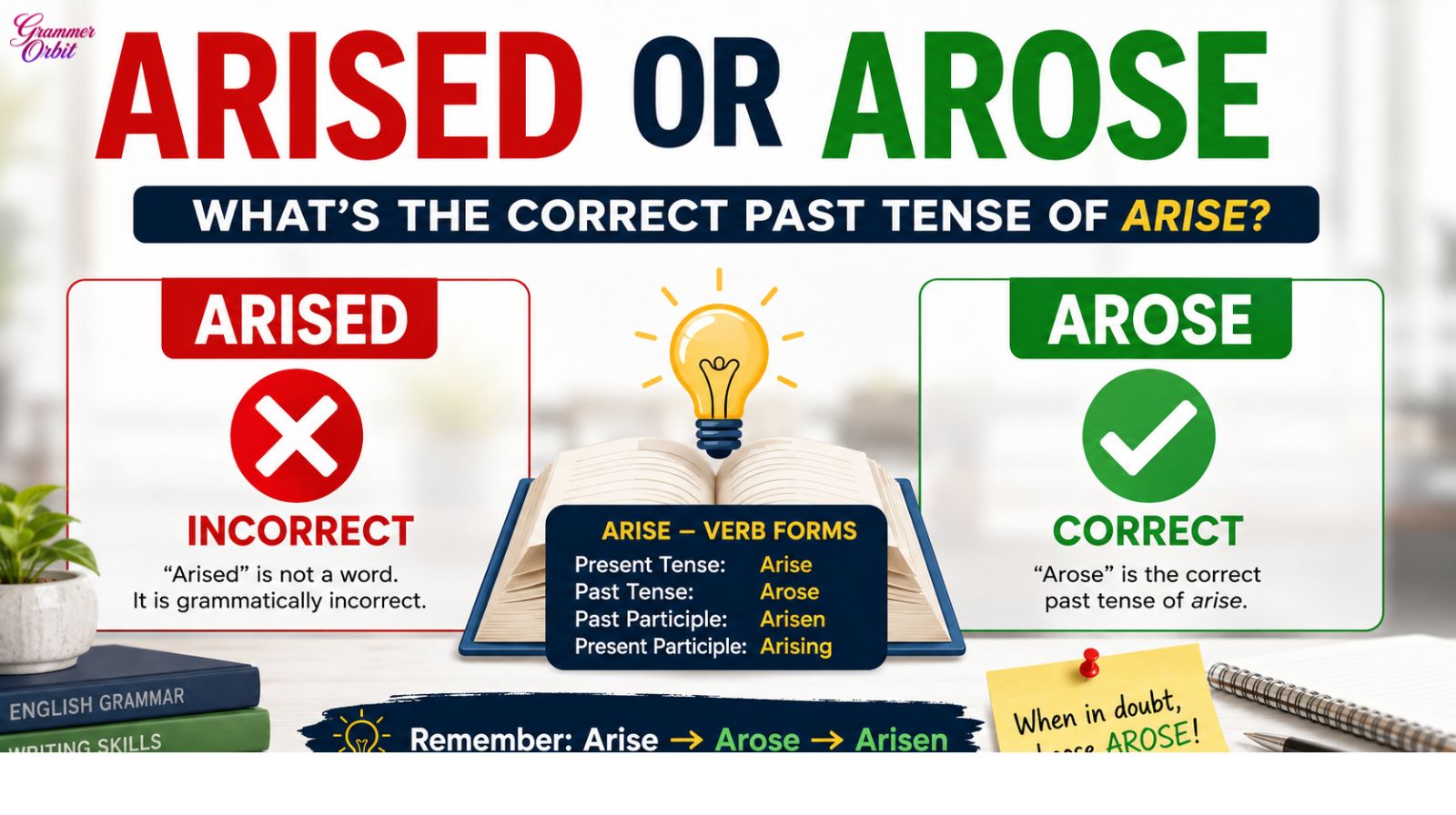
The correct past tense of arise is arose.
Present, Past, and Past Participle Forms
| Verb Form | Correct Word |
|---|---|
| Base Form | Arise |
| Past Tense | Arose |
| Past Participle | Arisen |
| Present Participle | Arising |
Examples
- A problem arose during the discussion.
- Several questions arose after the presentation.
- Unexpected issues arose while developing the software.
In each sentence, arose correctly describes something that happened in the past.
Quick Answer
If you’re wondering whether to use arised or arose, the answer is simple:
✅ Arose = Correct
❌ Arised = Incorrect
Why Is “Arised” Incorrect?
Many people assume that because verbs like walk become walked and jump becomes jumped, arise should become arised.
However, arise is an irregular verb.
What Are Irregular Verbs?
Irregular verbs do not follow the standard -ed pattern when forming the past tense.
Examples include:
| Base Verb | Past Tense |
|---|---|
| Go | Went |
| Begin | Began |
| Rise | Rose |
| Arise | Arose |
| Write | Wrote |
Because arise belongs to this group, adding -ed creates a form that is not accepted in standard English grammar.
Why the Mistake Happens
See also Zeroes or Zeros: Complete Guide To The Correct Plural Form Of Zero
Several factors contribute to this confusion:
Similarity to Regular Verbs
Most English verbs follow predictable rules, causing learners to assume all verbs behave similarly.
Influence of Spoken English
People sometimes create nonstandard verb forms in casual speech, which can spread online.
Lack of Exposure
Writers who rarely encounter the word arise may naturally guess its past tense incorrectly.
Therefore, understanding irregular verb patterns is essential for accurate writing.
Arised vs Arose: Side-by-Side Comparison
The easiest way to remember the difference is through a direct comparison.
| Feature | Arised | Arose |
|---|---|---|
| Grammatical? | No | Yes |
| Standard English? | No | Yes |
| Past Tense of Arise? | No | Yes |
| Accepted in Academic Writing? | No | Yes |
| Accepted in Professional Writing? | No | Yes |
Correct Usage
- A disagreement arose between the two departments.
- Several concerns arose after the policy change.
Incorrect Usage
- A disagreement arised between the two departments.
- Several concerns arised after the policy change.
The second examples should always be corrected to arose.
How to Use “Arose” Correctly in Sentences
Knowing the correct word is only the first step. The next step is understanding how it fits naturally into sentences.
When Referring to Problems
Problems often arise unexpectedly.
Examples:
- A technical issue arose during the live broadcast.
- Concerns arose regarding data privacy.
- Questions arose about the project’s budget.
When Referring to Opportunities
The verb isn’t limited to problems.
Examples:
- A new opportunity arose after the merger.
- Several partnerships arose from the event.
- New possibilities arose during the discussion.
When Referring to Situations
Examples:
- A unique situation arose last week.
- Unexpected circumstances arose during the trip.
- Legal complications arose after the agreement.
Common Sentence Pattern
A useful structure is:
Something + arose + during/after/from + event
For example:
- Concerns arose after the announcement.
- Questions arose during the meeting.
- Challenges arose from the new policy.
Understanding Arise, Arose, and Arisen
Many writers confuse not only arised and arose but also arose and arisen.
Arise (Present Tense)
Used when discussing something happening now or generally.
Examples:
- Problems often arise in complex projects.
- Questions may arise later.
Arose (Past Tense)
Used for completed past actions.
Examples:
- Several issues arose yesterday.
- Concerns arose after the meeting.
Arisen (Past Participle)
Used with helping verbs such as has, have, or had.
Examples:
- New challenges have arisen recently.
- Problems had arisen before management noticed them.
Simple Formula
| Tense | Example |
|---|---|
| Present | Problems arise |
| Past | Problems arose |
| Perfect | Problems have arisen |
Remembering this sequence makes correct usage much easier.
Real-Life Example: How One Grammar Mistake Affected Professional Writing
A marketing agency preparing content for an international client faced an unexpected issue during a website launch. The agency’s copywriter drafted a report stating:
“Several concerns arised during the testing phase.”
At first glance, nobody noticed the error. The report passed through multiple reviews and was sent directly to the client. However, the client’s editor quickly flagged the word arised as incorrect.
Although the mistake seemed minor, it affected the document’s professionalism. The client questioned whether the agency had native-level editing standards and requested a full language review before approving future reports.
The team later corrected the sentence to:
“Several concerns arose during the testing phase.”
This small correction instantly improved the report’s credibility.
The lesson is simple: grammar mistakes involving irregular verbs can influence how readers perceive expertise and professionalism. Whether you’re writing academic papers, business reports, blog posts, or emails, using the correct verb form helps establish trust.
Today, many companies include grammar-checking tools and editorial reviews specifically to catch errors involving irregular verbs such as arise, begin, write, and go.
Grammar Trends and Language Data (2025–2026)
Recent language-learning platforms and grammar software continue to report confusion around irregular verbs as one of the most common writing issues among English learners.
Key Findings
- Irregular verb mistakes remain among the most frequently corrected grammar errors.
- Search interest for questions involving verb forms continues to grow globally.
- Grammar-checking tools regularly flag incorrect forms such as arised, writed, and buyed.
- Educational content about irregular verbs receives millions of views annually across language-learning platforms.
These trends highlight an important reality: even experienced writers occasionally struggle with irregular verb patterns.
As English becomes increasingly important in business, education, and online communication, mastering commonly confused words such as arose can significantly improve writing quality.
Easy Checklist: How to Remember the Correct Form
Use this quick checklist whenever you’re unsure.
Step 1: Identify the Base Verb
Ask yourself:
“What is the original verb?”
Answer:
Arise
Step 2: Check Whether It’s Irregular
Arise is irregular.
See also Afterward vs Afterword: Know The Difference And Use Them Correctly
Step 3: Use the Correct Past Form
Past tense:
Arose
Step 4: Avoid Adding “-ed”
Never write:
❌ Arised
Always write:
✅ Arose
Memory Trick
Think of this pattern:
- Rise → Rose
- Arise → Arose
Since rise becomes rose, arise naturally becomes arose.
This shortcut helps many learners remember the correct form instantly.
Common Mistakes Writers Make
Using Arised in Formal Writing
Incorrect:
- Several issues arised during testing.
Correct:
- Several issues arose during testing.
Confusing Arose and Arisen
Incorrect:
- Problems have arose.
Correct:
- Problems have arisen.
Mixing Tenses
Incorrect:
- Yesterday, several concerns have arisen.
Correct:
- Yesterday, several concerns arose.
Overusing Grammar Checkers
Grammar tools are useful but not perfect. Understanding the underlying rule is always more reliable than depending solely on software.
Authoritative References
For additional grammar guidance, consult:
- Merriam-Webster Dictionary
- Cambridge Dictionary
- Oxford Learner’s Dictionaries
FAQs
Q1: Is arised a real word?
A: No. Arised is generally considered incorrect in modern standard English. The correct past tense of arise is arose.
Q2: What is the past tense of arise?
A: The past tense of arise is arose.
Example:
- A problem arose during the meeting.
Q3: What is the past participle of arise?
A: The past participle is arisen.
Example:
- Several issues have arisen recently.
Q4: Why do people say arised?
A: People often assume that all verbs form the past tense with -ed. Since arise is irregular, this assumption leads to the incorrect form arised.
Q5: Is arose grammatically correct?
A: Yes. Arose is the correct and accepted past-tense form of arise.
Q6: How do I remember arose vs arisen?
A: Use this pattern:
- Present: Arise
- Past: Arose
- Past Participle: Arisen
Q7: Can I use arised in academic writing?
A: No. Academic, professional, and standard English writing should always use arose instead of arised.
Conclusion
If you’ve been wondering whether arised or arose is correct, the answer is clear: arose is the proper past tense of arise, while arised is considered incorrect in modern standard English.
Remember the simple pattern:
- Arise → Arose → Arisen
Whenever a problem, opportunity, question, or situation happened in the past, use arose. Following this rule will help you write more confidently, avoid common grammar mistakes, and improve the professionalism of your communication.
The next time this question arises, you’ll know exactly which form to choose and why.
👉 Discover more simple and practical grammar guides on Grammer Orbit

Zia Ahmad is a professional blogger specializing in grammar tips and spelling accuracy. He creates clear, practical content that helps readers eliminate errors, strengthen writing skills, and communicate effectively for students, professionals, and everyday writers worldwide.