
Have you ever heard someone say a product has many functions while another person talks about its functionality? Although these terms sound similar, they are not interchangeable.
Many writers, students, software professionals, and business users mistakenly use function and functionality as synonyms. However, understanding the difference can improve your communication and help you sound more professional.
In this guide, you’ll learn the exact meaning of function vs functionality, when to use each term, real-world examples, common mistakes, and practical tips for choosing the correct word every time.
What Is the Difference Between Function and Functionality?
The primary difference is simple:
| Term | Meaning | Example |
|---|---|---|
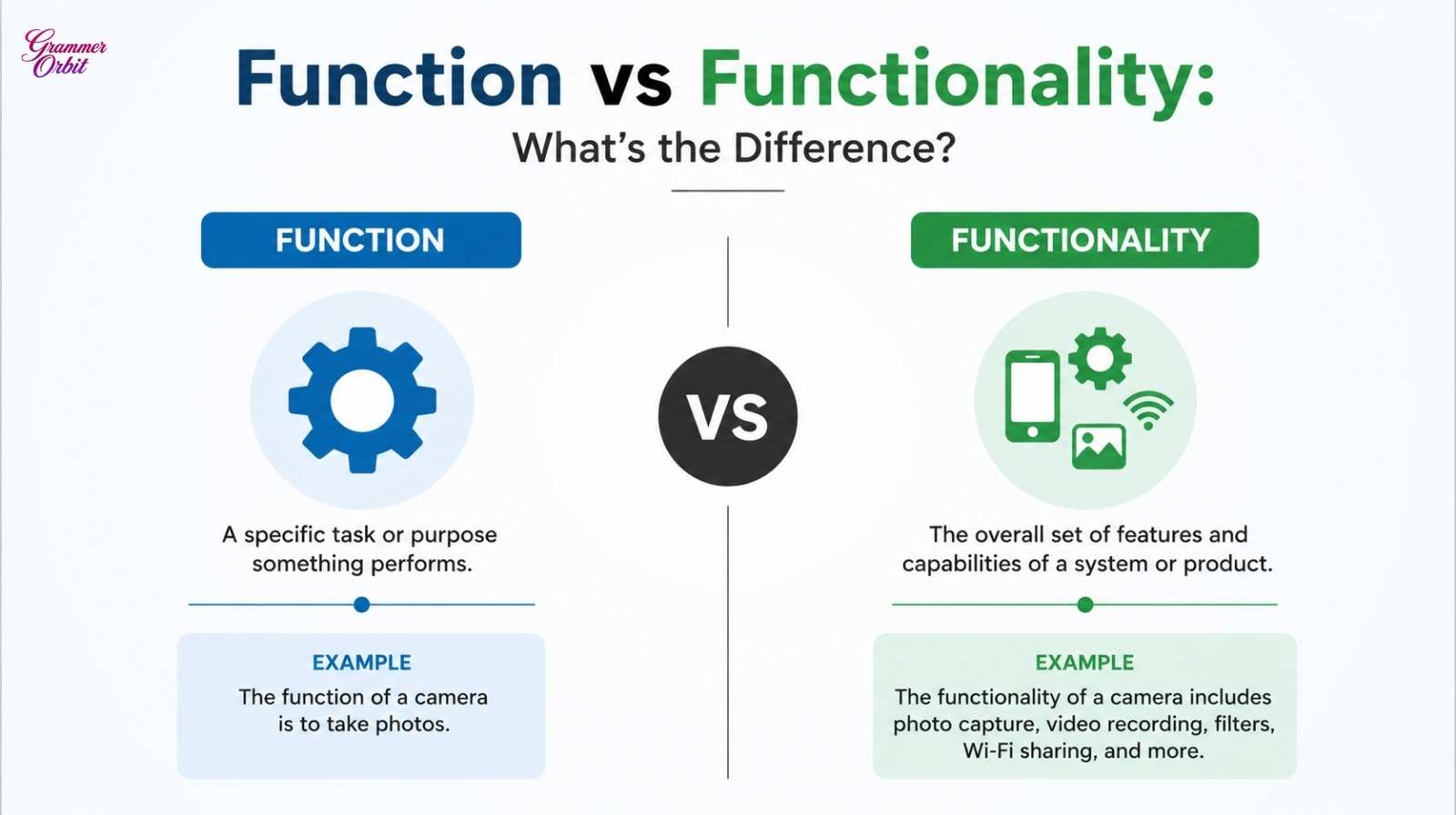
| Function | A specific task or purpose something performs | A calculator’s function is to perform mathematical calculations. |
| Functionality | The overall set of features and capabilities of a system or product | A calculator’s functionality includes memory storage, graphing, and equation solving. |
Function Definition
A function refers to a particular action, role, or purpose.
For example:
- The function of a keyboard is to input text.
- The heart’s primary function is to pump blood.
- One function of a smartphone is making calls.
In most contexts, a function is a single, identifiable task.
Functionality Definition
Functionality refers to the collection of features, operations, and capabilities that enable a system to work effectively.
Examples:
- The functionality of a smartphone includes calling, messaging, photography, internet browsing, and mobile payments.
- New software functionality was added in the latest update.
- Customers often compare product functionality before purchasing.
Quick Summary
Think of it this way:
A function is one job.
Functionality is everything the system can do.
See also Soo vs So: What’s the Difference and Which One Is Correct?
Why People Confuse Function and Functionality
The confusion happens because both words relate to purpose and operation.
Similar Meanings
Both terms describe how something works, which makes them appear interchangeable.
For example:
- Incorrect: “The software has many functions and functionality.”
- Better: “The software has many functions that improve its functionality.”
Frequent Use in Technology
The tech industry often uses both words in product descriptions, software documentation, and marketing materials.
As a result, users may assume they mean exactly the same thing.
Marketing Language
Many companies use “functionality” to describe advanced features because it sounds more comprehensive and professional.
However, this doesn’t change the distinction between the two terms.
Function vs Functionality in Technology
Technology provides some of the clearest examples of this distinction.
Software Function
A software function is a specific operation.
Examples:
- Exporting a file
- Sending an email
- Resetting a password
- Generating a report
Each task is an individual function.
Software Functionality
Software functionality refers to the complete capability of the application.
Examples:
- User management
- Reporting systems
- Security controls
- Data analytics
- Cloud integration
Together, these create the software’s overall functionality.
See also Leafs or Leaves: Which Is The Correct Plural Form?
Why This Matters
Developers, product managers, and marketers often evaluate products based on functionality rather than individual functions because it reflects the complete user experience.
Real-Life Example: How Businesses Evaluate Product Functionality
A mid-sized marketing agency needed a new project management platform in 2025. Initially, the team compared software options by looking at individual functions. They created a checklist that included task assignment, file sharing, deadline tracking, and team messaging.
Several products appeared similar because they offered these functions. However, after testing them, the agency discovered major differences in overall functionality.
One platform allowed seamless integration with customer relationship management tools, automated workflow creation, advanced reporting dashboards, and AI-powered scheduling. Another platform provided the same basic functions but lacked these broader capabilities.
As a result, the agency selected the software with stronger functionality because it improved productivity across multiple departments rather than simply performing isolated tasks.
Six months later, the company reported faster project completion times, improved collaboration, and reduced administrative work. This example illustrates why businesses often focus on functionality when making purchasing decisions. Individual functions matter, but overall functionality determines the real value users receive.
Function vs Functionality: Common Usage Examples
Correct Use of Function
- The function of this button is to print documents.
- One function of the app is location tracking.
- The liver performs several essential functions.
Correct Use of Functionality
- The new update improves system functionality.
- Customers requested additional functionality.
- The platform offers advanced functionality for large businesses.
Side-by-Side Comparison
| Sentence | Correct Term |
|---|---|
| The purpose of this tool is data analysis. | Function |
| The software offers reporting, automation, and integrations. | Functionality |
| The heart pumps blood throughout the body. | Function |
| The CRM platform includes numerous business features. | Functionality |
Function vs Functionality in Business and Product Development
Businesses frequently distinguish between these terms during product planning.
Product Functions
Individual capabilities include:
- Search tools
- Payment processing
- Notifications
- Account creation
Product Functionality
Overall functionality includes:
- User experience
- Feature integration
- Performance
- Scalability
- Security
Customer Expectations
Customers often evaluate products based on functionality because they want solutions rather than isolated features.
Therefore, understanding the distinction helps companies communicate product value more effectively.
Functionality Trends and Statistics (2025–2026)
Recent industry research highlights the growing importance of functionality in digital products.
User Expectations Continue to Rise
According to research from HubSpot and broader software industry reports, users increasingly prioritize integrated functionality over standalone features when selecting software solutions.
Key trends include:
- Over 70% of buyers compare feature sets before making software purchases.
- User experience and functionality remain among the top decision-making factors for SaaS products.
- Businesses continue investing in platforms that combine multiple functions into unified ecosystems.
See also Oversight vs Oversite: What’s the Real Difference?
What This Means
Organizations no longer compete solely on individual features. Instead, comprehensive functionality has become a major competitive advantage in technology, healthcare, education, and e-commerce sectors.
How to Choose the Correct Word
Use “Function” When
- Referring to a specific task
- Describing a particular purpose
- Explaining what something does
Example:
“The primary function of a thermostat is temperature control.”
Use “Functionality” When
- Discussing a complete feature set
- Evaluating a product or system
- Describing overall capabilities
Example:
“The software’s functionality improved significantly after the update.”
Easy Memory Trick
Remember:
Function = One Job
Functionality = Total Capability
This simple rule works in most situations.
FAQs
Q1: Is functionality just a fancy word for function?
A: No. A function is a specific task, while functionality refers to the complete set of features and capabilities.
Q2: Can function and functionality be used interchangeably?
A: Sometimes in casual conversation, but professional writing benefits from using the correct term based on context.
Q3: Which term is more common in software development?
A: Both are common. Developers discuss individual functions, while product teams often focus on overall functionality.
Q4: Is functionality grammatically correct?
A: Yes. Functionality is a standard English noun recognized by major dictionaries and style guides.
Q5: What is an example of function versus functionality?
A: A smartphone’s function may be making calls, while its functionality includes calling, texting, internet access, photography, GPS, and mobile payments.
Q6: Why is functionality important in business?
A: Functionality helps businesses evaluate the overall value, efficiency, and usefulness of products or systems.
Conclusion
Understanding function vs functionality is essential for clear communication in technology, business, education, and everyday writing.
A function refers to a specific task or purpose, while functionality describes the complete set of capabilities and features a product, system, or process offers. Although the words are related, using the correct term improves accuracy and professionalism.
The next time you’re describing software, products, or systems, remember this simple rule: a function is one task, but functionality is the bigger picture.
By applying this distinction correctly, you’ll write more clearly, communicate more effectively, and avoid one of the most common language mistakes in modern business and technology.
👉 Discover more simple and practical grammar guides on Grammer Orbit

Zia Ahmad is a professional blogger specializing in grammar tips and spelling accuracy. He creates clear, practical content that helps readers eliminate errors, strengthen writing skills, and communicate effectively for students, professionals, and everyday writers worldwide.