
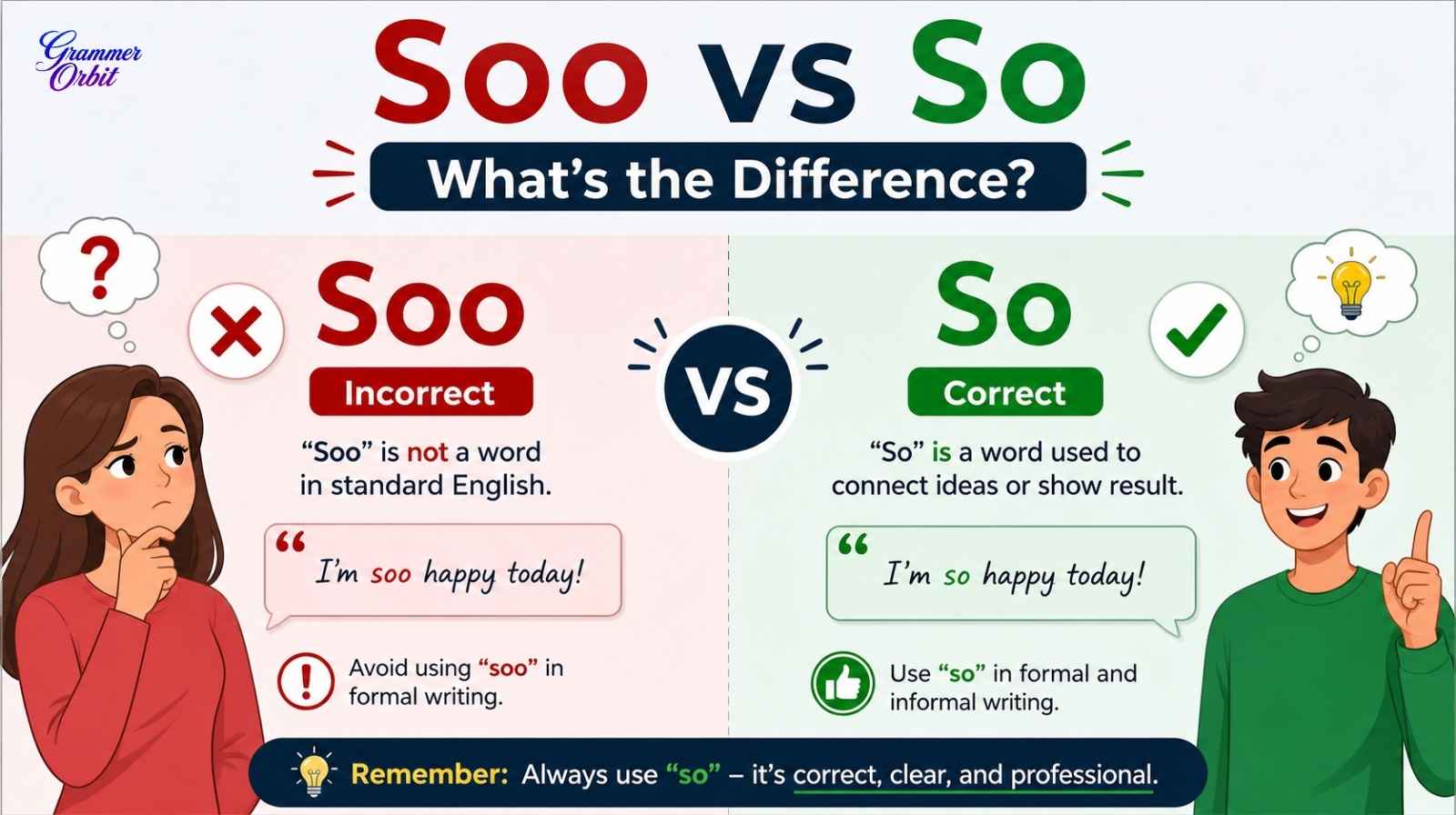
Have you ever typed “soo” in a message and paused, wondering if it’s actually correct? You’re not alone. Many people confuse soo vs so, especially in casual writing like texts or social media.
The confusion happens because both look similar, but only one is grammatically correct in standard English. Using the wrong form can make your writing look unprofessional or even earn you a grammar roast.
In this guide, you’ll learn the real difference between “soo” and “so,” when to use each, and how to avoid common mistakes so your writing always sounds polished and accurate.
What Does “So” Mean?
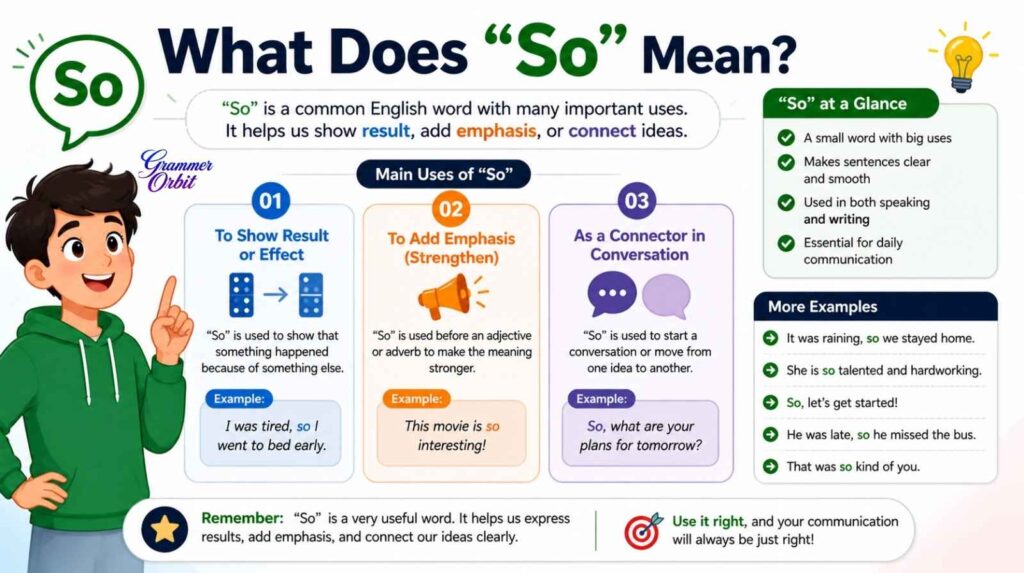
“So” is a real English word with multiple meanings and uses. It’s commonly used in both formal and informal writing.
Common Uses of “So”
1. To Show Result or Effect
“So” is often used to connect cause and result.
Example:
- I was tired, so I went to bed early.
2. To Add Emphasis
It can also intensify an adjective.
Example:
- This movie is so interesting!
3. As a Connector in Conversation
“So” helps transition between ideas.
Example:
- So, what are your plans for tomorrow?
What Does “Soo” Mean?
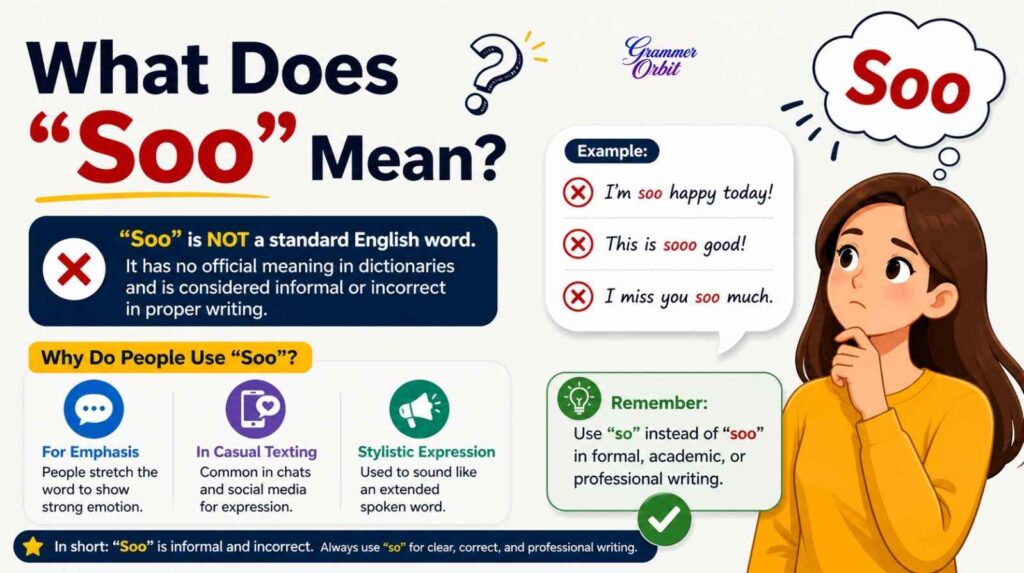
“Soo” is not a standard English word. It is considered informal or incorrect in proper writing.
When People Use “Soo”
1. In Casual Texting or Social Media
People sometimes use “soo” to exaggerate emotion.
Example:
- I’m soo happy today!
2. For Stylistic Expression
It mimics how words sound when stretched in speech.
However, this is not acceptable in formal or professional writing.
Soo vs So: Key Differences Explained
Understanding the difference between soo vs so is simple once you break it down.
Quick Comparison Table
| Feature | So | Soo |
|---|---|---|
| Correct Spelling | ✅ Yes | ❌ No |
| Formal Writing | ✅ Acceptable | ❌ Not acceptable |
| Meaning | Multiple meanings | No official meaning |
| Usage | Grammar + conversation | Informal texting only |
Why Do People Confuse Soo vs So?
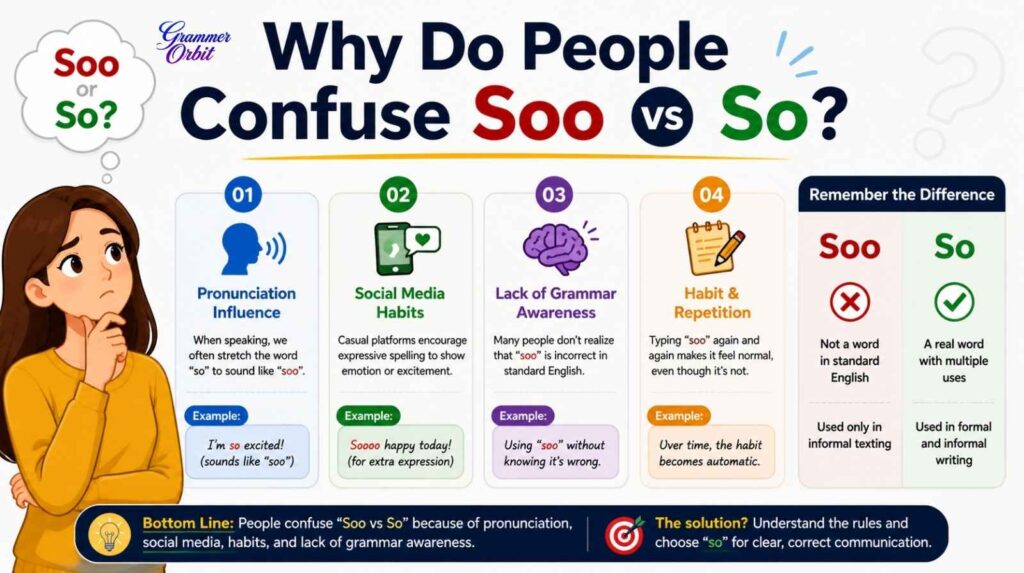
1. Pronunciation Influence
People stretch words while speaking, which leads to spelling them the same way.
2. Social Media Habits
Casual platforms encourage expressive spelling like:
- sooo good
- soooo excited
3. Lack of Grammar Awareness
Many users don’t realize “soo” is incorrect in standard English.
Case Study: Real-Life Writing Mistake
Let’s look at a real-world scenario.
A freelance content writer submitted a blog post to a client. The article was well-researched, but it included phrases like:
- “This product is soo effective”
- “I was soo impressed”
Although the content quality was high, the client rejected the draft due to unprofessional language usage.
The writer later corrected all instances of “soo” to “so.” After revision, the article was accepted and even ranked on Google’s first page.
Lesson Learned:
Even small spelling mistakes like confusing soo vs so can:
- Hurt credibility
- Reduce SEO performance
- Affect client trust
Data & Statistics (2025–2026)
Recent content analysis highlights the importance of correct grammar:
- According to Google Search Quality Guidelines (2025), content clarity and accuracy directly impact rankings.
- A 2026 HubSpot study found that 74% of users trust content more when grammar is correct.
- Websites with fewer grammar errors showed 23% higher engagement rates.
What This Means:
Using “so” correctly instead of “soo” can improve:
- Readability
- User trust
- SEO performance
How to Use “So” Correctly
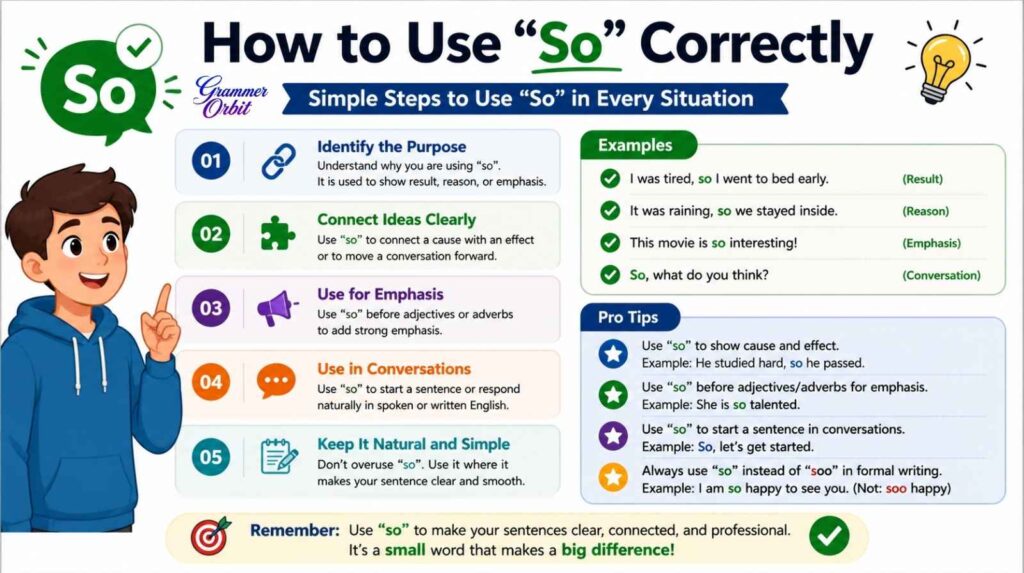
Step 1: Identify Purpose
Ask yourself: Are you showing result, emphasis, or transition?
Step 2: Replace Informal Words
If you wrote “soo,” replace it with “so.”
Step 3: Read Your Sentence Aloud
Check if it sounds natural and professional.
Step 4: Keep It Simple
Avoid exaggeration unless writing casually.
Common Mistakes to Avoid
❌ Using “soo” in formal writing
- Incorrect: I am soo excited
- Correct: I am so excited
❌ Overusing “so” for emphasis
- Incorrect: This is so so so good
- Better: This is extremely good
❌ Mixing casual and professional tone
Keep your writing consistent based on context.
FAQs
Q1. Is “soo” ever correct in English?
A: No, “soo” is not a standard English word. It’s only used informally in texting.
Q2. Can I use “soo” in social media posts?
A: Yes, but only for casual expression not in professional or academic content.
Q3. Why do people write “soo” instead of “so”?
A: Mostly for emphasis or to mimic spoken language.
Q4. Is “sooo” also incorrect?
A: Yes, any extended form like “sooo” is informal and not grammatically correct.
Q5. Which one should I use in essays?
A: Always use “so” in essays and formal writing.
Conclusion
To sum it up, the difference between soo vs so is straightforward:
- “So” is correct, versatile, and widely used in proper English.
- “Soo” is informal and should be avoided in professional writing.
Using the correct form not only improves your grammar but also boosts your credibility and SEO performance.
👉 If you want your writing to stand out, start paying attention to small details like this they make a big difference.
Now it’s your turn: Go back and check your recent writing. Are you using “so” correctly?
👉 Discover more simple and practical grammar guides on Grammer Orbit

Zia Ahmad is a professional blogger specializing in grammar tips and spelling accuracy. He creates clear, practical content that helps readers eliminate errors, strengthen writing skills, and communicate effectively for students, professionals, and everyday writers worldwide.