
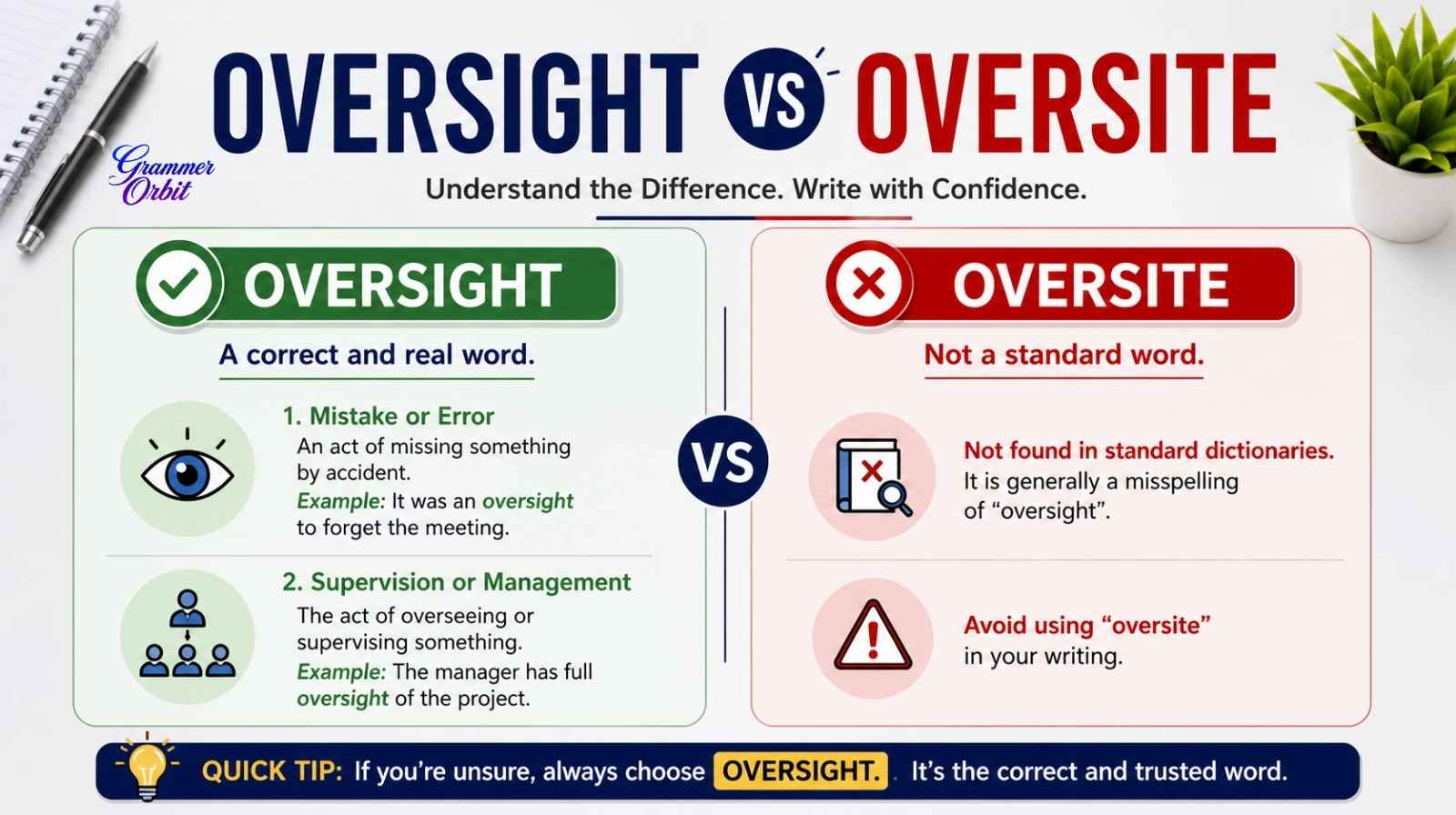
Have you ever typed “oversite” and wondered if it was correct or if you just made a mistake? You’re not alone. Many writers confuse oversight vs oversite because they sound similar, but their meanings are very different.
One is a correct and widely used word in professional writing, while the other is usually just a spelling mistake. Understanding this difference is essential for clear, effective communication. In this guide, you’ll learn what each term means, when to use oversight, and why oversite is almost always incorrect.
What Does “Oversight” Mean?
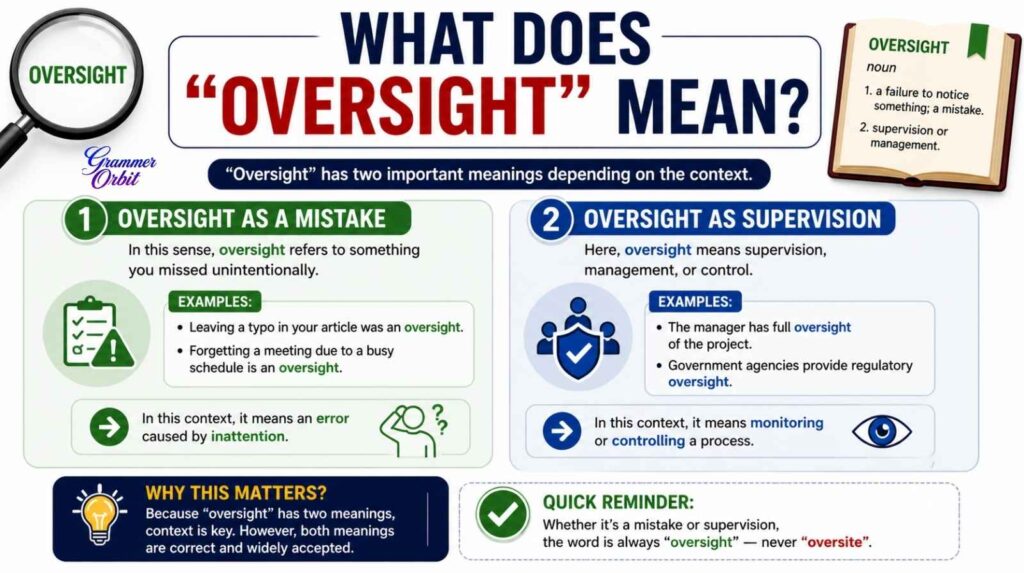
The word oversight is a correct English term with two distinct meanings.
1. Oversight as a Mistake
In one sense, oversight refers to something you missed unintentionally.
Example:
- Leaving a typo in your article was an oversight.
- Forgetting a meeting due to a busy schedule is an oversight.
👉 In this context, it means an error caused by inattention.
2. Oversight as Supervision
Interestingly, oversight can also mean supervision or management.
Example:
- The manager has full oversight of the project.
- Government agencies provide regulatory oversight.
👉 Here, it means monitoring or controlling a process.
Why This Matters
Because oversight has two meanings, context is key. However, both meanings are correct and widely accepted.
What Is “Oversite”? Is It a Real Word?
The Truth About “Oversite”
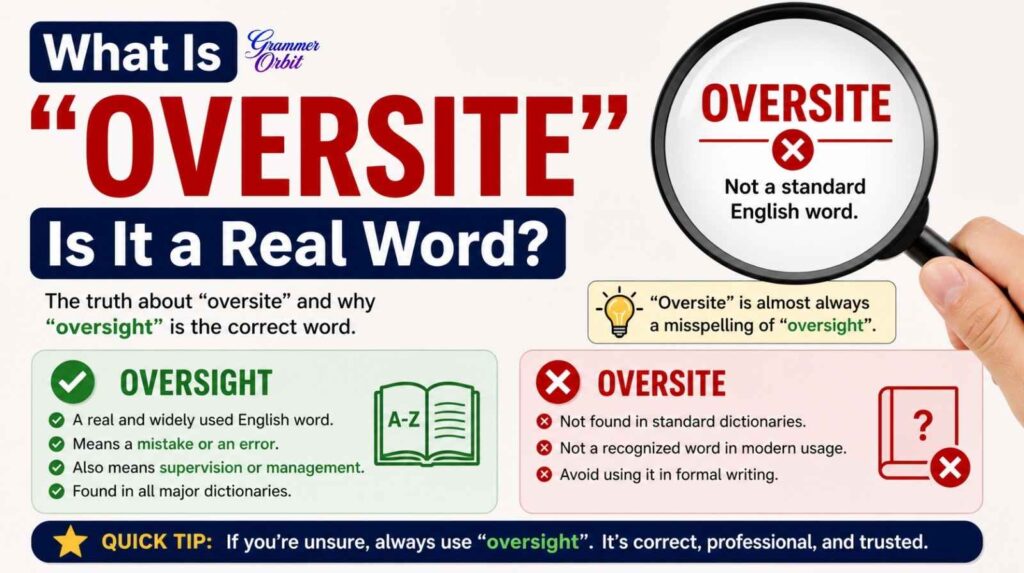
The term oversite is not a standard English word in modern usage.
- It does not appear in most major dictionaries.
- It is usually considered a misspelling of oversight.
Rare Exceptions
In extremely rare cases, “oversite” might appear as a compound of:
- over + site (e.g., construction context)
However, this usage is:
- Not common
- Not grammatically standard
- Not recommended in formal writing
👉 Therefore, in almost all cases, you should use oversight, not oversite.
Oversight vs Oversite: Key Differences
Here’s a simple comparison to make things crystal clear:
| Feature | Oversight ✅ | Oversite ❌ |
|---|---|---|
| Valid word | Yes | No (usually incorrect) |
| Meaning | Mistake or supervision | Not standard |
| Usage | Formal & informal writing | Avoid using |
| Dictionary | Included | Not recognized |
👉 Quick tip: If you’re unsure, always choose oversight.
Common Mistakes to Avoid
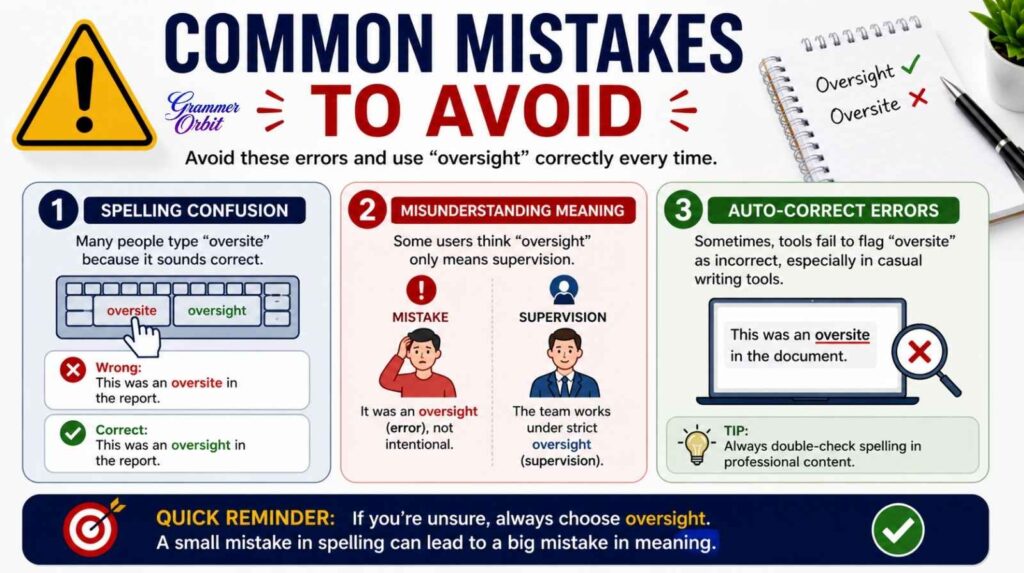
Even experienced writers make errors when using oversight vs oversite. Here are the most common ones:
1. Spelling Confusion
Many people type oversite because it sounds correct.
Wrong:
- This was an oversite in the report.
Correct:
- This was an oversight in the report.
2. Misunderstanding Meaning
Some users think oversight only means supervision.
However, it can also mean a mistake.
Example:
- It was an oversight (error), not intentional.
- The team works under strict oversight (supervision).
3. Auto-Correct Errors
Sometimes, tools fail to flag oversite as incorrect, especially in casual writing tools.
👉 Always double-check spelling in professional content.
Real-Life Case Study: How One Small “Oversight” Cost a Business
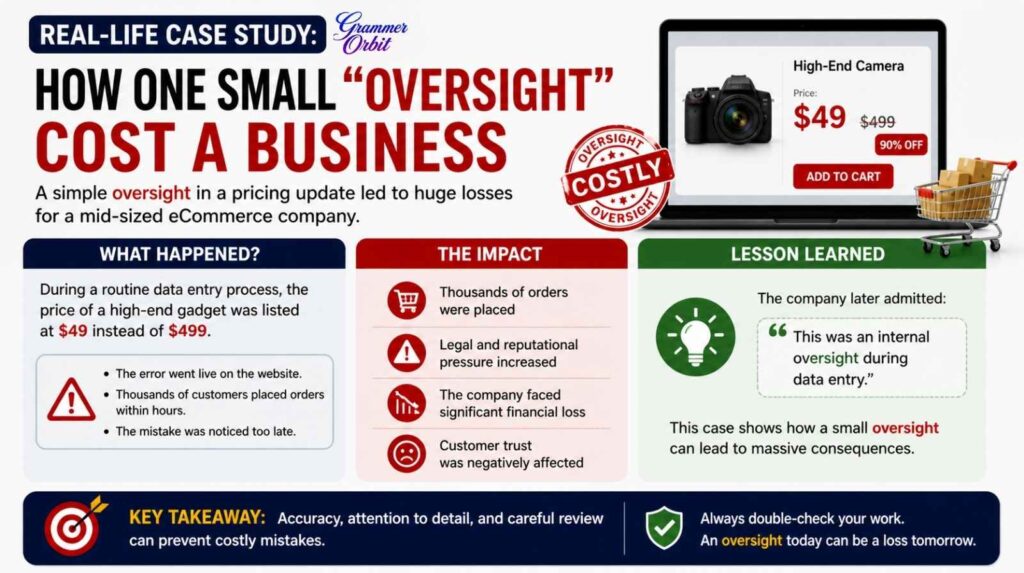
In 2025, a mid-sized eCommerce company published a product page with a pricing error. Due to a simple oversight, the price of a high-end gadget was listed at $49 instead of $499.
Within hours:
- Thousands of customers placed orders
- The company faced legal and reputational pressure
- They lost significant revenue before fixing the issue
The company later admitted:
“This was an internal oversight during data entry.”
This example highlights how a small mistake an oversight can lead to major consequences. It also shows why understanding and using the correct term matters, especially in professional communication.
Data & Statistics (2025–2026 Insights)
Accurate language plays a critical role in credibility and SEO performance.
- According to a 2025 report by HubSpot, 74% of readers trust content more when it is free of spelling errors
- Google’s content quality guidelines emphasize clarity and correctness as ranking factors
- A 2026 UX study found that typos reduce user trust by up to 59%
👉 This means confusing oversight vs oversite can directly impact:
- User trust
- Engagement
- Search rankings
How to Remember the Correct Word
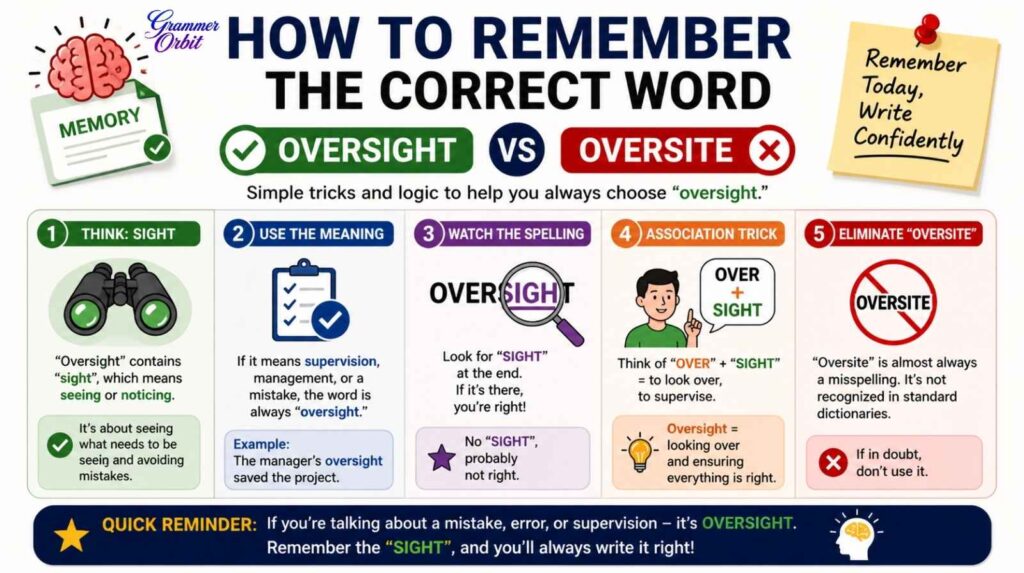
Here’s a simple trick to never confuse them again:
Memory Tip
👉 “Oversight = Seeing Over Something”
- If you oversee, you supervise → oversight
- If you miss something → still oversight
Step-by-Step Check
- Ask: Is this about a mistake or supervision?
- If yes → use oversight
- Avoid oversite completely
- Double-check spelling before publishing
FAQs
Q1. Is “oversite” ever correct?
A: No, oversite is generally incorrect. It’s almost always a misspelling of oversight.
Q2. Can “oversight” mean both mistake and supervision?
A: Yes. That’s what makes it unique it has two opposite meanings depending on context.
Q3. Why do people confuse oversight vs oversite?
A: Because they sound similar, and English spelling rules can be tricky.
Q4. Is oversight formal or informal?
A: It works in both formal and informal contexts.
Q5. How can I avoid spelling mistakes like this?
A: Use spell-check tools, proofread carefully, and learn common confusing word pairs.
Q6. Does using the wrong word affect SEO?
A: Yes. Spelling errors can reduce trust, readability, and rankings.
Conclusion
Understanding the difference between oversight vs oversite is simple once you know the truth:
👉 Oversight is correct.
👉 Oversite is almost always wrong.
Whether you’re writing emails, blog posts, or professional content, using the correct word improves clarity and credibility. More importantly, it helps you avoid embarrassing mistakes that can affect trust and SEO performance.
👉 Discover more simple and practical grammar guides on Grammer Orbit

Zia Ahmad is a professional blogger specializing in grammar tips and spelling accuracy. He creates clear, practical content that helps readers eliminate errors, strengthen writing skills, and communicate effectively for students, professionals, and everyday writers worldwide.