
Have you ever typed “curtesy” when you actually meant “courtesy”? You’re not alone. Many English learners, students, and even professional writers occasionally confuse these two words because they look and sound similar.
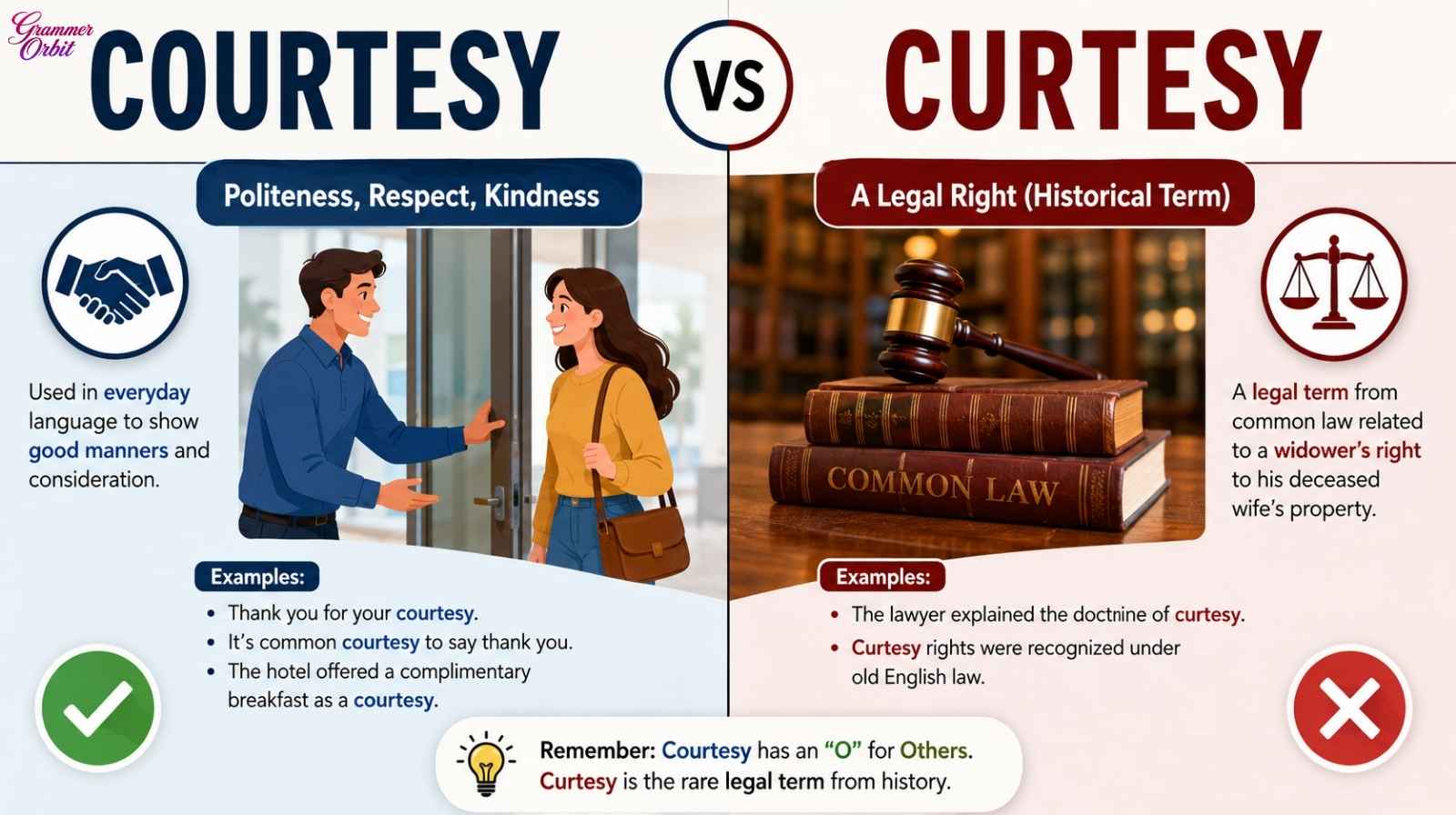
However, courtesy and curtesy have completely different meanings. One is a common word used in everyday communication, while the other is an uncommon legal term that most people rarely encounter.
In this guide, you’ll learn the difference between Courtesy vs Curtesy, when to use each word, common mistakes to avoid, and practical examples that will help you remember the correct spelling every time.
What Is the Difference Between Courtesy and Curtesy?
The simplest way to understand the difference is this:
| Word | Meaning | Common Usage |
|---|---|---|
| Courtesy | Polite behavior, respect, kindness, or a considerate act | Very common |
| Curtesy | A historical legal right granted to a widower under common law | Rare |
Courtesy Definition
Courtesy refers to politeness, respect, good manners, and considerate behavior toward others.
Examples:
- Thank you for your courtesy and professionalism.
- Showing courtesy to customers improves business relationships.
- It is common courtesy to hold the door open for someone.
See also Tweek vs Tweak: Clarifying the Difference and Usage
Curtesy Definition
Curtesy is a legal term from historical English common law. It refers to a widower’s right to inherit or use his deceased wife’s property under certain conditions.
Examples:
- The lawyer discussed the ancient doctrine of curtesy.
- Curtesy rights existed in many common-law jurisdictions centuries ago.
In modern conversation, curtesy is rarely used, while courtesy appears frequently in writing and speech.
Why Do People Confuse Courtesy and Curtesy?
The confusion mainly comes from their similar pronunciation and spelling.
Similar Letter Structure
Both words contain nearly the same letters:
- Courtesy
- Curtesy
A small spelling difference creates a completely different meaning.
Autocorrect and Typing Errors
Fast typing often causes people to omit the letter “o,” turning courtesy into curtesy accidentally.
Lack of Familiarity With Curtesy
Most people know the word courtesy but have never encountered curtesy in legal or historical contexts. Therefore, they may assume the words are interchangeable.
How to Use Courtesy Correctly
Since courtesy is the word most people need, understanding its usage is important.
Courtesy as Politeness
The most common meaning refers to good manners and respectful behavior.
Examples:
- She treated every customer with courtesy.
- Professional courtesy helps create a positive workplace.
Courtesy as a Favor
Sometimes courtesy refers to something provided free of charge.
Examples:
- The hotel offered complimentary drinks as a courtesy.
- The company extended a courtesy discount.
Courtesy in Formal Communication
Business emails frequently use courtesy-related phrases.
Examples:
- Thank you for your courtesy and support.
- We appreciate your professional courtesy.
Courtesy vs Curtesy in Professional Writing
When writing emails, articles, reports, or customer communications, courtesy is almost always the correct word.
Common Courtesy vs Curtesy Mistakes
Mistake #1: Using Curtesy Instead of Courtesy
❌ Thank you for your curtesy.
✅ Thank you for your courtesy.
Mistake #2: Assuming Both Words Mean Politeness
See also Moment vs Momment: Correct Spelling, Definition, And Usage Guide
❌ Her curtesy impressed the guests.
✅ Her courtesy impressed the guests.
Mistake #3: Misspelling Business Documents
Professional documents often contain accidental spelling errors.
❌ Courtesy notice → Curtesy notice
Always proofread important communications before publishing.
Real-Life Example: How One Spelling Error Affected Business Communication
A customer service manager at a mid-sized company prepared hundreds of client emails before launching a customer appreciation campaign. The emails included the sentence:
“As a curtesy, we are offering a free consultation.”
Initially, nobody noticed the mistake. However, after sending the emails, several clients replied asking whether “curtesy” was a new company term or a typo.
Although the error seemed minor, it reduced the professionalism of the campaign. The marketing team later corrected the message and resent future communications using the proper spelling:
“As a courtesy, we are offering a free consultation.”
This example demonstrates an important lesson. Small spelling mistakes can affect credibility, especially in business writing, customer support, academic work, and content marketing. Readers often judge professionalism based on attention to detail.
By understanding the difference between courtesy vs curtesy, writers can avoid confusion and communicate more effectively.
Courtesy vs Curtesy: Quick Memory Trick
Here’s an easy way to remember:
Remember the Letter “O”
Courtesy contains the letter O, which can remind you of:
- Others
- Offering respect
- Observing good manners
Since courtesy relates to treating others politely, the “O” can help trigger the correct spelling.
Curtesy Is the Rare Legal Term
If you see curtesy, think:
- Historical law
- Property rights
- Rare legal documents
This distinction makes choosing the correct word much easier.
Usage Trends and Language Data (2025–2026)
Modern language databases and writing tools consistently show that courtesy remains overwhelmingly more common than curtesy in published content, business communication, educational materials, and online searches.
According to language trend analyses from major dictionaries and writing platforms, searches for “courtesy meaning” and “courtesy examples” significantly outnumber searches for “curtesy” because the latter primarily appears in historical legal discussions.
This trend highlights an important point:
- Courtesy is part of modern everyday English.
- Curtesy survives mainly in historical and legal references.
Writers, students, and professionals are therefore much more likely to need courtesy than curtesy in daily communication.
Courtesy vs Curtesy in Grammar and Writing
When to Use Courtesy
See also Cheer vs Chear: When to Use Each One Correctly
Use courtesy when discussing:
- Politeness
- Respect
- Good manners
- Professional behavior
- Kind gestures
- Complimentary services
When to Use Curtesy
Use curtesy only when discussing:
- Historical law
- Common-law inheritance rights
- Legal history
- Property law research
Which Word Should Most Writers Use?
For nearly every modern writing situation, the correct choice is courtesy.
FAQs
Q1: Is curtesy a real word?
A: Yes. Curtesy is a legitimate legal term from historical common law referring to a widower’s property rights.
Q2: Which spelling is correct: courtesy or curtesy?
A: Both are technically correct words, but courtesy is the correct choice when referring to politeness, kindness, or good manners.
Q3: Why do people misspell courtesy as curtesy?
A: The words sound similar, and many people accidentally omit the letter “o” while typing.
Q4: Is curtesy still used today?
A: It is rarely used outside legal history, academic research, or discussions of old property laws.
Q5: Can courtesy mean a free service?
A: Yes. Courtesy can refer to something provided as a polite gesture, such as a courtesy shuttle or courtesy discount.
Q6: How can I remember the correct spelling of courtesy?
A: Remember that courtesy contains the letter “O” for others, which relates to treating people respectfully.
Conclusion
Understanding Courtesy vs Curtesy is surprisingly simple once you know their meanings. Courtesy refers to politeness, respect, and considerate behavior, making it a common word in everyday English. Curtesy, on the other hand, is a rare legal term connected to historical inheritance rights.
If you’re writing emails, articles, business documents, or everyday messages, courtesy is almost certainly the word you need. By remembering the spelling difference and understanding the context of each term, you can avoid common mistakes and write with greater confidence and accuracy.
The next time you encounter courtesy vs curtesy, you’ll know exactly which word belongs in your sentence.
👉 Discover more simple and practical grammar guides on Grammer Orbit

Zia Ahmad is a professional blogger specializing in grammar tips and spelling accuracy. He creates clear, practical content that helps readers eliminate errors, strengthen writing skills, and communicate effectively for students, professionals, and everyday writers worldwide.