
Have you ever seen the words dysregulated and disregulated and wondered whether both are correct? You’re not alone. These terms often confuse writers, students, healthcare professionals, and English learners because they look similar and appear in related contexts.
The good news is that understanding the difference is simpler than it seems. In this guide, you’ll learn the correct spelling, meaning, usage examples, and when each term should be used. By the end, you’ll know exactly which word belongs in your writing and why.
What Does Dysregulated Mean?
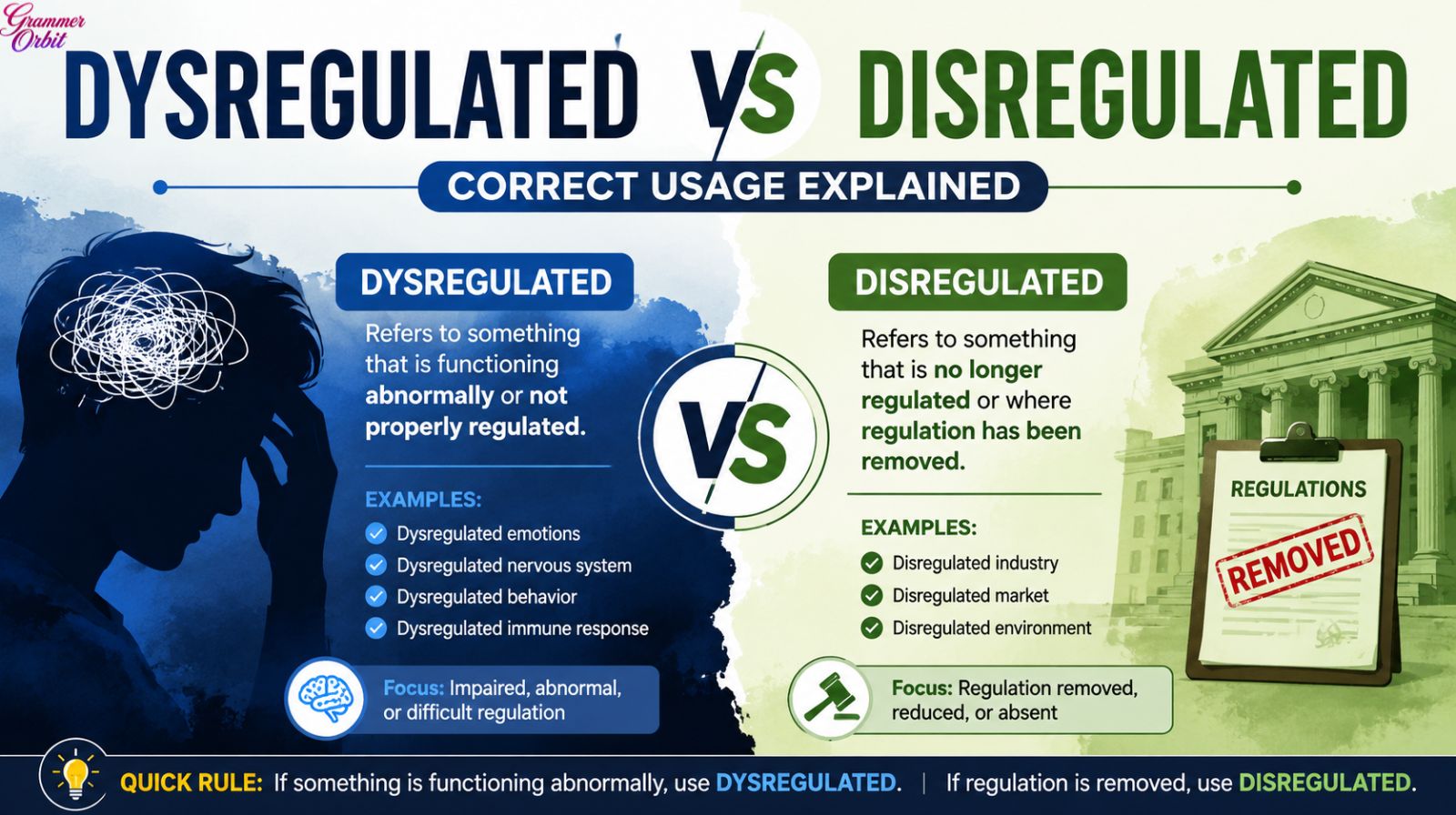
The word dysregulated refers to something that is functioning abnormally or failing to regulate properly. It is commonly used in psychology, medicine, biology, and neuroscience.
Definition of Dysregulated
“Dysregulated” comes from the prefix dys-, which means “abnormal,” “impaired,” or “difficult.”
Definition:
Dysregulated means not properly controlled, balanced, or regulated.
Common Contexts Where Dysregulated Is Used
The term frequently appears in:
- Mental health discussions
- Emotional regulation studies
- Medical research
- Biological systems
- Neurological conditions
Examples of Dysregulated in Sentences
- The patient showed dysregulated emotional responses during the assessment.
- Chronic stress can lead to a dysregulated nervous system.
- Researchers studied how trauma affects dysregulated behavior.
- The immune system became dysregulated, causing inflammation.
In all these examples, the word describes a system or response that is not functioning normally.
Is Disregulated a Real Word?
Yes, disregulated exists in some dictionaries and academic texts. However, it is significantly less common than dysregulated.
Definition of Disregulated
The prefix dis- generally means “not,” “opposite of,” or “removed from.”
Disregulated typically means:
No longer regulated or lacking regulation.
Why It Causes Confusion
Because both prefixes suggest a problem with regulation, many writers assume the words are interchangeable. However, modern usage strongly favors dysregulated, especially in healthcare and psychology.
Examples of Disregulated
- The industry became disregulated after government oversight was removed.
- Some markets operate in a relatively disregulated environment.
These examples focus more on regulation being removed rather than functioning abnormally.
Dysregulated vs Disregulated: Key Differences
Understanding the distinction becomes easier when comparing them side by side.
| Feature | Dysregulated | Disregulated |
|---|---|---|
| Meaning | Functioning abnormally | Regulation removed or absent |
| Prefix Meaning | Impaired or abnormal | Not, opposite, removed |
| Common Usage | Medicine, psychology, biology | Policy, systems, governance |
| Frequency | Very common | Rare |
| Preferred in Mental Health? | Yes | No |
Quick Rule to Remember
If you’re talking about:
- Emotions
- Mental health
- Biological functions
- Nervous systems
Use dysregulated.
If you’re discussing:
- Rules being removed
- Oversight ending
- Regulatory systems changing
Use disregulated.
Why Dysregulated Is More Common Today
In modern English, especially scientific and medical writing, dysregulated has become the preferred term.
Growth in Medical Literature
Researchers regularly use the word when discussing:
- Anxiety disorders
- Depression
- ADHD
- Trauma responses
- Immune system dysfunction
Mental Health Awareness
As conversations about emotional health have increased, terms like:
- Emotional dysregulation
- Dysregulated behavior
- Dysregulated nervous system
have become much more familiar to the public.
Academic Preference
Most psychology textbooks and peer-reviewed studies use dysregulated because it accurately describes impaired regulation rather than the complete absence of regulation.
Real-Life Example: How a Mental Health Professional Uses the Word
Imagine a therapist working with a teenager who experiences intense emotional reactions. The teenager becomes extremely angry over small frustrations, struggles to calm down, and often feels overwhelmed.
Rather than saying the teenager is simply “overreacting,” the therapist may describe the situation as emotional dysregulation. This term helps explain that the individual’s emotional regulation system is not functioning as expected.
The therapist might write in a report:
“The client demonstrates dysregulated emotional responses during stressful situations.”
This wording is important because it focuses on the underlying challenge rather than assigning blame. It also provides a more accurate clinical description.
If the therapist wrote disregulated emotional responses, most professionals would consider it unusual because emotional regulation issues are traditionally described as dysregulated, not disregulated.
This real-world example shows why choosing the correct term matters, especially in professional communication where precision is essential.
Language Trends and Usage Statistics (2025–2026)
Recent linguistic trends indicate that dysregulated appears far more frequently than disregulated in academic databases, healthcare publications, and online educational resources.
What Current Usage Shows
- Medical journals overwhelmingly prefer dysregulated.
- Psychology articles use dysregulated thousands of times more often than disregulated.
- Mental health resources commonly discuss emotional dysregulation.
- Educational content increasingly teaches dysregulated as the standard term.
As awareness of mental health continues to grow in 2025–2026, the use of dysregulated is expected to remain dominant.
How to Choose the Correct Word
Step 1: Identify the Context
Ask yourself what you’re describing.
Step 2: Consider the Meaning
Is something functioning poorly?
Use dysregulated.
Step 3: Check Whether Rules Were Removed
If regulation itself was removed or reduced, disregulated may fit.
Step 4: Follow Industry Standards
For psychology, medicine, and biology, choose dysregulated unless a specific source requires otherwise.
Common Mistakes Writers Make
Confusing the Prefixes
Many people assume dys- and dis- mean the same thing. They do not.
Using Disregulated in Medical Writing
In healthcare contexts, dysregulated is almost always the better choice.
Assuming Both Words Are Equally Common
Although both exist, one is clearly more widely accepted in modern usage.
FAQs
Q1: Is dysregulated a real word?
A: Yes. Dysregulated is a widely accepted word used in psychology, medicine, neuroscience, and biology.
Q2: Is disregulated correct?
A: No. The spelling disregulated is correct if you intend to use that word. “Disregulated” should not be confused with “disregulated.”
Q3: Which word is more common: dysregulated or disregulated?
A: Dysregulated is far more common in modern English, especially in healthcare and academic writing.
Q4: What does emotionally dysregulated mean?
A: It means a person has difficulty managing or controlling emotional responses effectively.
Q5: Can dysregulated be used outside psychology?
A: Yes. It is also used in biology, medicine, immunology, and neuroscience.
Q6: Why do professionals prefer dysregulated?
A: Because it accurately describes impaired regulation rather than the complete removal of regulation.
Conclusion
When comparing dysregulated vs disregulated, the key difference lies in their meanings and usage. Dysregulated refers to something functioning abnormally and is the preferred term in psychology, medicine, and scientific writing. Disregulated, while technically valid in some contexts, is much less common and usually refers to regulation being removed or absent.
Whenever you’re discussing emotions, behavior, mental health, biological systems, or neurological functions, dysregulated is almost always the correct choice. Understanding this distinction will help you write more clearly, accurately, and confidently.
👉 Discover more simple and practical grammar guides on Grammer Orbit

Zia Ahmad is a professional blogger specializing in grammar tips and spelling accuracy. He creates clear, practical content that helps readers eliminate errors, strengthen writing skills, and communicate effectively for students, professionals, and everyday writers worldwide.