
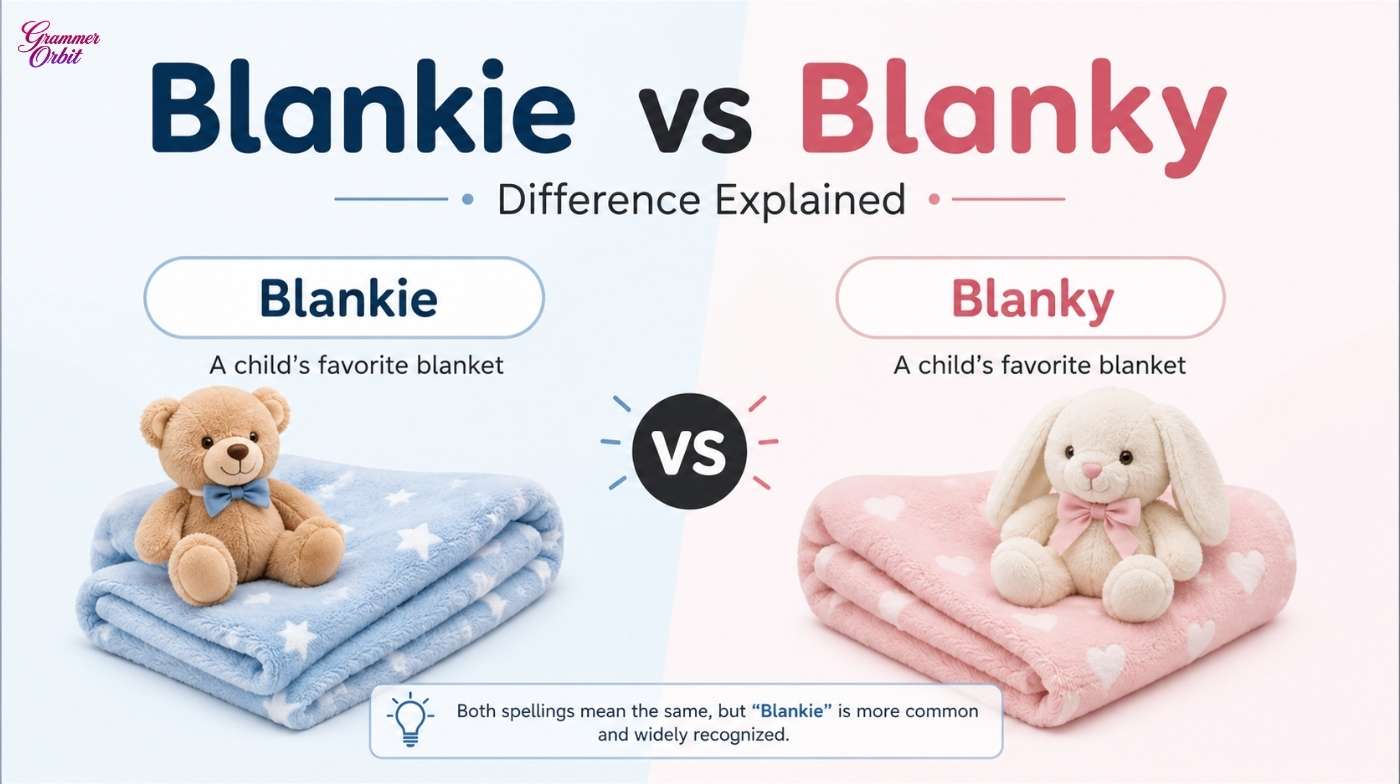
Have you ever seen the words Blankie vs Blanky and wondered if one is wrong? You’re not alone. Parents, writers, teachers, and English learners often encounter both spellings online, creating confusion about which one is correct.
The good news is that both spellings refer to the same thing a favorite blanket, usually loved by babies and young children. However, one spelling is significantly more common in dictionaries, books, and everyday English.
In this guide, you’ll learn the difference between Blankie vs Blanky, when to use each spelling, real-world examples, and why understanding the distinction can improve your writing.
What Is the Difference Between Blankie and Blanky?
The difference between Blankie and Blanky is mainly spelling rather than meaning.
| Feature | Blankie | Blanky |
|---|---|---|
| Meaning | A child’s favorite blanket | Same meaning |
| Dictionary Recognition | Widely recognized | Less common |
| Common Usage | Very common | Occasionally used |
| Preferred in Writing | Yes | Mostly informal or personal preference |
What Is a Blankie?
A blankie is an affectionate nickname for a blanket, especially one that provides comfort to babies or toddlers.
Examples:
- Emma refuses to sleep without her blankie.
- My nephew carries his blankie everywhere.
Because English often adds -ie to create affectionate words (dog → doggie, aunt → auntie), blankie feels natural and familiar.
What Is a Blanky?
Blanky has exactly the same meaning but is simply an alternative spelling.
Examples:
- The child hugged his blanky tightly.
- She packed her daughter’s favorite blanky for vacation.
Although understandable, blanky appears less frequently in books, dictionaries, and professional writing.
Why Is Blankie More Common?
Several factors explain why blankie has become the preferred spelling.
It Matches English Word Formation
Many affectionate English words end in -ie:
See also Really vs Realy: Which Is Correct? And Proper Usage
- Doggie
- Birdie
- Sweetie
- Auntie
- Blankie
This pattern makes blankie look more familiar to readers.
Dictionaries Prefer Blankie
Major English dictionaries commonly list blankie as the primary spelling, while blanky is often absent or considered a variant.
Publishing Standards
Children’s books, parenting blogs, childcare resources, and educational materials overwhelmingly use blankie, making it the standard choice.
Blankie vs Blanky in Everyday English
Both spellings may appear in casual conversation.
Parents
Parents often use whichever spelling feels natural.
Example:
“Don’t forget your blankie before bedtime.”
Children’s Books
Most children’s authors prefer blankie because it aligns with dictionary usage.
Social Media
On platforms like Instagram, Facebook, and TikTok, you’ll find both spellings. Personal preference often determines which one people use.
Real-Life Example: Choosing the Right Spelling for a Parenting Blog
A parenting blogger wanted to write an article about helping toddlers sleep better. Initially, the article repeatedly used blanky because that was the spelling commonly used within the blogger’s family. Before publishing, the editor reviewed the content and noticed that most parenting websites, dictionaries, and children’s resources consistently used blankie instead.
The editor researched search behavior using SEO tools and discovered that “blankie” received considerably more searches than “blanky.” The article was updated by replacing most instances of blanky with blankie, while briefly mentioning that blanky is an alternative spelling some families still prefer.
See also Excited vs Exited: Learn The Difference And Correct Usage
After the update, the article became easier for readers to find because it matched the language people were actually searching for online. Readers also found the spelling more familiar, resulting in better engagement and fewer questions about whether the word was spelled correctly. This example shows that using the commonly accepted spelling can improve both readability and search visibility without changing the meaning.
Usage Statistics and Language Trends (2025–2026)
Recent language trends continue to favor blankie over blanky.
Some notable observations include:
- Parenting websites overwhelmingly use blankie.
- Children’s books commonly prefer blankie.
- Educational websites typically recommend blankie.
- Search engines display substantially more results for blankie than blanky.
- Online dictionaries consistently recognize blankie as the standard spelling.
These trends suggest that writers aiming for clarity and SEO performance should generally choose blankie while acknowledging blanky as an acceptable informal variant.
How to Choose the Correct Spelling
Use Blankie When:
- Writing blog posts
- Creating educational content
- Publishing books
- Writing professionally
- Optimizing for search engines
Use Blanky When:
- Quoting someone’s personal wording
- Writing dialogue
- Preserving a family nickname
- Reflecting a specific character’s speech
Common Mistakes to Avoid
Assuming Blanky Is Incorrect
It isn’t incorrect it is simply less common.
Mixing Spellings
Avoid switching between blankie and blanky within the same article unless discussing their differences.
Ignoring Audience Expectations
See also Dysregulated vs Disregulated: Correct Usage Explained
If your audience expects standard English, blankie is usually the better choice.
FAQs
Q1: Is Blankie the correct spelling?
A: Yes. Blankie is generally considered the standard and most widely recognized spelling.
Q2: Is Blanky a real word?
A: Yes. Blanky is an accepted informal variant, although it is much less common.
Q3: Do Blankie and Blanky mean different things?
A: No. Both refer to a comforting blanket, usually belonging to a young child.
Q4: Which spelling is better for SEO?
A: Blankie is generally the stronger choice because it aligns with common search behavior and published usage.
Q5: Can I use Blanky in fiction?
A: Absolutely. Fiction often reflects natural speech, so blanky may suit a character’s dialogue or family traditions.
Q6: Why do some families spell it Blanky?
A: Many families simply adopt the spelling that feels natural to them. Since it’s a nickname, personal preference plays a significant role.
Conclusion
When comparing Blankie vs Blanky, the meaning remains the same, but the spelling differs. Blankie is the preferred and more widely recognized version, making it the best choice for articles, educational materials, books, and SEO-focused content. Blanky, on the other hand, is an informal alternative that some families and writers continue to use.
If your goal is clear communication, professional writing, and better search visibility, blankie is the spelling to choose. Understanding this small difference helps ensure your writing looks polished, consistent, and reader-friendly.
👉 Discover more simple and practical grammar guides on Grammer Orbit

Zia Ahmad is a professional blogger specializing in grammar tips and spelling accuracy. He creates clear, practical content that helps readers eliminate errors, strengthen writing skills, and communicate effectively for students, professionals, and everyday writers worldwide.