
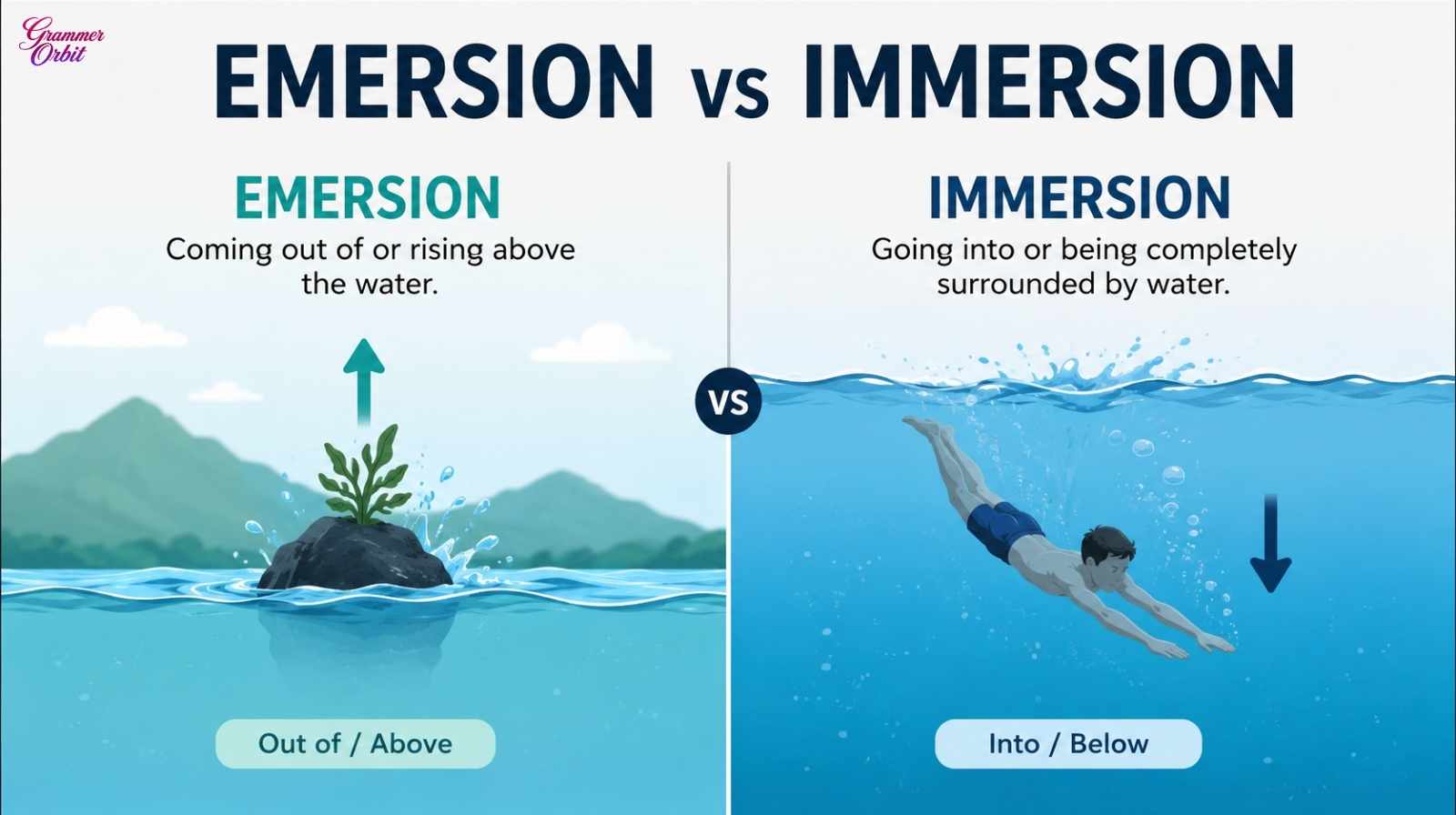
Have you ever seen the words emersion vs immersion and wondered if they mean the same thing? At first glance, they look almost identical, but they describe two completely opposite actions. Because they are uncommon in everyday writing, many English learners and even native speakers mix them up.
Understanding the difference between emersion vs immersion is important whether you’re reading scientific articles, discussing language learning, talking about virtual reality, or simply trying to improve your English vocabulary. In this guide, you’ll discover what each word means, when to use it, common mistakes to avoid, and practical examples that make the difference easy to remember.
What Is the Difference Between Emersion and Immersion?
The simplest way to understand these words is to remember the direction of movement.
| Term | Meaning | Direction |
|---|---|---|
| Immersion | The act of going into or being surrounded by something | Into |
| Emersion | The act of coming out of or rising above something | Out of |
Think of a swimmer entering a pool.
- The moment they dive into the water is immersion.
- The moment they rise back above the surface is emersion.
Although both words come from Latin and are related, they describe opposite processes.
See also Really vs Realy: Which Is Correct? And Proper Usage
Understanding Immersion
Definition
Immersion means placing something completely into a liquid or becoming deeply involved in an activity or environment.
It is by far the more common of the two words.
Common Uses of Immersion
Language Learning
Many people learn a language through language immersion, where they communicate only in the target language.
Example:
She became fluent after six months of language immersion in Spain.
Science
Scientists may immerse samples in water or chemicals during experiments.
Example:
The metal was tested after complete immersion in salt water.
Technology
Virtual Reality (VR) creates an immersive experience that makes users feel present inside a digital world.
Example:
The headset provides complete immersion in the virtual environment.
Understanding Emersion
Definition
Emersion refers to emerging from water or another covering substance. It is commonly used in biology, marine science, and geology.
Unlike immersion, it rarely appears in everyday conversation.
Common Uses of Emersion
Marine Biology
Some sea plants and animals experience periods of emersion during low tide.
Example:
The oysters survived several hours of emersion before the tide returned.
Botany
Wetland plants may experience daily cycles of immersion and emersion.
Geology
Certain coastal rock formations become visible during emersion.
Emersion vs Immersion: Side-by-Side Comparison
| Feature | Emersion | Immersion |
|---|---|---|
| Meaning | Coming out | Going into |
| Usage Frequency | Rare | Very Common |
| Fields | Biology, Marine Science, Ecology | Education, Technology, Science, Daily English |
| Direction | Upward/Outward | Downward/Inward |
| Everyday Use | Uncommon | Very Common |
When Should You Use Each Word?
Use Immersion When:
- Talking about learning a language
- Referring to diving into water
- Describing VR experiences
- Explaining complete involvement
- Discussing scientific experiments
Examples:
See also Dysregulated vs Disregulated: Correct Usage Explained
- The students benefited from total language immersion.
- Complete immersion improved the cleaning process.
- The documentary created emotional immersion.
Use Emersion When:
- Discussing tides
- Talking about marine organisms
- Explaining ecological conditions
- Describing something rising above water
Examples:
- Coral experiences regular emersion during low tide.
- The turtle’s emersion marked the beginning of nesting season.
Real-Life Example: Why Choosing the Correct Word Matters
Imagine two university students preparing presentations for different subjects.
Sarah is studying education and writes about language immersion programs. She explains how students become fluent faster by surrounding themselves with native speakers, listening to everyday conversations, and using the language throughout the day. Her use of immersion is correct because she is describing deep involvement in a learning environment.
Meanwhile, David is studying marine biology. His research focuses on tidal ecosystems where shellfish spend several hours exposed to air before seawater returns. He correctly describes this process as emersion, since the organisms temporarily emerge above the water during low tide.
If Sarah accidentally wrote “language emersion,” her presentation would sound incorrect because English speakers associate emersion with emerging from water rather than entering an environment. Likewise, if David described oysters experiencing “immersion” during low tide, he would be stating the opposite of what actually happens.
This example shows why understanding these similar-looking words improves both clarity and accuracy.
Data and Usage Trends (2025–2026)
Language databases and digital publishing trends continue to show a significant difference in how often these words appear.
- Immersion remains thousands of times more common in books, education, technology, healthcare, and online content.
- The growing popularity of virtual reality, AI learning tools, and online language education has increased searches for terms like immersive learning and language immersion.
- Emersion continues to appear mainly in scientific journals related to marine biology, ecology, environmental science, and geology.
- Google search trends consistently indicate that most users searching “emersion vs immersion” are trying to determine which word fits their sentence correctly rather than looking for scientific definitions.
Common Mistakes to Avoid
Confusing the Direction
Remember:
- Immersion = Into
- Emersion = Out of
Using Emersion in Everyday English
Unless you’re discussing science or marine environments, immersion is almost always the correct choice.
See also Anyway vs Anyways: The Real Difference Explained
Assuming They’re Interchangeable
Although they share similar spelling and Latin origins, they describe opposite actions.
Tips to Remember the Difference
Think of the Prefixes
- Im- → In
- E- → Exit
Visualize a Swimmer
- Diving into the pool = Immersion
- Coming back above the surface = Emersion
Remember Everyday Usage
If you’re talking about learning, technology, books, movies, or experiences, you almost certainly need immersion.
FAQs
Q1: Is emersion a real English word?
A: Yes. Emersion is a legitimate English word, but it is mainly used in scientific and environmental contexts.
Q2: Which word is more common?
A: Immersion is far more common in modern English and appears in education, technology, healthcare, and everyday communication.
Q3: Can emersion replace immersion?
A: No. They describe opposite actions and cannot be used interchangeably.
Q4: What is language immersion?
A: Language immersion is a teaching method where learners are surrounded by the target language through speaking, listening, reading, and daily interaction.
Q5: What does emersion mean in biology?
A: In biology, emersion refers to aquatic organisms or plants becoming exposed above the water surface, often during low tide.
Q6: Is immersion only used for water?
A: No. Besides physical immersion in liquids, it also refers to deep involvement in learning, gaming, reading, virtual reality, and other experiences.
Conclusion
Understanding emersion vs immersion becomes much easier once you remember their opposite meanings. Immersion refers to going into or becoming deeply involved in something, while emersion means coming out of or rising above it. Since immersion is widely used in education, technology, and everyday English, you’ll encounter it much more often. Emersion, on the other hand, is primarily found in scientific fields like marine biology and ecology.
Whenever you’re unsure, simply remember: into equals immersion, out of equals emersion. Keeping this simple rule in mind will help you choose the correct word confidently in both writing and conversation.
👉 Discover more simple and practical grammar guides on Grammer Orbit

Zia Ahmad is a professional blogger specializing in grammar tips and spelling accuracy. He creates clear, practical content that helps readers eliminate errors, strengthen writing skills, and communicate effectively for students, professionals, and everyday writers worldwide.