
Have you ever wondered whether you should use quantify vs qualify in a sentence? Although these two words look and sound somewhat similar, they have completely different meanings. Mixing them up can change the meaning of your writing, especially in academic, business, research, and everyday communication.
The good news is that understanding the difference isn’t difficult. Once you know what each word means and when to use it, you’ll never confuse them again.
In this guide, you’ll learn the meaning of quantify vs qualify, their key differences, examples, common mistakes, grammar tips, and practical ways to remember which word fits your sentence.
See also Accross vs Across: Which Is The Correct Spelling?
What Does Quantify Mean?
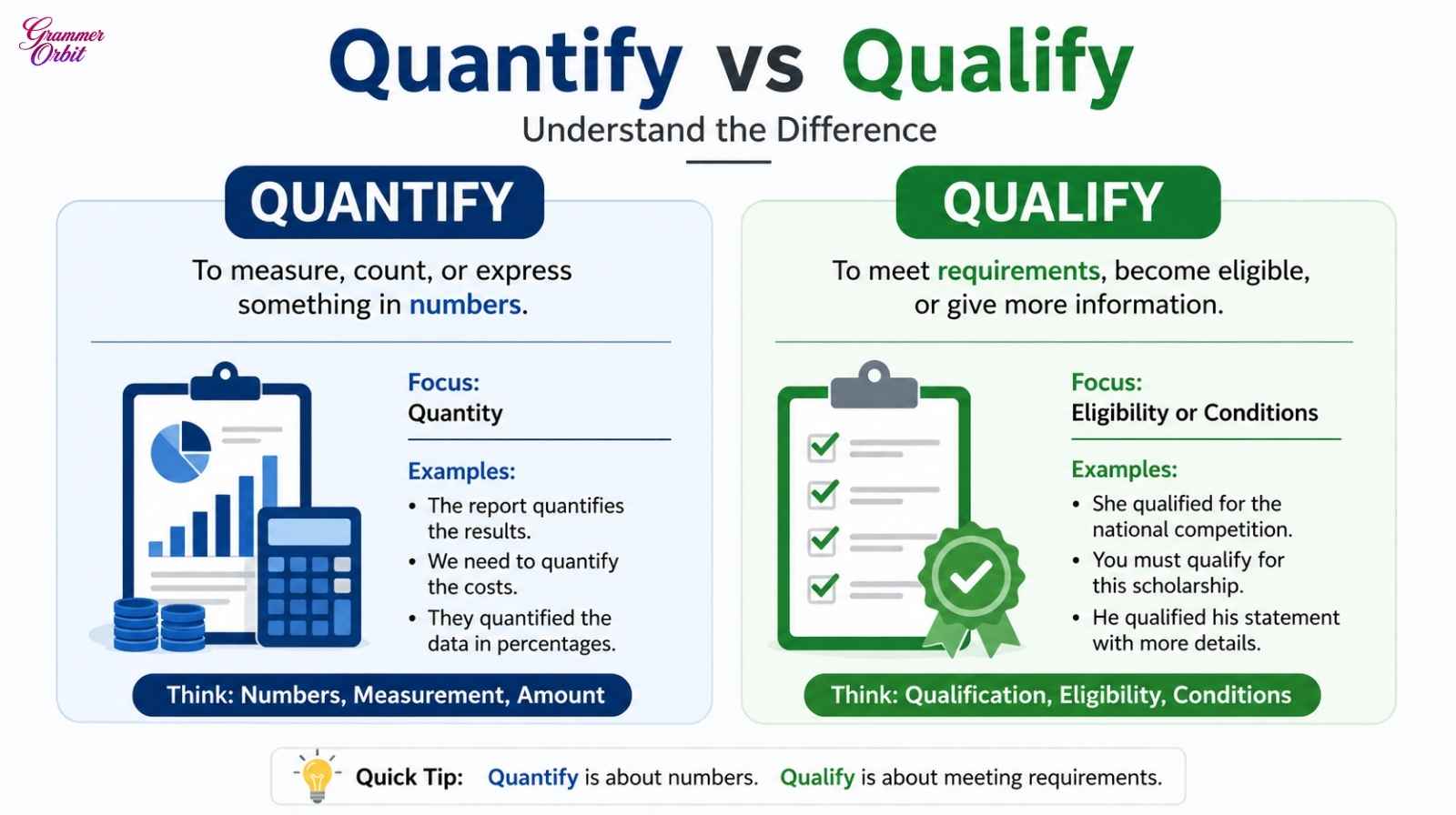
The verb quantify means to measure, count, or express something as a number or amount.
Whenever you are dealing with statistics, percentages, measurements, totals, or numerical data, you are usually quantifying something.
Quantify Definition
Quantify means to determine or express the quantity of something.
Examples of Quantify
- Researchers quantified the results of the survey.
- The company quantified its annual sales growth.
- Scientists quantified pollution levels in the river.
- It’s difficult to quantify happiness.
- We need to quantify the risks before making a decision.
Notice that each example involves measuring or expressing something numerically.
Common Situations Where “Quantify” Is Used
- Scientific research
- Data analysis
- Business reports
- Financial statements
- Statistics
- Surveys
- Performance measurement
What Does Qualify Mean?
The verb qualify has several meanings, but the most common are:
- to become eligible
- to meet certain requirements
- to describe or limit a statement
- to gain the necessary skills or credentials
Unlike quantify, qualify usually has nothing to do with numbers.
Qualify Definition
Qualify means to meet conditions, become eligible, or modify the meaning of something.
Examples of Qualify
- She qualified for the national championship.
- You must qualify before applying.
- He qualified his statement by adding more details.
- The experience helped her qualify for promotion.
- Only registered members qualify for the discount
Quantify vs Qualify: What’s the Difference?
Although only one letter separates these words, their meanings are completely different.
| Feature | Quantify | Qualify |
|---|---|---|
| Meaning | Measure in numbers | Meet conditions or modify |
| Focus | Quantity | Eligibility or description |
| Related to | Numbers, statistics, measurement | Requirements, skills, conditions |
| Common Fields | Science, research, business | Education, careers, sports, grammar |
| Question Answered | “How much?” | “Who can?” or “Under what conditions?” |
Quick Memory Trick
- Quantify → Quantity → Numbers
- Qualify → Qualification → Eligibility
Remembering these word associations makes it much easier to choose the correct verb.
Quantify vs Qualify in Different Contexts
In Business
Businesses quantify profits, expenses, customer growth, and market trends.
Employees qualify for promotions, bonuses, or special training.
In Research
Researchers quantify data collected during experiments.
Participants qualify for studies if they meet specific requirements.
In Education
Teachers quantify test scores.
Students qualify for scholarships based on grades or achievements.
In Everyday English
You might quantify how much money you spent.
You qualify for a reward after collecting enough points.
See also Commit vs Comit: Correct Spelling, Meaning & Usage Explained
Real-Life Example: Why Mixing Up These Words Can Cause Confusion
Imagine a company preparing its annual performance report for investors. The finance team is responsible for presenting measurable results, such as revenue growth, customer acquisition, and operating expenses. Their manager asks them to quantify the company’s progress by including exact percentages, dollar amounts, and year-over-year comparisons. These numbers help investors understand the company’s financial performance objectively.
At the same time, the human resources department is reviewing applications for a leadership development program. Employees must meet specific experience and performance requirements before joining. HR evaluates each candidate to determine whether they qualify for the program based on company policies, not numerical measurements alone.
If someone mistakenly tells the finance team to “qualify the company’s revenue” instead of “quantify the company’s revenue,” the instruction becomes confusing because revenue should be measured with numbers, not evaluated for eligibility. Likewise, asking HR to “quantify employees for promotion” would sound incorrect because promotions depend on qualifications and requirements rather than numerical measurement alone.
This example shows that understanding the distinction between quantify and qualify improves clarity, prevents misunderstandings, and helps professionals communicate more accurately.
Quantify vs Qualify: Common Mistakes
Mistake 1
❌ We need to qualify the sales figures.
✅ We need to quantify the sales figures.
Mistake 2
❌ She quantified for the finals.
✅ She qualified for the finals.
Mistake 3
❌ The survey qualified customer satisfaction.
✅ The survey quantified customer satisfaction.
Mistake 4
❌ You must quantify before entering the competition.
✅ You must qualify before entering the competition.
Data and Language Usage (2025–2026)
Language experts continue to emphasize the importance of choosing precise vocabulary in professional communication. According to recent guidance from major writing resources such as Merriam-Webster, Cambridge Dictionary, and Oxford Learner’s Dictionaries, quantify consistently refers to measuring or expressing something numerically, while qualify relates to eligibility, requirements, credentials, or limiting a statement.
In addition, workplace communication surveys published in recent years show that clear and accurate word choice improves collaboration and reduces misunderstandings in business and technical writing. As organizations increasingly rely on data-driven reporting and precise documentation, distinguishing between terms like quantify and qualify has become even more important.
How to Remember Quantify vs Qualify

Think of the Letter “N”
QuaNtify
The letter N reminds you of Numbers.
If numbers are involved, choose quantify.
See also Vinal vs Vinyl: Which Is The Correct One To Use?
Think of Qualifications
Qualify
The word starts the same way as qualification.
If someone meets requirements or becomes eligible, choose qualify.
Ask Yourself One Question
- Am I talking about numbers? → Quantify
- Am I talking about eligibility or requirements? → Qualify
This simple question solves most confusion instantly.
FAQs
Q1: Is quantify the same as qualify?
A: No. Quantify means to measure or express something numerically, while qualify means to meet requirements, become eligible, or modify a statement.
Q2: Can quantify refer to people?
A: Usually no. You quantify data, amounts, costs, or measurements not people.
Q3: When should I use qualify?
A: Use qualify when talking about eligibility, requirements, credentials, competitions, or limiting statements.
Q4: Is “quantify the results” correct?
A: Yes. Results can be measured using numbers, percentages, or statistics.
Q5: What is an easy way to remember the difference?
A: Remember:
- Quantity = Quantify
- Qualification = Qualify
Q6: Can a sentence contain both words?
A: Yes.
Example: Researchers quantified the data to determine which participants qualified for the next stage of the study.
Conclusion
Understanding the difference between quantify vs qualify is easier than it first appears. Quantify focuses on numbers, measurements, and data, while qualify focuses on eligibility, requirements, credentials, or limiting a statement. Although the words are similar in spelling, they serve very different purposes in English.
The easiest way to remember them is this: if you’re measuring how much, use quantify. If you’re deciding who meets the requirements or modifying a statement, use qualify. Mastering this distinction will make your writing clearer, more professional, and more accurate in academic, business, and everyday situations.
👉 Discover more simple and practical grammar guides on Grammer Orbit

Zia Ahmad is a professional blogger specializing in grammar tips and spelling accuracy. He creates clear, practical content that helps readers eliminate errors, strengthen writing skills, and communicate effectively for students, professionals, and everyday writers worldwide.