
Have you ever paused while writing and wondered whether to use “whether” or “whether or not”? Many English learners and even native speakers struggle with this common grammar choice.
Although both expressions are often used interchangeably, they do not always serve the same purpose. Using the wrong form can make a sentence sound awkward, repetitive, or less professional.
In this guide, you’ll learn the difference between whether and whether or not, discover when each is appropriate, see real-world examples, and gain practical tips to improve your writing confidence.
What Is the Difference Between “Whether” and “Whether or Not”?
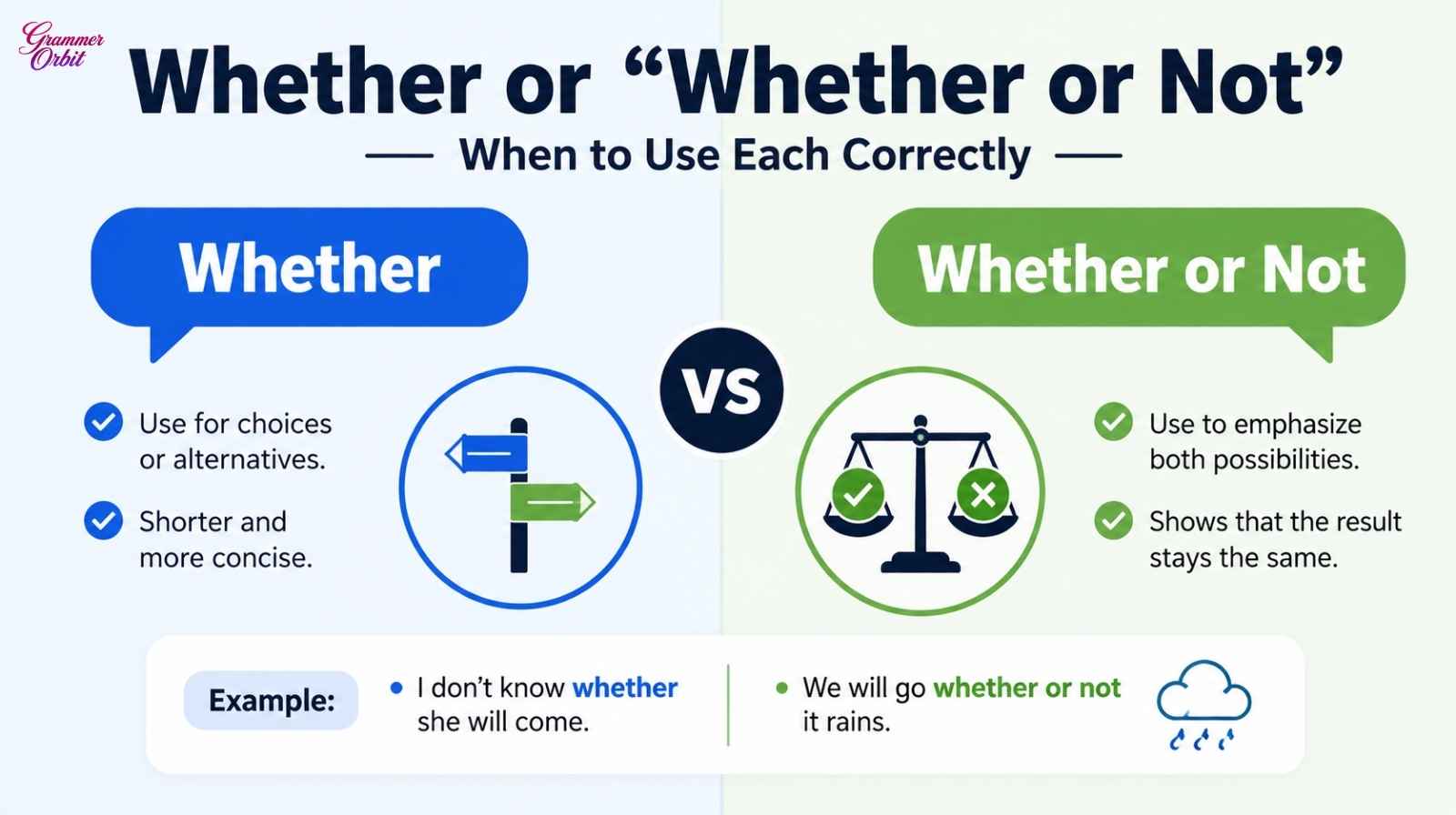
The primary difference is that whether already implies a choice between alternatives, while whether or not emphasizes that both possibilities are being considered.
Understanding “Whether”
The word whether introduces alternatives or possibilities.
Examples:
- I don’t know whether she will attend the meeting.
- We are deciding whether to move abroad.
- Please tell me whether the package arrived.
In these sentences, the alternative option is understood without being explicitly stated.
See also Consistent or Consistant: Which Spelling Is Correct?
Understanding “Whether or Not”
The phrase whether or not explicitly highlights both outcomes.
Examples:
- The event will happen whether or not it rains.
- She plans to apply whether or not she receives encouragement.
- We must finish the project whether or not additional funding arrives.
Here, both possibilities are intentionally emphasized.
Quick Rule
In many cases, whether alone is sufficient. Use whether or not when you want to stress that either outcome will not change the result.
When Should You Use “Whether”?
Use whether when introducing uncertainty, alternatives, or indirect questions.
Indirect Questions
Indirect questions frequently use whether.
Examples:
- He asked whether I was available.
- They wondered whether the store was open.
- She couldn’t decide whether to accept the offer.
Formal Writing
In academic and professional writing, whether often sounds cleaner and more concise.
Example:
- Researchers examined whether sleep quality affects productivity.
When “Or Not” Is Unnecessary
Many writers add “or not” even when it contributes nothing to the meaning.
Wordy:
- I don’t know whether or not he is coming.
Better:
- I don’t know whether he is coming.
When Should You Use “Whether or Not”?
There are situations where whether or not is the better choice.
To Emphasize Both Possibilities
Sometimes you want to clearly mention that both outcomes are included.
Examples:
- Whether or not you agree, the policy will take effect.
- The course remains valuable whether or not you earn certification.
Before an Independent Clause
The phrase is often used when the second possibility needs explicit emphasis.
Example:
- Whether or not the shipment arrives today, we will continue production.
To Remove Ambiguity
In certain contexts, adding or not improves clarity.
See also Function vs Functionality: What’s The Difference?
Example:
- The committee must decide whether or not to proceed immediately.
Whether vs Whether or Not: Comparison Table
| Situation | Whether | Whether or Not |
|---|---|---|
| Indirect questions | ✅ Preferred | Sometimes acceptable |
| Formal writing | ✅ Concise | Usually unnecessary |
| Emphasizing both outcomes | ⚠️ Less emphasis | ✅ Best choice |
| Fixed-result statements | ⚠️ Possible | ✅ Recommended |
| Avoiding wordiness | ✅ Better | ❌ Can be redundant |
Featured Snippet Answer
Use “whether” when simply presenting alternatives or uncertainty. Use “whether or not” when you want to emphasize that both possible outcomes are included or when clarity requires it.
Real-Life Writing Example: How a Business Improved Its Website Copy
A content marketing agency was reviewing the customer support section of an e-commerce website. The original copy repeatedly used phrases such as:
“Customers can contact support whether or not they have a technical issue.”
“You may submit feedback whether or not you purchased a product.”
While grammatically correct, the constant use of whether or not made the content feel repetitive and unnecessarily long. The editing team analyzed each sentence individually.
For situations where both outcomes truly mattered, they kept the phrase. For example:
“Returns are accepted whether or not the item has been opened.”
However, in sentences where no emphasis was needed, they simplified the wording:
“Customers can contact support whether they have a technical issue.”
After revising dozens of pages, the company reported improved readability scores and a smoother user experience. More importantly, visitors spent more time engaging with help-center content because the writing became easier to scan.
This example demonstrates a key lesson: choosing between whether and whether or not is not merely a grammar issue. It directly affects clarity, readability, and user engagement.
Grammar Trends and Writing Data (2025–2026)
Language analysis tools continue to emphasize concise writing as a best practice.
According to guidance from professional writing platforms and style experts, unnecessary words reduce readability and can weaken content quality. Modern SEO-focused writing increasingly favors concise sentence structures that improve user experience and content comprehension.
In 2025–2026, readability remains a major ranking and engagement factor. Studies from major content marketing platforms show that readers prefer clear, direct language over wordy constructions. Therefore, writers are encouraged to use whether instead of whether or not unless additional emphasis is genuinely needed.
Why This Matters for SEO
See also Courtesy vs Curtesy: Meaning, Usage And Common Mistakes
- Improves readability
- Reduces unnecessary wording
- Enhances user experience
- Helps readers find answers faster
- Supports clear and authoritative content
Common Mistakes Writers Make
Using “If” Instead of “Whether”
Many writers incorrectly substitute if for whether.
Incorrect:
- I don’t know if she prefers tea or coffee.
Better:
- I don’t know whether she prefers tea or coffee.
Adding “Or Not” Unnecessarily
Wordy:
- We need to know whether or not the report is finished.
Concise:
- We need to know whether the report is finished.
Ignoring Context
The correct choice often depends on emphasis and meaning rather than strict grammar rules.
How to Decide Which One to Use
Step 1: Ask Yourself What You Mean
Are you simply expressing uncertainty?
Use whether.
Step 2: Check for Emphasis
Do you want to stress that both outcomes are included?
Use whether or not.
Step 3: Remove Extra Words
Try deleting “or not.”
If the sentence still works perfectly, whether is usually enough.
Step 4: Read It Aloud
The more natural option is often the correct choice.
FAQs
Q1: Is “whether or not” grammatically correct?
A: Yes. It is completely grammatically correct when used to emphasize both possible outcomes or improve clarity.
Q2: Can I always replace “whether or not” with “whether”?
A: Not always. In many cases you can, but some sentences lose emphasis or clarity without “or not.“
Q3: Which is more formal: “whether” or “whether or not”?
A: Both are formal, but whether is usually more concise and preferred in professional writing.
Q4: Is “whether or not” redundant?
A: Sometimes. If “or not” adds no meaning, it may be unnecessary.
Q5: Should I use “if” or “whether”?
A: Use whether when presenting alternatives. Use if mainly for conditional situations.
Q6: Why do style guides prefer “whether”?
A: Because it often creates shorter, clearer, and more readable sentences.
Conclusion
Understanding whether versus whether or not can significantly improve your writing clarity. In most situations, whether is sufficient because it already implies alternatives. However, whether or not is useful when you want to emphasize that both outcomes are being considered.
The next time you write, review your sentence carefully. If removing “or not” does not change the meaning, choose the simpler option. Clear, concise writing is easier for readers to understand and more effective in professional, academic, and online content.
Want to improve your grammar and writing skills further? Bookmark this guide and use it as a quick reference whenever you’re unsure whether to use “whether” or “whether or not.”
👉 Discover more simple and practical grammar guides on Grammer Orbit

Zia Ahmad is a professional blogger specializing in grammar tips and spelling accuracy. He creates clear, practical content that helps readers eliminate errors, strengthen writing skills, and communicate effectively for students, professionals, and everyday writers worldwide.