
Have you ever wondered whether you should write nonresponsive vs unresponsive? At first glance, these two words seem interchangeable because they both describe someone or something that does not respond. However, they are not always used in the same situations.
Choosing the wrong word can confuse readers, especially in medical, business, customer service, and technology contexts. Understanding the subtle difference helps you communicate more clearly and professionally.
In this guide, you’ll learn the meaning of each word, how they’re different, when to use them, and common mistakes to avoid.
Nonresponsive vs Unresponsive: Quick Answer
If you’re looking for the short answer, here it is.
| Word | Meaning | Common Use |
|---|---|---|
| Nonresponsive | Not responding to a specific treatment, stimulus, request, or condition. | Medical, scientific, technical, business |
| Unresponsive | Unable or unwilling to respond. | Everyday English, medicine, customer service, technology |
Quick rule:
- Unresponsive is more common in everyday English.
- Nonresponsive is usually preferred in technical or professional writing.
What Does “Nonresponsive” Mean?
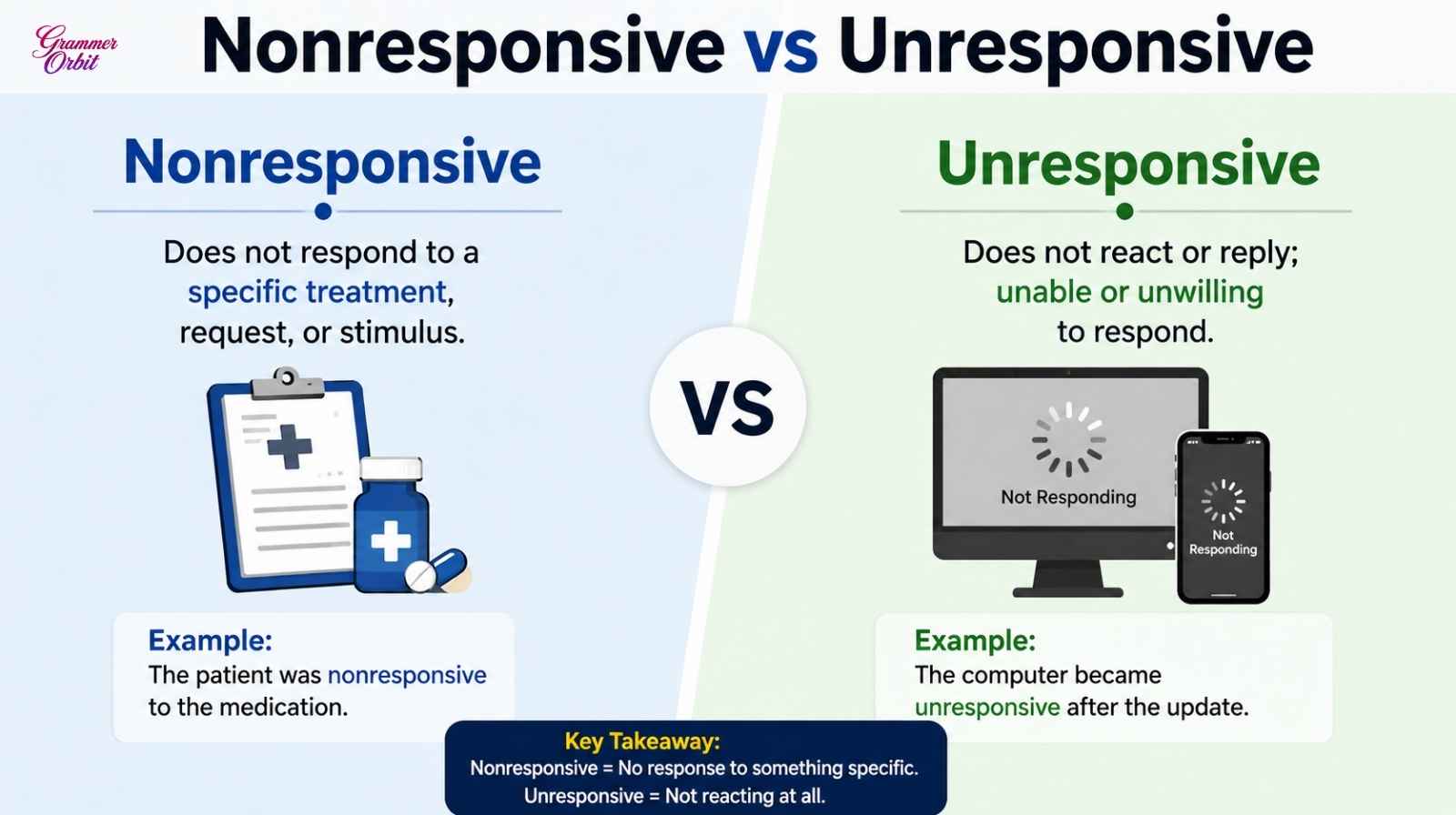
The adjective nonresponsive describes a person, system, or object that fails to respond to a particular action or stimulus.
It often suggests that a response was expected but did not happen.
Common Uses
A patient may be nonresponsive to treatment, meaning the medication is not working.
Example
The patient remained nonresponsive to the new therapy.
See also Leafs or Leaves: Which Is The Correct Plural Form?
Business
A customer may be nonresponsive after several follow-up emails.
Example
The client became nonresponsive after receiving the proposal.
Technology
Software may become nonresponsive after an error.
Example
The application became nonresponsive during installation.
What Does “Unresponsive” Mean?
The word unresponsive refers to someone or something that does not react or reply.
Unlike nonresponsive, it often describes a person’s overall condition rather than a response to one specific event.
Everyday Examples
- She was completely unresponsive during the meeting.
- My phone became unresponsive after the update.
- The child was unresponsive when the doctor examined him.
Because of its broader meaning, unresponsive is much more common in everyday conversation.
Nonresponsive vs Unresponsive: Key Differences
Scope of Meaning
Nonresponsive usually focuses on a failure to respond to something specific.
Example:
The patient was nonresponsive to antibiotics.
Unresponsive usually means not reacting at all.
Example:
The patient was unresponsive when emergency workers arrived.
Tone
Nonresponsive
- Technical
- Professional
- Clinical
- Scientific
Unresponsive
- General English
- Everyday speech
- News writing
- Medical emergencies
Grammar
Both words are adjectives.
Examples:
✔ The server became unresponsive.
✔ The software is nonresponsive.
See also Soo vs So: What’s the Difference and Which One Is Correct?
Real-Life Example: Choosing the Right Word
Imagine a customer support team handling two different situations.
Sarah, a customer service manager at an online software company, notices that one client has ignored every follow-up email for three weeks. In the company’s CRM notes, she writes, “The client has been nonresponsive despite multiple contact attempts.” This wording is accurate because it refers to the client’s lack of response to specific communications.
Later that day, another customer calls to report that the company’s mobile app has frozen. The screen won’t react to taps or swipes. The support technician explains, “Your app has become unresponsive. Please restart your device.” In this case, unresponsive is the better choice because it describes the app’s current inability to react.
These examples show why context matters. While both words relate to a lack of response, nonresponsive usually points to a missing response in a particular situation, whereas unresponsive describes a broader inability or failure to react.
Nonresponsive vs Unresponsive in Different Contexts
Medical Writing
Healthcare professionals often use both words, but their meanings differ slightly.
- Nonresponsive to treatment → The treatment isn’t working.
- Unresponsive patient → The patient is not conscious or reacting.
Business Communication
Use nonresponsive when discussing emails, proposals, or negotiations.
Example:
The vendor remained nonresponsive after several reminders.
Technology
Both words appear in software documentation.
Examples:
- The application became unresponsive.
- The interface remained nonresponsive after the update.
However, unresponsive is generally more common in user-facing messages.
Data & Usage Trends (2025–2026)
Recent language usage patterns from major English dictionaries and digital writing platforms show that unresponsive remains significantly more common in general English, journalism, healthcare communication, and technology support. Meanwhile, nonresponsive appears more frequently in clinical research papers, scientific publications, legal documents, and formal business communication.
Grammar and editing tools also tend to recommend unresponsive for everyday writing because it is more familiar to readers, while nonresponsive is often retained in specialized contexts where precision matters. This distinction helps writers match their vocabulary to the intended audience and improve clarity.

How to Choose the Correct Word
Ask Yourself These Questions
Use unresponsive.
Is it technical or medical writing?
Use nonresponsive when referring to a specific treatment, request, or stimulus.
Are you describing a person’s physical condition?
Use unresponsive.
See also Oversight vs Oversite: What’s the Real Difference?
Are you describing someone’s failure to reply?
Usually nonresponsive fits better.
Common Mistakes to Avoid
❌ Saying “The patient was nonresponsive” when describing unconsciousness.
✅ Better:
“The patient was unresponsive.”
❌ Using “unresponsive to treatment” in highly technical medical writing.
✅ Better:
“The patient was nonresponsive to treatment.”
❌ Assuming both words always mean exactly the same thing.
✅ Context determines the better choice.
FAQs
Q1: Is nonresponsive a real word?
A: Yes. It is a correct English adjective commonly used in medical, scientific, technical, and business writing.
Q2: Is unresponsive more common?
A: Yes. Unresponsive is much more common in everyday English and general communication.
Q3: Can both words describe software?
A: Yes. However, software error messages usually use unresponsive because it is easier for users to understand.
Q4: Which word should I use in business emails?
A: Use nonresponsive when referring to someone who has not replied to messages or requests.
Q5: Are nonresponsive and unresponsive synonyms?
A: They are close synonyms, but they are not always interchangeable because their preferred usage depends on the context.
Q6: Which word is better for medical emergencies?
A: Unresponsive is the standard choice when describing a patient who is unconscious or not reacting.
Conclusion
Although nonresponsive and unresponsive both describe a lack of response, they are used differently depending on the context. Unresponsive is the preferred choice in everyday English, emergency medicine, and technology because it describes someone or something that is not reacting at all. Nonresponsive, on the other hand, is more common in technical, scientific, medical, and business writing when referring to a failure to respond to a specific treatment, request, or stimulus.
When in doubt, think about the situation you’re describing. Choosing the correct word will make your writing clearer, more professional, and easier for your audience to understand.
👉 Discover more simple and practical grammar guides on Grammer Orbit

Zia Ahmad is a professional blogger specializing in grammar tips and spelling accuracy. He creates clear, practical content that helps readers eliminate errors, strengthen writing skills, and communicate effectively for students, professionals, and everyday writers worldwide.