
Have you ever wondered whether you should write in person vs in-person? You’re not alone. These two forms look almost identical, but using the wrong one can make your writing seem less polished.
The good news is that the difference is simple once you understand one basic grammar rule. In this guide, you’ll learn when to use in person, when in-person is correct, common mistakes to avoid, and plenty of real-world examples to help you remember the difference.
In Person vs In-Person: What’s the Difference?
The difference comes down to how the phrase is used in a sentence.
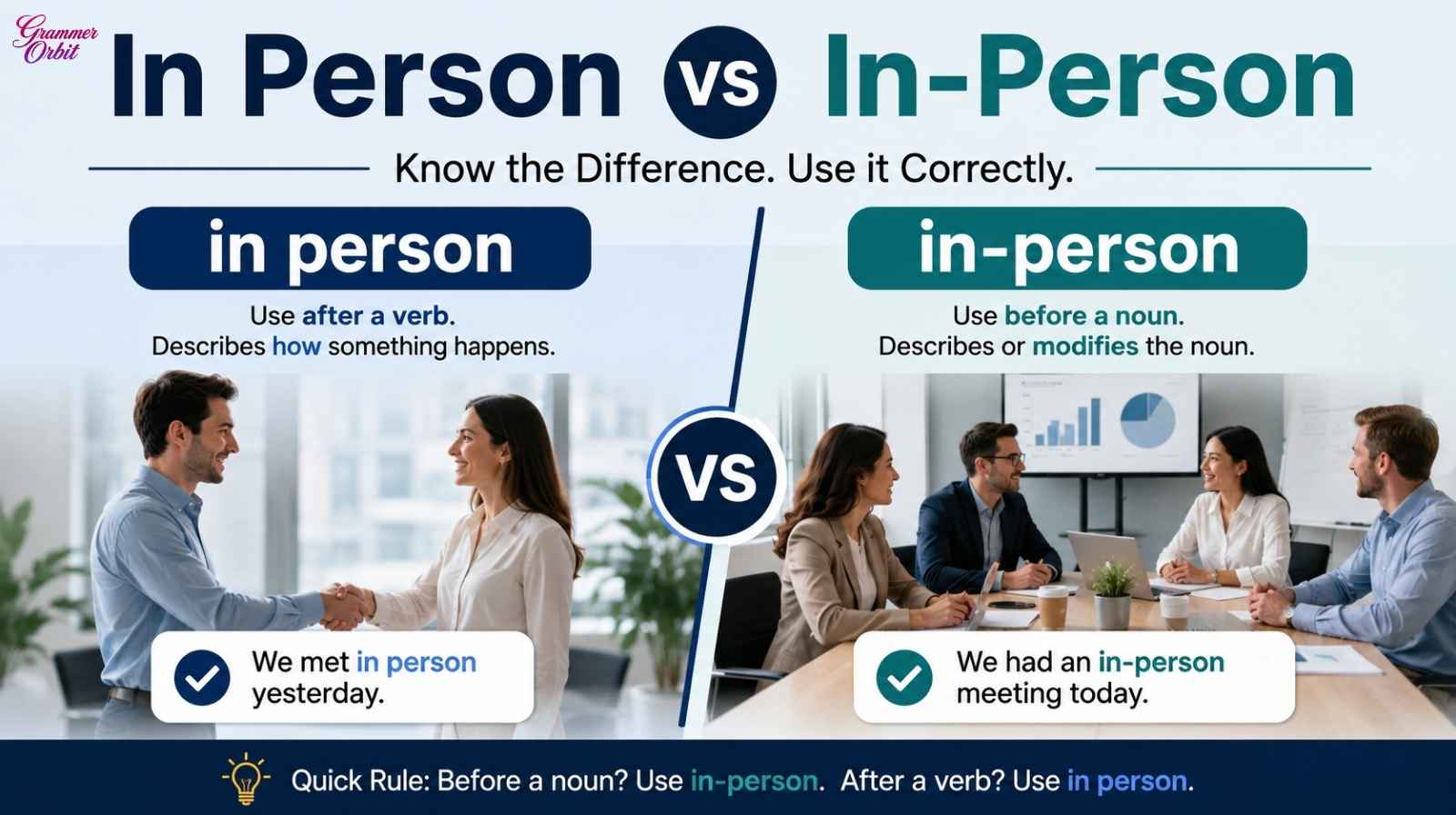
- In person is an adverbial phrase. It describes how something happens.
- In-person is a compound adjective. It describes a noun.
Quick Answer
| Correct Form | Use It When | Example |
|---|---|---|
| In person | After a verb | We met in person yesterday. |
| In-person | Before a noun | We had an in-person meeting today. |
A simple trick is to ask yourself:
Is it describing a noun?
- Yes → in-person
- No → in person
When to Use “In Person”
In person means physically present rather than online, by phone, or through someone else.
It Comes After the Verb
Examples:
- I finally met my online friend in person.
- The doctor prefers to see patients in person.
- We discussed the project in person.
- She apologized in person.
- You should verify your identity in person.
Why It Doesn’t Need a Hyphen
Because the phrase isn’t acting as an adjective. It’s simply explaining how something happened.
Think of phrases like:
- on time
- at home
- by hand
“In person” works the same way.
Examples in Everyday English
✔ We interviewed the candidate in person.
✔ The manager spoke to every employee in person.
✔ They celebrated together in person after months of video calls.
❌ We attended an in person meeting.
✔ We attended an in-person meeting
See also Maintained vs Maintenanced: What’s The Difference?
When to Use “In-Person”
Use in-person only when it comes directly before a noun.
Here, it functions as a compound adjective, so the hyphen connects the two words.
Examples
- an in-person interview
- an in-person conference
- an in-person class
- an in-person appointment
- an in-person consultation
More Sentences
The company scheduled an in-person training session.
The school offers in-person learning.
Our team held an in-person workshop.
The hospital requires an in-person examination.
The university resumed in-person classes.
Why the Hyphen Matters
Without the hyphen, readers may briefly pause because they expect “in” and “person” to function separately.
The hyphen signals that both words work together as one adjective.
Common Mistakes People Make
Many writers mix these forms because both are grammatically correct but only in the right context.
Mistake 1
❌ I attended an in person interview.
✔ I attended an in-person interview.
Mistake 2
❌ We met in-person yesterday.
✔ We met in person yesterday.
See also Unorganized vs Disorganized: Understanding The Key Differences
Mistake 3
❌ The company held the meeting in-person.
✔ The company held the meeting in person.
Easy Memory Trick
Before a noun?
→ Use the hyphen.
After a verb?
→ Leave the hyphen out.
In Person vs In-Person in American and British English
The rule is the same in both American and British English.
Examples:
American English
- in-person interview
- meet in person
British English
- in-person appointment
- speak in person
Major style guides and dictionaries follow this same pattern, making it the accepted standard across English varieties.
Real-Life Example: How One Company Improved Communication
During the rise of remote work, many organizations shifted to virtual meetings. A mid-sized marketing agency relied almost entirely on video calls for client communication. While convenient, the team noticed that important discussions often led to misunderstandings because participants missed body language and face-to-face interaction.
To address this, the agency introduced monthly in-person meetings for major project reviews while continuing routine updates online. Employees reported that these meetings improved collaboration, strengthened client relationships, and helped resolve complex issues more quickly. Clients also expressed greater confidence after meeting the team in person, saying it built trust that was difficult to establish through video calls alone.
This example highlights the grammar difference in a practical context. The company scheduled in-person meetings (adjective before the noun “meetings”), and team members met in person (adverbial phrase describing how they met). Using the correct form makes business writing clearer and more professional.
Data and Trends (2025–2026)
The preference for in-person interactions has continued to grow alongside hybrid work. Recent workplace surveys in 2025–2026 show that many organizations combine remote flexibility with scheduled face-to-face collaboration. Reports from workplace research firms indicate that hybrid employees often value in-person meetings for brainstorming, onboarding, and relationship-building, while routine updates remain virtual. At the same time, style guides continue to recommend in person as an adverbial phrase and in-person as a compound adjective, reinforcing consistent usage in professional writing.
See also Message or Messege? What’s The Correct Spelling?
Quick Checklist for Correct Usage
Use this checklist whenever you’re unsure:
✅ Is the phrase describing a noun?
→ Use in-person
✅ Does it come before words like meeting, interview, class, appointment, event, or training?
→ Use in-person
✅ Is it explaining how someone met, spoke, visited, or appeared?
→ Use in person
✅ Is it after the main verb?
→ Use in person
FAQs
Q1: Is “in person” one word?
A: No. It is always written as two separate words when used after a verb.
Q2: Is “in-person” hyphenated?
A: Yes. It is hyphenated when it acts as an adjective before a noun.
Q3: Which is correct: “meet in person” or “meet in-person”?
A: Meet in person is correct.
Q4: Is “in-person meeting” correct?
A: Yes. Because in-person describes the noun meeting.
Q5: Can I write “the meeting was in-person”?
A: Most style guides prefer the meeting was held in person. However, the meeting was in-person is increasingly seen in informal writing, though it’s less traditional.
Q6: Do American and British English use different rules?
A: No. Both follow the same grammar rule.
Q7: Why do writers confuse these expressions?
A: Because both spellings are correct, but each has a different grammatical role.
Q8: What’s the easiest way to remember?
A: If the phrase comes before a noun, use a hyphen. If it comes after the verb, don’t.
Conclusion
Understanding the difference between in person vs in-person is easier than it first appears. Use in person when describing how something happens, and use in-person when describing a noun.
Remember this simple rule:
- Meet in person
- Attend an in-person meeting
Following this pattern will make your writing more professional, accurate, and easier to understand. Whenever you’re unsure, check whether the phrase modifies a noun or describes an action that one question will usually lead you to the correct choice.
👉 Discover more simple and practical grammar guides on Grammer Orbit

Zia Ahmad is a professional blogger specializing in grammar tips and spelling accuracy. He creates clear, practical content that helps readers eliminate errors, strengthen writing skills, and communicate effectively for students, professionals, and everyday writers worldwide.