
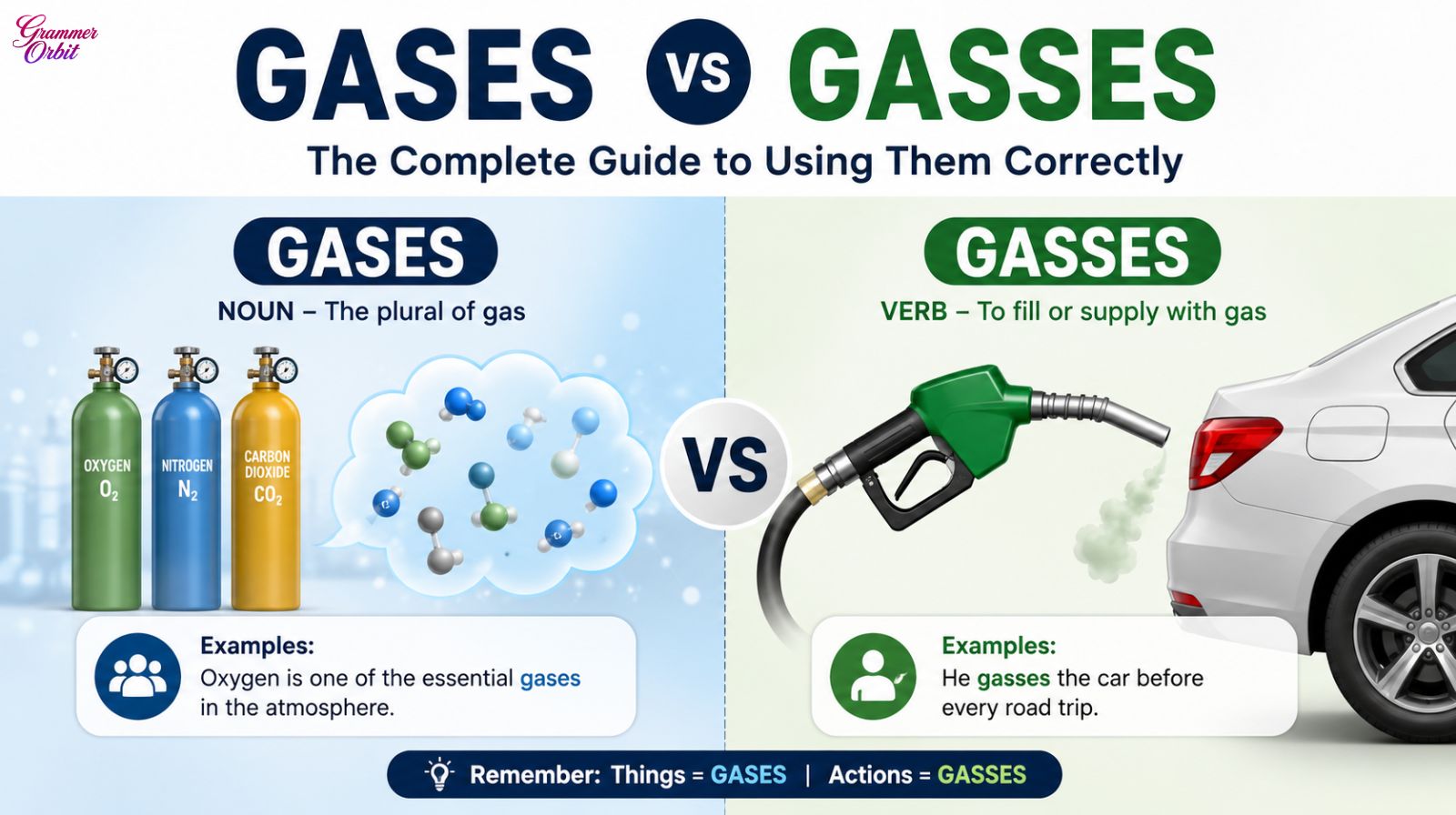
Have you ever stopped while writing and wondered whether the correct plural of gas is gases vs gasses? You’re not alone. This spelling question confuses students, writers, bloggers, and even native English speakers because both words appear in dictionaries.
The good news is that the answer is simpler than it seems. Although both spellings exist, they are not always interchangeable. One is the standard plural noun, while the other is mainly used as a verb.
In this guide, you’ll learn the difference between gases vs gasses, discover when each word should be used, avoid common grammar mistakes, and see plenty of real-life examples.
What Is the Difference Between Gases and Gasses?

The difference depends on how the word is being used.
| Word | Part of Speech | Meaning | Common Use |
|---|---|---|---|
| Gases | Noun | More than one gas | ✅ Standard and most common |
| Gasses | Verb | Third-person singular of to gas | ✅ Less common |
Simply put:
- Gases = plural noun
- Gasses = verb
Examples
✅ The laboratory stores several gases safely.
✅ Different gases react differently under pressure.
✅ The volcano releases harmful gases.
Meanwhile:
✅ The old truck gasses the neighborhood with thick smoke.
✅ She gasses the car before every road trip.
Here, gasses is a verb, not a plural noun.
See also Bony vs Boney: Which Spelling Is Correct?
Is “Gases” the Correct Plural of Gas?
Yes.
The standard plural of gas is gases.
English usually adds -es to nouns ending in -s, creating an extra syllable for easier pronunciation.
Examples
- Natural gases exist beneath the Earth’s surface.
- Greenhouse gases contribute to climate change.
- Scientists tested several gases during the experiment.
- Industrial gases are used in manufacturing.
Whenever you’re referring to more than one gas, gases is almost always the correct choice.
Why It Uses “-es”
Many English nouns ending in -s, -x, -z, -ch, and -sh form their plurals by adding -es.
Examples include:
- bus → buses
- class → classes
- box → boxes
- gas → gases
When Should You Use “Gasses”?
Gasses is the third-person singular form of the verb gas.
The verb to gas has several meanings.
Meaning 1 – Filling With Fuel
- He gasses the truck every Monday.
- She always gasses the lawn mower before mowing.
Meaning 2 – Releasing Gas
- The factory gasses the storage chamber.
- The mechanic gasses the system before testing it.
Meaning 3 – Informal Usage
In informal English, gas can mean talking excessively or showing off.
Example:
- He gasses everyone up before the game.
Although this slang meaning exists, it is much less common in formal writing.

Gases vs Gasses: Quick Comparison
| Feature | Gases | Gasses |
|---|---|---|
| Part of speech | Noun | Verb |
| Meaning | Multiple gases | Action of gassing |
| Common in science | ✅ Yes | ❌ No |
| Used in academic writing | ✅ Frequently | Rarely |
| Used in everyday English | Very common | Less common |
Easy Trick to Remember
If you can replace the word with “more than one gas,” use gases.
See also Laid or Layed: Which One Is Correct?
If the word describes an action, use gasses.
Example:
✔ The room contains several gases.
✔ The mechanic gasses the vehicle.
Common Mistakes Writers Make

Many writers assume gasses is simply another spelling of the plural noun.
That is incorrect in most situations.
Incorrect:
❌ Scientists studied dangerous gasses.
Correct:
✅ Scientists studied dangerous gases.
Incorrect:
❌ Greenhouse gasses trap heat.
Correct:
✅ Greenhouse gases trap heat.
Remember:
Plural noun = gases
Verb = gasses
Real-Life Example: A Student’s Science Report
Emma, a high school student, was writing a report about Earth’s atmosphere. Throughout her first draft, she repeatedly wrote, “Greenhouse gasses are increasing because of human activities.” Her teacher highlighted each instance and explained that while gasses is a real English word, it functions as a verb rather than the plural noun.
After checking several reputable dictionaries and grammar resources, Emma revised every sentence to use gases. The corrected report read, “Greenhouse gases such as carbon dioxide and methane trap heat in the atmosphere.” Not only did her writing become grammatically accurate, but it also sounded more professional and aligned with scientific conventions. This small spelling correction improved the clarity of her work and helped her understand that context not just spelling determines the correct word choice. It’s a common mistake, but one that’s easy to avoid once you know the rule.
Gases in Science and Everyday Life
The word gases appears frequently in chemistry, physics, environmental science, and everyday conversations.
Examples include:
- Oxygen and nitrogen are atmospheric gases.
- Greenhouse gases affect global temperatures.
- Medical gases support patients during surgery.
- Industrial gases are essential in manufacturing.
- Cooking gases power many household stoves.
Because this usage is widespread, gases is the spelling you’ll encounter far more often than gasses.
See also Copies or Copys? A Complete Grammar Guide
Data & Statistics (2025–2026)
According to recent climate reporting and scientific publications (2025–2026):
- Carbon dioxide remains the largest human-caused greenhouse gas by total emissions.
- Methane has a much higher warming effect per molecule over a 20-year period than carbon dioxide.
- Greenhouse gases continue to be a central topic in environmental research, education, and public policy.
- Searches related to grammar differences such as “gases vs gasses” continue to grow as more learners rely on online writing resources.
These examples reinforce why the noun gases is the standard spelling used in scientific, educational, and professional writing.
FAQs
Q1: Is “gases” grammatically correct?
A: Yes. It is the standard plural form of gas.
Q2: Is “gasses” ever correct?
A: Yes. It is correct only when used as a verb.
Q3: Which spelling should I use in science writing?
A: Always use gases when referring to multiple gases.
Q4: Why do dictionaries include “gasses”?
A: Because it is the third-person singular form of the verb gas.
Q5: Is “greenhouse gasses” correct?
A: No. The correct phrase is greenhouse gases.
Q6: Can both words appear in the same sentence?
A: Yes.
Example:
“The technician gasses the chamber before measuring the gases inside.”
Q7: Which spelling is more common?
A: Gases is far more common than gasses.
Q: How can I remember the difference?
A: Think: Things = gases. Actions = gasses.
Conclusion
Understanding gases vs gasses is easier once you know the role each word plays. Gases is the standard plural noun used for multiple gases and is the correct choice in nearly all scientific, academic, and everyday contexts. Gasses, on the other hand, is a verb that describes the action of gassing something or someone.
Whenever you’re unsure, remember this simple rule: if you’re talking about more than one gas, write gases. If you’re describing an action, use gasses. Applying this distinction will make your writing clearer, more accurate, and more professional.
👉 Discover more simple and practical grammar guides on Grammer Orbit

Zia Ahmad is a professional blogger specializing in grammar tips and spelling accuracy. He creates clear, practical content that helps readers eliminate errors, strengthen writing skills, and communicate effectively for students, professionals, and everyday writers worldwide.