
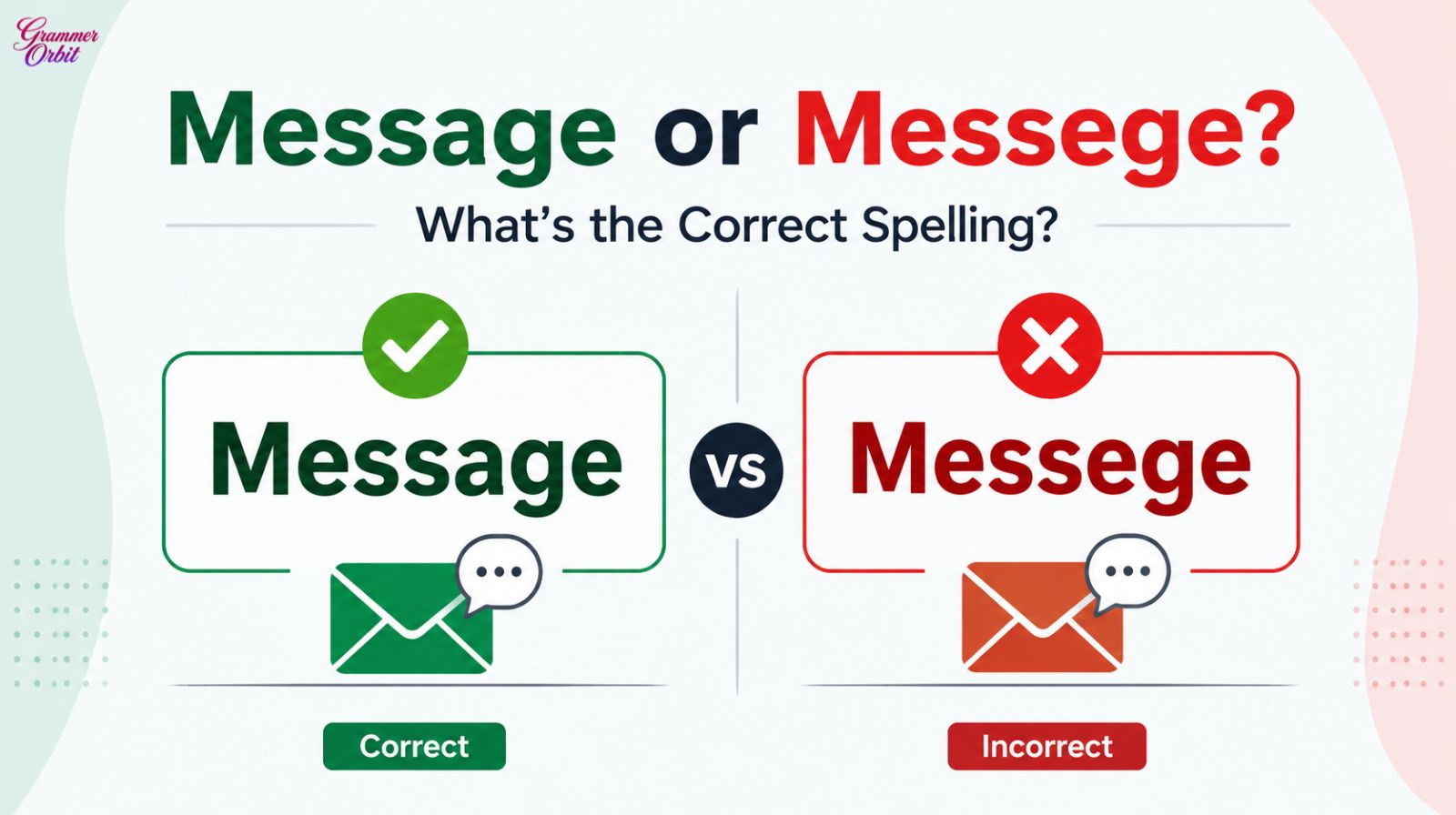
Have you ever typed messege in a text, email, or social media post and suddenly noticed the red spell-check line underneath it? If so, you’re not alone. Thousands of English learners and even native speakers occasionally confuse messege and message because they sound very similar when spoken.
However, only one spelling is correct in standard English.
Understanding the difference is important because spelling mistakes can affect your credibility in emails, academic writing, business communication, and online content. Fortunately, the rule is simple once you learn it.
In this guide, you’ll discover the correct spelling, meaning, pronunciation, examples, common mistakes, and easy tricks to remember the right word every time.
Is It Message or Messege?
The correct spelling is message.
❌ Messege
See also Village vs Subdivision: Which One Is Correct?
✅ Message
Message is the standard English spelling recognized by dictionaries worldwide.
Quick Answer
| Word | Correct? | Meaning |
|---|---|---|
| Message | ✅ Yes | A piece of communication sent from one person to another |
| Messege | ❌ No | Misspelling of message |
If you’re writing an email, text, letter, chat, or social media post, always use message.
Definition of Message
A message is information, communication, or a statement that is sent from one person to another.
Examples:
- I received your message this morning.
- Please send me a message when you arrive.
- The teacher left an important message for the students.
- She read the message carefully before replying.
Why Do People Misspell Message as Messege?

The mistake happens mainly because English pronunciation doesn’t always match spelling patterns.
When spoken quickly, message may sound similar to how some people imagine messege should be spelled.
Common Reasons for the Confusion
Similar Sound
The vowel sound in the second syllable can make people guess the wrong spelling.
Pronunciation:
Message = /ˈmes.ɪdʒ/
Typing Errors
Fast typing often causes accidental spelling mistakes, especially in texts and emails.
Lack of Exposure
Many English learners hear the word before seeing it written regularly.
Phonetic Assumptions
People often assume words should be spelled exactly how they sound.
However, English contains many words where pronunciation and spelling differ.
What Does Message Mean?
The word message has several meanings depending on context.
Communication Between People
This is the most common meaning.
Examples:
- I sent her a message on WhatsApp.
- Did you get my message?
- He replied to my message immediately.
Information Delivered to Someone
A message can also refer to information passed from one person to another.
Examples:
- Can you give John a message for me?
- The receptionist took a message.
Underlying Meaning
Sometimes a message refers to an idea or lesson.
Examples:
- The movie had a powerful message.
- The speaker’s message inspired the audience.
Message in Different Types of Communication
The word appears frequently across modern communication channels.
Text Messages
People send messages through phones every day.
Examples:
- She sent me a text message.
- I forgot to reply to your message.
Email Messages
Businesses and professionals rely heavily on messages.
Examples:
- Your message has been received.
- Thank you for your message.
Social Media Messages
Private communication often happens through direct messages.
Examples:
- Send me a message on Instagram.
- I received several messages after posting the video.
Business Communication
Organizations use messages internally and externally.
Examples:
- The CEO shared an important message.
- Employees received a company-wide message.
Message vs Messege: Side-by-Side Comparison
The easiest way to understand the difference is through comparison.
| Feature | Message | Messege |
|---|---|---|
| Correct English Spelling | ✅ Yes | ❌ No |
| Found in Dictionaries | ✅ Yes | ❌ No |
| Accepted in Formal Writing | ✅ Yes | ❌ No |
| Used in Emails | ✅ Yes | ❌ No |
| Used in Academic Writing | ✅ Yes | ❌ No |
| Professional Usage | ✅ Yes | ❌ No |
Key Takeaway
There is no situation where messege is considered the correct spelling in modern English.
Always choose message.
Real-Life Example: How a Simple Spelling Mistake Can Affect Professional Communication
Consider a university student applying for an internship at a technology company.
The student sends an email to a hiring manager and writes:
“I am following up regarding the messege I sent last week.”
Although the hiring manager understands the intended meaning, the spelling mistake creates a less professional impression. In competitive environments, small errors can influence how carefully a candidate appears to communicate.
Now imagine the same sentence written correctly:
“I am following up regarding the message I sent last week.”
The second version looks polished, professional, and trustworthy.
This example demonstrates why correct spelling matters. Whether you’re writing business emails, job applications, academic papers, customer support responses, or social media content, using the correct spelling helps build credibility.
In today’s digital world, where communication happens constantly through emails, messaging apps, and online platforms, spelling accuracy has become more important than ever. A simple mistake like messege may seem minor, but repeated errors can affect how readers perceive your professionalism and attention to detail.
Therefore, learning the correct spelling now can improve both personal and professional communication in the long run.
Message in Grammar and Sentence Structure
Understanding how message functions grammatically can help you use it correctly.
As a Noun
Most commonly, message functions as a noun.
Examples:
- Your message was helpful.
- I received an important message.
As a Verb
Less commonly, message can be used as a verb.
Examples:
- Message me later.
- I’ll message you the details tonight.
This usage has become increasingly common with digital communication.
Data and Trends: Digital Messaging in 2025–2026
Digital communication continues to grow worldwide.
According to recent reports from leading technology and communication platforms:
- More than 23 billion text messages are sent globally each day.
- Messaging apps remain among the most-used mobile applications worldwide.
- Billions of users actively communicate through messaging platforms such as WhatsApp, Messenger, Telegram, and business chat systems.
- Professional communication increasingly relies on instant messaging alongside email.
These trends show why words like message have become part of everyday vocabulary for people around the world.
See also Writen or Written? Which Form Is Correct?
As digital communication expands, correct spelling becomes increasingly important because written messages often create first impressions.
What This Means
Since messaging is a daily activity for billions of people, knowing the correct spelling of common communication terms helps improve clarity and professionalism.
How to Remember the Correct Spelling of Message
If you frequently confuse message and messege, try these memory tricks.
Trick 1: Think of “Mess + Age”
Break the word into:
Mess + age = Message
This simple visualization helps many learners remember the spelling.
Trick 2: Read It Frequently
Exposure strengthens memory.
Read books, articles, emails, and online content where the word appears naturally.
Trick 3: Use Spell Check Wisely
Most writing tools immediately flag messege as incorrect.
Pay attention to these corrections.
Trick 4: Practice Writing Sentences
Write examples such as:
- I received your message.
- Please send a message later.
- The message was clear.
Repetition improves retention.
Common Expressions Using Message
The word appears in many everyday phrases.
Leave a Message
Example:
- Please leave a message after the beep.
Send a Message
Example:
- I’ll send a message tonight.
Get the Message
Example:
- I think he finally got the message.
Hidden Message
Example:
- The story contains a hidden message.
Text Message
Example:
- She sent a text message this morning.
FAQs
Q1: Is messege a real word?
A: No. Messege is not a recognized English word. It is simply a misspelling of message.
Q2: Which spelling is correct: messege or message?
A: Message is the correct spelling.
Q3: Why do people write messege?
A: People often write messege because the pronunciation can lead to spelling confusion or because of typing mistakes.
Q4: Is message a noun or a verb?
A: It can be both. Most commonly it is a noun, but it can also function as a verb in modern communication.
Q5: How do you use message in a sentence?
Example:
A: “I received your message yesterday.”
Q6: Is message used in formal writing?
A: Yes. Message is appropriate in formal, academic, professional, and casual writing.
Q7: Can spell check detect messege?
A: Yes. Most modern spell-check tools identify messege as an incorrect spelling.
Conclusion
If you’ve ever wondered whether messege or message is correct, the answer is simple: message is the only correct spelling in English.
While messege is a common mistake, it is not accepted in dictionaries, academic writing, business communication, or professional content. Learning the correct spelling helps improve your writing accuracy, credibility, and confidence.
The next time you write an email, text, social media post, or business document, remember that message is the correct choice. Using the proper spelling ensures your communication remains clear, professional, and easy to understand.
By practicing the examples and memory tips in this guide, you’ll never have to second-guess the spelling of message again.
References
- Merriam-Webster Dictionary
- Cambridge Dictionary
- Oxford Learner’s Dictionaries
👉 Discover more simple and practical grammar guides on Grammer Orbit

Zia Ahmad is a professional blogger specializing in grammar tips and spelling accuracy. He creates clear, practical content that helps readers eliminate errors, strengthen writing skills, and communicate effectively for students, professionals, and everyday writers worldwide.