
Have you ever written boney and then stopped to wonder whether it should actually be bony? You’re not alone. Many English learners and even native speakers get confused by these two spellings because they look similar and sound almost identical when spoken.
However, when it comes to standard English grammar and modern dictionaries, only one spelling is generally considered correct in most situations.
In this guide, you’ll learn the difference between bony vs boney, discover which spelling dictionaries recommend, see real-world examples, understand common mistakes, and learn how to use the correct form confidently in your writing.
Whether you’re writing an essay, a social media post, or professional content, this article will help you avoid a common spelling error and improve your English accuracy.
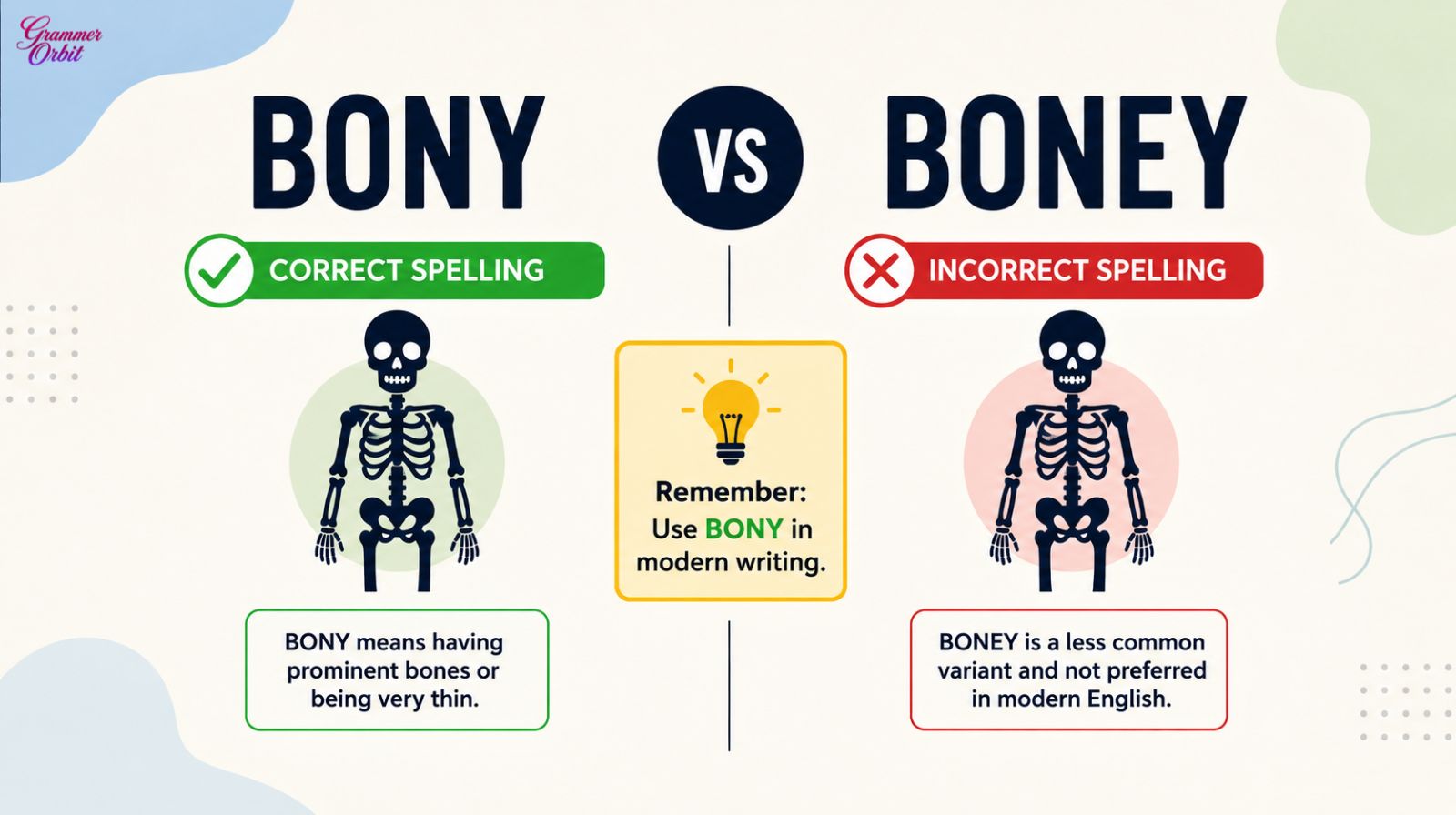
Bony vs Boney: Quick Answer
If you’re looking for the short answer, here it is:
| Word | Correct? | Meaning |
|---|---|---|
| Bony | ✅ Yes | Having prominent bones or consisting of bones |
| Boney | ⚠ Usually No | Alternative spelling used less frequently |
Bony is the preferred and standard spelling in modern English.
Featured Snippet Answer
The correct spelling is “bony.” It describes someone or something with visible bones or made of bone. While boney occasionally appears as a variant spelling, bony is the form recommended by major dictionaries and style guides.
What Does Bony Mean?
The adjective bony refers to a person, animal, or body part that has noticeable or prominent bones.
Common Definitions of Bony
- Thin with visible bones
- Made of bone
- Having a skeletal appearance
- Containing many bones
Examples of Bony in Sentences
- The rescued dog looked extremely bony after weeks without food.
- His bony fingers gripped the edge of the table.
- The fish was difficult to eat because it was very bony.
- She had a naturally bony face structure.
In each example, bony clearly describes something related to bones.
Why Bony Is the Preferred Spelling
Most modern dictionaries use bony as the primary spelling because it follows common English adjective formation patterns.
Examples:
- Stone → Stony
- Bone → Bony
- Cloud → Cloudy
This pattern makes bony the standard choice in contemporary English.
What Does Boney Mean?
The word boney is generally considered a variant spelling of bony.
Although it occasionally appears in literature, regional writing, or older texts, it is far less common today.
When You Might See Boney
You may encounter boney in:
- Older books
- Historical documents
- Regional dialects
- Personal writing styles
Example
- The old story described a boney traveler crossing the desert.
Although understandable, most editors would replace boney with bony in modern writing.
Is Boney Wrong?
Not completely.
However, it is usually considered nonstandard compared to bony.
For professional, academic, business, and online writing, bony is almost always the better choice.
Why Do People Confuse Bony and Boney?
The confusion comes from several factors.
Similar Pronunciation
Both words are pronounced almost the same way:
BOH-nee
Since the pronunciation doesn’t change significantly, many writers assume both spellings are equally correct.
Influence of Similar Words
English contains many words ending in -ey, such as:
See also Realist vs Realest: How Are These Different? When To Use Each Word
- Honey
- Money
- Chimney
Because of these familiar spellings, some people instinctively write boney.
Autocorrect and Informal Writing
Informal writing on social media sometimes includes nonstandard spellings. Seeing boney online can make people think it is the preferred form.
However, frequency on the internet does not always equal grammatical correctness.
Bony vs Boney: Side-by-Side Comparison
Key Differences
| Feature | Bony | Boney |
|---|---|---|
| Standard English | ✅ Yes | ❌ Usually No |
| Dictionary Preferred | ✅ Yes | ⚠ Variant |
| Academic Writing | ✅ Recommended | ❌ Not Recommended |
| Professional Writing | ✅ Recommended | ❌ Avoid |
| Modern Usage | ✅ Common | ⚠ Rare |
| Search Popularity | ✅ Much Higher | ❌ Lower |
Easy Rule to Remember
If you’re unsure which spelling to use, choose bony.
You’ll almost never be wrong using bony in modern English.
Real-Life Example: How a Small Spelling Choice Affects Professional Writing
A freelance health writer was creating an article about nutrition and eating disorders. While describing symptoms of severe weight loss, she repeatedly used the word boney throughout the article.
After submission, the editor reviewed the content and replaced every instance of boney with bony.
The reason was simple. Major style guides and dictionaries recognize bony as the standard spelling. Using the preferred form improves professionalism, readability, and search engine trust.
The editor explained that readers often associate correct spelling with expertise. Even a small spelling variation can affect how credible content appears.
After updating the article, the writer adopted a proofreading checklist that included verifying commonly confused words. Over time, this improved the quality of her work and reduced editorial corrections.
This example shows how a seemingly minor spelling choice can influence professional communication. Choosing bony helps ensure consistency with modern English standards and avoids unnecessary corrections.
Usage Examples in Everyday English
Let’s look at how native speakers commonly use the word.
Physical Appearance
- The cat became bony after its illness.
- His bony shoulders were visible through the shirt.
Medical Context
- Doctors noticed the patient appeared unusually bony.
- Severe malnutrition can cause a bony appearance.
Food and Cooking
- This fish is too bony for young children.
- Be careful when eating bony meat.
Animal Descriptions
- The horse looked thin and bony.
- The shelter rescued several bony animals.
Data and Language Trends (2025–2026)
Recent language trend analyses from major dictionary databases and search behavior reports continue to show that bony overwhelmingly dominates modern usage.
Key Findings
- Bony appears significantly more often in published books and articles.
- Major dictionaries list bony as the primary spelling.
- Educational websites overwhelmingly teach bony as the standard form.
- Search queries for bony greatly exceed searches for boney.
These trends indicate that modern English strongly favors bony in both formal and informal contexts.
What This Means for Writers
If your goal is clear communication, better readability, and stronger SEO performance, bony should be your default choice.
How to Remember the Correct Spelling
Trick #1: Think of Similar Adjectives
Many English adjectives drop the extra “e”:
See also Message or Messege? What’s The Correct Spelling?
- Bone → Bony
- Stone → Stony
- Cloud → Cloudy
Following this pattern makes bony easier to remember.
Trick #2: Use the Dictionary Rule
When in doubt, choose the spelling most dictionaries prefer.
That spelling is bony.
Trick #3: Read It Aloud
Ask yourself:
“Does adding an extra e change the pronunciation?”
The answer is no.
Since the extra letter doesn’t add value, the simpler spelling usually wins.
Common Mistakes to Avoid
Mistake 1: Using Boney in Academic Writing
Incorrect:
- The patient appeared extremely boney.
Better:
- The patient appeared extremely bony.
Mistake 2: Assuming Both Are Equally Common
While both forms may exist, they are not equally accepted in modern English.
Mistake 3: Copying Informal Internet Usage
Always verify spelling through trusted dictionaries rather than relying solely on social media content.
Is Bony an American or British Spelling?
One interesting fact is that both American English and British English generally prefer bony.
American English
- Uses bony as the standard form.
British English
- Also primarily uses bony.
This means you don’t need different spellings for different regions.
The same word works well in both major forms of English.
FAQs
Q1: Is bony or boney correct?
A: Bony is the standard and preferred spelling in modern English. Boney is considered a less common variant.
Q2: What does bony mean?
A: Bony means having prominent bones, being very thin, or consisting of bones.
Q3: Is boney a real word?
A: Yes, boney exists as a variant spelling, but it is rarely used compared to bony.
Q4: Which spelling should I use in school assignments?
A: Use bony because it is the dictionary-preferred spelling and widely accepted in academic writing.
Q5: Is boney incorrect?
A: Not entirely, but it is generally considered nonstandard in modern professional writing.
Q6: Do American and British English use different spellings?
A: No. Both American and British English typically use bony.
Q7: Why is bony more common?
A: Because dictionaries, style guides, publishers, and educators overwhelmingly recommend bony as the standard spelling.
Conclusion
When comparing bony vs boney, the answer is straightforward: bony is the correct and preferred spelling in modern English.
Although boney may occasionally appear as a variant form, it is far less common and generally not recommended for academic, professional, or SEO-focused writing.
If you want your writing to look polished, credible, and grammatically correct, choose bony whenever you’re describing something with visible bones, a skeletal appearance, or bone-related characteristics.
The next time you find yourself deciding between bony vs boney, remember the simple rule: use bony and you’ll be following modern English standards with confidence.
👉 Discover more simple and practical grammar guides on Grammer Orbit

Zia Ahmad is a professional blogger specializing in grammar tips and spelling accuracy. He creates clear, practical content that helps readers eliminate errors, strengthen writing skills, and communicate effectively for students, professionals, and everyday writers worldwide.