
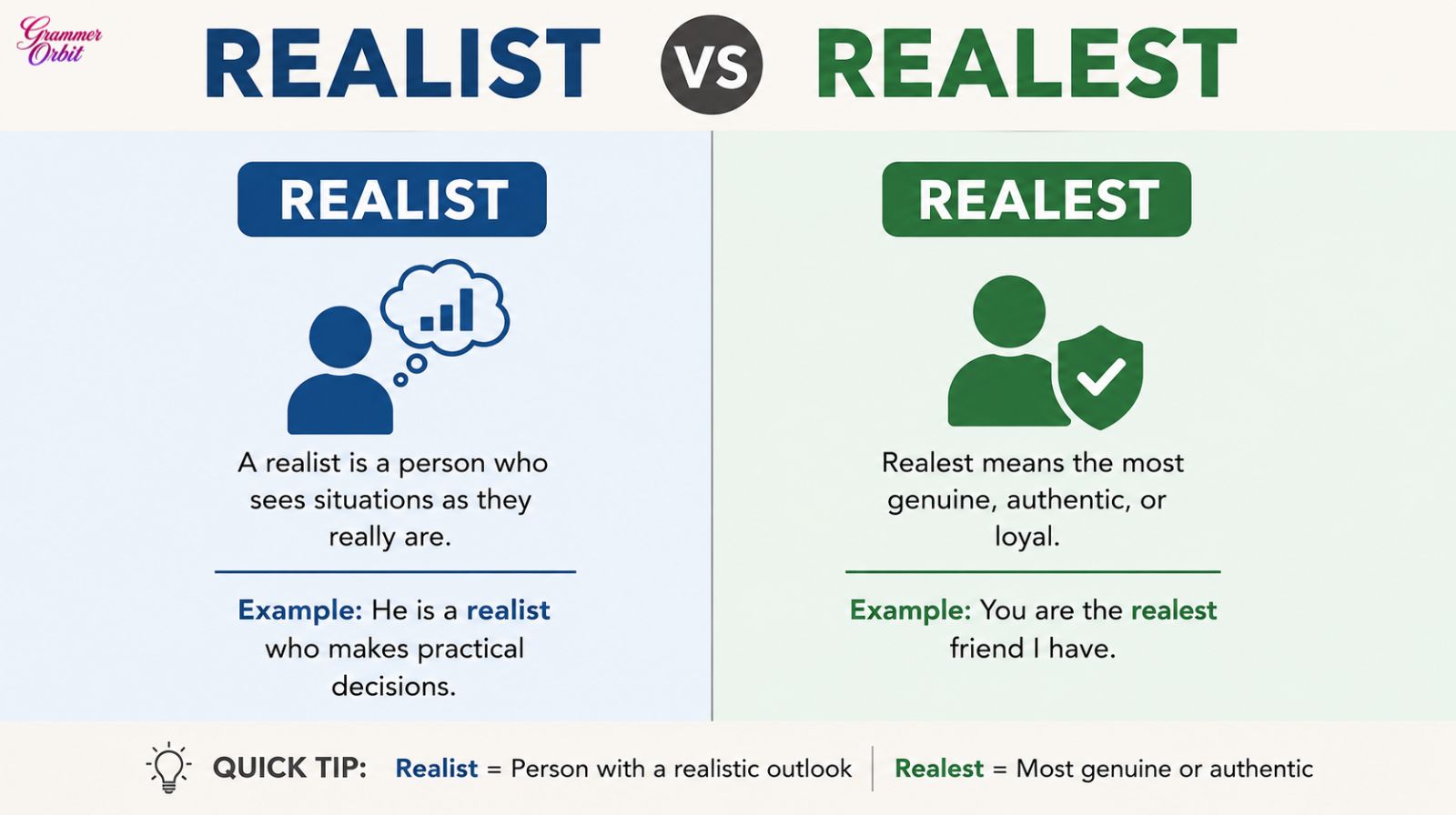
Have you ever come across the words realist and realest and wondered whether they mean the same thing? At first glance, both words seem related because they come from the root word real. However, they serve completely different purposes in English grammar and communication.
Many English learners mistakenly use these words interchangeably, which can lead to awkward or incorrect sentences. Understanding the distinction between realist vs realest can improve both your writing and speaking skills.
In this guide, you’ll learn what each word means, how they differ, when to use them, common mistakes to avoid, and practical examples that make the difference easy to remember.
What Does Realist Mean?
The word realist is a noun that refers to a person who sees situations as they truly are rather than through wishful thinking or excessive optimism.
A realist focuses on facts, practical outcomes, and reality.
Definition of Realist
A realist is someone who accepts and understands the world based on facts and evidence.
Examples of Realist in Sentences
- Sarah is a realist who carefully evaluates risks before making decisions.
- My father is a realist and always prepares for potential challenges.
- Investors often succeed when they remain realists during market fluctuations.
- A realist understands that success requires effort and patience.
Characteristics of a Realist
A realist typically:
- Focuses on facts
- Thinks practically
- Avoids unrealistic expectations
- Makes decisions based on evidence
- Plans for both opportunities and risks
Being a realist does not mean being negative. It simply means viewing situations objectively.
What Does Realest Mean?
Unlike realist, the word realest is an adjective.
It is the superlative form of the adjective real, meaning “the most real” or, in informal speech, “the most genuine, authentic, or loyal.”
Definition of Realest
Realest means:
- Most authentic
- Most genuine
- Most truthful
- Most loyal
- Most realistic in a particular comparison
Examples of Realest in Sentences
- She is the realest friend I have ever had.
- That documentary provides the realest depiction of life in the region.
- Among all the contestants, Jake seemed the realest.
- His advice was the realest thing I heard all day.
Formal vs Informal Usage
The word realest appears most often in:
See also Maintained vs Maintenanced: What’s The Difference?
- Casual conversations
- Social media posts
- Music lyrics
- Pop culture discussions
In formal writing, writers often prefer alternatives such as:
- Most authentic
- Most genuine
- Most realistic
Realist vs Realest: Key Differences
The confusion usually occurs because both words originate from real, but they belong to different parts of speech and have different meanings.
Quick Comparison Table
| Feature | Realist | Realest |
|---|---|---|
| Part of Speech | Noun | Adjective (Superlative) |
| Meaning | A person who sees reality objectively | Most genuine or authentic |
| Usage | Describes a person | Describes a person, thing, or situation |
| Formality | Common in formal and informal writing | Mostly informal |
| Example | She is a realist. | She is the realest friend. |
Simple Rule to Remember
Ask yourself:
Are you talking about a person who sees reality clearly?
→ Use realist
Are you describing someone or something as the most genuine?
→ Use realest
Why People Confuse Realist and Realest
English contains many words that look similar but perform different grammatical functions.
Because both words begin with “real,” learners often assume they are variations of the same meaning.
Common Mistake #1
❌ He is the realist friend I know.
✅ He is the realest friend I know.
Why?
Because you’re describing the friend as the most genuine, not identifying him as a person who sees reality objectively.
Common Mistake #2
❌ She is a realest.
✅ She is a realist.
Why?
The sentence refers to a person with a practical outlook, making realist the correct noun.
Common Mistake #3
❌ My brother is the realest about financial planning.
✅ My brother is a realist about financial planning.
The focus is on practical thinking, not authenticity.
Realist in Psychology and Everyday Life
The concept of realism has been widely studied in psychology and decision-making.
A realist tends to balance optimism with practical assessment.
How Realists Think
Realists usually:
- Analyze facts before acting
- Consider risks and benefits
- Accept challenges realistically
- Focus on achievable goals
Benefits of Being a Realist
Being realistic can help individuals:
- Make better decisions
- Reduce disappointment
- Improve planning
- Develop resilience
Example
Imagine two entrepreneurs launching a startup.
The optimist believes success is guaranteed.
The pessimist expects failure.
The realist studies market conditions, competition, costs, and opportunities before making decisions.
This balanced approach often leads to better outcomes.
Realest in Modern Culture and Social Media
The word realest has become increasingly popular in online communication.
See also Smoke Show Meaning: What It Really Means In Modern Slang
It often expresses admiration for someone’s authenticity.
Social Media Usage
Examples include:
- “You’re the realest person I know.”
- “Thanks for always being honest. You’re the realest.”
- “This creator keeps it real and is one of the realest influencers online.”
Music and Entertainment
Many artists use realest to emphasize:
- Loyalty
- Authenticity
- Honesty
- Staying true to oneself
As a result, younger audiences encounter the word frequently on social platforms.
Real-Life Example: Choosing the Correct Word
Consider a workplace scenario.
Emily and David work in the same company.
Emily consistently evaluates projects using data, budgets, and realistic timelines. Her colleagues often describe her as a realist because she focuses on practical outcomes rather than assumptions.
David, on the other hand, is known for being honest, transparent, and genuine. He openly supports coworkers and never pretends to be someone he is not. Many employees describe him as the realest person in the office.
Notice the difference.
Emily is called a realist because of her mindset and decision-making style.
David is called the realest because of his authenticity and sincerity.
Understanding this distinction helps you select the correct word naturally in everyday conversations and professional communication.
Language Trends and Usage Statistics (2025–2026)
Language analysis tools and digital publishing platforms continue to show significant growth in searches related to grammar comparisons.
Recent search trend reports from major SEO platforms indicate that grammar clarification queries such as:
- Word comparisons
- Spelling confusion
- Usage guides
- Vocabulary explanations
have increased substantially during 2025 and 2026 as more people create online content and communicate globally.
According to language-learning platforms and educational publishers, learners frequently search for distinctions between similar-looking words because these terms often cause confusion in writing.
This growing interest highlights the importance of understanding differences like realist vs realest for accurate communication.
Trusted References
- Merriam-Webster Dictionary
- Cambridge Dictionary
- Oxford Learner’s Dictionaries
How to Remember the Difference
A simple memory trick can help.
Think About the Endings
-ist
Usually refers to a person.
Examples:
- Artist
- Scientist
- Realist
-est
Usually indicates the highest degree.
Examples:
- Fastest
- Strongest
- Realest
Memory Formula
Realist = Person
Realest = Most Genuine
This quick rule solves the confusion in seconds.
FAQs
Q1: Is realest a real word?
A: Yes. Realest is a legitimate English word and the superlative form of “real.”
Q2: What is the difference between realist and realest?
A: A realist is a person who sees situations objectively, while realest means the most authentic or genuine.
Q3: Can realest be used in formal writing?
A: It can be used, but formal writing often prefers phrases such as “most authentic” or “most genuine.”
Q4: Is a realist positive or negative?
A: Neither. A realist focuses on facts and practical realities rather than extreme optimism or pessimism.
Q5: Can someone be both a realist and the realest person?
A: Yes. Someone can think realistically and also be highly authentic and genuine.
Q6: Which word is more common in social media?
A: Realest is more common because users often use it to praise authenticity and loyalty.
Q7: Is realist a noun or adjective?
A: Realist is primarily a noun referring to a person who views reality objectively.
Conclusion
Understanding realist vs realest is easier once you know their grammatical roles.
A realist is a person who sees situations realistically and bases decisions on facts and practical thinking. Meanwhile, realest describes someone or something as the most genuine, authentic, or truthful.
Although the words share the same root, they serve entirely different purposes in English. By remembering that realist refers to a person and realest refers to the highest level of authenticity, you’ll avoid common mistakes and communicate with greater confidence.
The next time you encounter realist vs realest, you’ll know exactly which word fits the situation.
👉 Discover more simple and practical grammar guides on Grammer Orbit

Zia Ahmad is a professional blogger specializing in grammar tips and spelling accuracy. He creates clear, practical content that helps readers eliminate errors, strengthen writing skills, and communicate effectively for students, professionals, and everyday writers worldwide.