
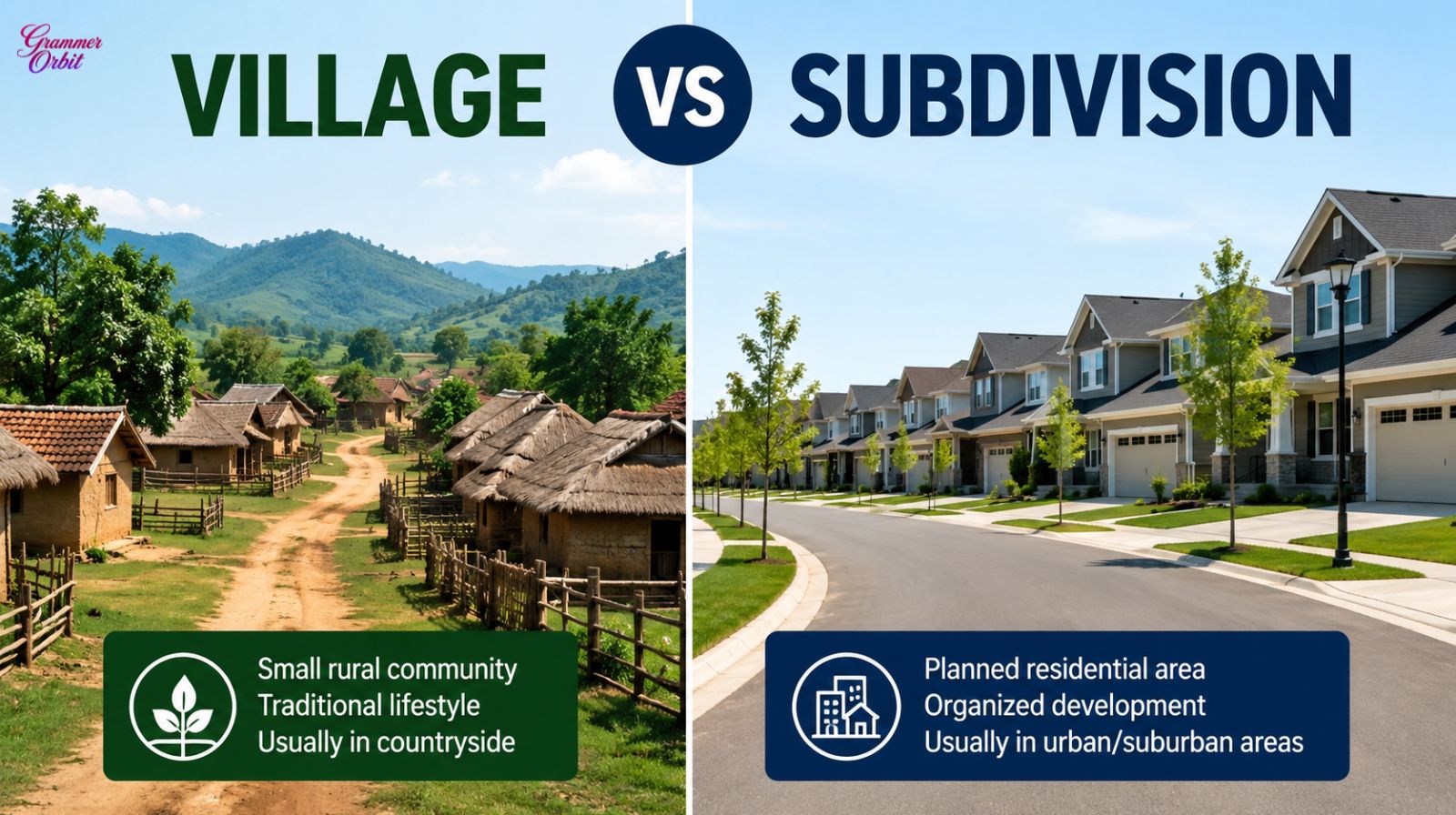
Have you ever heard someone use the words village and subdivision and wondered if they mean the same thing? Many people get confused because both terms describe places where people live. However, they are not interchangeable, and using the wrong word can completely change the meaning of a sentence.
In simple terms, a village is usually a small rural community, while a subdivision is a planned residential area divided into plots or housing units. Understanding the difference is important not only for daily communication but also for writing, real estate discussions, geography, and even legal documents.
In this guide, you will learn the exact meaning of both words, their differences, real-life examples, common mistakes, and the correct way to use them in English. By the end of this article, you will confidently know when to say village and when to use subdivision.
What Does “Village” Mean?
A village is a small community or settlement that is usually located in a rural area. Villages are generally smaller than towns and cities and often have a close-knit population.
Key Characteristics of a Village
- Smaller population
- Often located in countryside or rural areas
- Traditional community lifestyle
- May include farms, local shops, and schools
- Usually less crowded than cities
Examples of “Village” in Sentences
- My grandparents live in a peaceful village near the mountains.
- The village has only one small market.
- Many tourists visit the fishing village every summer.
Is “Village” Only Used for Rural Areas?
Mostly yes. The word village is commonly connected with rural communities. However, in some countries, the term may also refer to small residential communities inside larger cities.
For example:
- Greenwich Village in New York City
- Olympic Village during sports events
Even in these cases, the word still carries the idea of a smaller community.
What Does “Subdivision” Mean?
A subdivision is a piece of land divided into smaller lots for homes, buildings, or development projects. This term is commonly used in real estate and urban planning.
Unlike villages, subdivisions are usually carefully planned and developed.
Key Characteristics of a Subdivision
- Planned residential area
- Divided into housing lots
- Found mostly in urban or suburban regions
- Built by developers
- Includes roads, parks, and utilities
Examples of “Subdivision” in Sentences
See also Choosing or Chosing: Which One Is Correct?
- They bought a house in a new subdivision outside the city.
- The subdivision has modern streets and parks.
- Several subdivisions are being built near the highway.
Why Are Subdivisions Popular?
Subdivisions are popular because they provide organized housing communities with modern facilities. Many families prefer subdivisions because they often include:
- Security systems
- Parks and playgrounds
- Nearby schools
- Better road planning
- Community services
Therefore, subdivisions are common in growing cities and suburban areas.
Village vs Subdivision: Main Differences
Although both words describe places where people live, they are very different in meaning and usage.
| Feature | Village | Subdivision |
|---|---|---|
| Meaning | Small rural community | Planned residential area |
| Location | Usually countryside | Usually urban/suburban |
| Planning | Naturally developed over time | Carefully planned by developers |
| Population | Smaller community | Can vary greatly |
| Main Use | Geography and community life | Real estate and housing |
| Lifestyle | Traditional and rural | Modern and organized |
Quick Answer
If you are talking about a small traditional community, use village.
If you are talking about a planned housing area, use subdivision.
Which One Is Correct?
The truth is that both words are correct, but they are correct in different situations.
See also Requester vs Requestor: Correct Spelling, Meaning & Usage
Use “Village” When:
- Talking about rural communities
- Describing traditional settlements
- Referring to smaller countryside areas
Examples
- She grew up in a quiet village.
- The village celebrates festivals together.
Use “Subdivision” When:
- Talking about housing developments
- Discussing real estate
- Referring to planned residential areas
Examples
- We moved into a gated subdivision.
- The subdivision includes over 200 homes.
Common Mistake People Make
Many English learners incorrectly use subdivision instead of village because both involve neighborhoods or communities. However, saying:
❌ “My grandparents live in a subdivision in the countryside.”
may sound strange unless it is an actual planned housing project.
The more natural sentence would be:
✅ “My grandparents live in a village in the countryside.”
Real-Life Example: How These Words Are Used Differently
To better understand the difference, imagine two families living in different places.
Family 1: Living in a Village
Ahmed’s family lives in a small farming community surrounded by fields and mountains. Most people know each other personally, and many families have lived there for generations. The area has a local school, a few shops, and a weekly market. Life is peaceful and traditional.
In this situation, the correct word is village because the community developed naturally over time and reflects rural life.
Family 2: Living in a Subdivision
Sarah’s family recently moved into a newly developed housing community near a large city. The subdivision includes paved roads, modern houses, parks, and security gates. Every house follows a planned design created by a real estate developer.
Here, the correct word is subdivision because the area was intentionally planned and divided into residential lots.
This example clearly shows that the two words describe very different types of communities, even though both involve places where people live.
Why Understanding the Difference Matters
Knowing the difference between village and subdivision helps improve both speaking and writing accuracy.
Better Communication
Using the correct word prevents confusion. For example, a village creates an image of rural life, while a subdivision suggests a modern housing area.
Important in Real Estate
In property discussions, using the wrong term can lead to misunderstandings about the type of location being described.
Helpful for English Learners
Many learners mix these words because dictionaries sometimes give broad definitions. However, context is extremely important in English.
Therefore, learning the real usage improves fluency and confidence.
Village vs Subdivision in Different Countries
The meaning and usage of these words can slightly vary around the world.
United States
In the U.S., subdivisions are extremely common in suburban areas. Villages also exist, but the term is often used officially for smaller municipalities.
United Kingdom
In the UK, villages are traditional rural communities. Subdivision is less commonly used in everyday conversation.
Asian Countries
In many Asian countries, villages are still major parts of rural life. Meanwhile, subdivisions are becoming more common in growing cities.
Cultural Importance of Villages
Villages often carry historical and cultural value. Many traditions, festivals, and local customs are preserved in village communities.
Subdivisions, however, mainly focus on organized housing and modern living standards.
2025–2026 Housing and Population Trends
Recent urban development data shows major growth in planned housing communities worldwide.
According to urban development reports from 2025:
- Over 56% of the global population now lives in urban areas.
- Suburban housing subdivisions continue to expand rapidly in developing countries.
- Rural villages are slowly decreasing in population in many regions due to migration toward cities.
At the same time, some villages are becoming popular tourist destinations because people seek peaceful environments away from crowded cities.
These trends show why understanding terms like village and subdivision is becoming increasingly important in modern communication.
Credible References
Common Phrases and Expressions
Common Phrases with “Village”
- Village life
- Village community
- Fishing village
- Mountain village
- Small village
Common Phrases with “Subdivision”
- Housing subdivision
- Residential subdivision
- Gated subdivision
- New subdivision
- Planned subdivision
Which Sounds More Natural?
Correct usage depends on context:
✅ “A peaceful village”
✅ “A modern subdivision”
❌ “A peaceful subdivision” (possible, but less natural in rural context)
❌ “A modern village subdivision” (confusing wording)
How to Remember the Difference Easily
Here is a simple trick:
Think About Nature vs Planning
- Village = Natural community growth
- Subdivision = Planned housing development
Another memory tip:
- Villages often have farms and history.
- Subdivisions often have developers and blueprints.
This quick comparison makes it easier to choose the correct word instantly.
FAQs
Q1: Is a subdivision the same as a village?
A: No. A village is usually a small rural community, while a subdivision is a planned residential development.
Q2: Can a village contain subdivisions?
A: Yes. Some larger villages may include modern housing subdivisions within their boundaries.
Q3: Which word is more common in real estate?
A: Subdivision is far more common in real estate discussions.
Q4: Is a subdivision always in a city?
A: Not always. Some subdivisions are built in suburban or semi-rural areas, but they are still planned developments.
Q5: Why do people confuse village and subdivision?
A: People confuse them because both describe communities where people live. However, their meanings and contexts are different.
Q6: Which word should I use in daily conversation?
A: Use village for rural communities and subdivision for planned housing areas.
Q7: Is subdivision an American English term?
A: It is more commonly used in American English, especially in real estate and urban planning.
Conclusion
So, Village vs Subdivision: Which One Is Correct? The answer is simple: both are correct, but they describe completely different types of communities.
A village refers to a small rural settlement with a traditional lifestyle, while a subdivision refers to a planned residential development usually designed for modern housing.
Understanding this difference helps improve your English, prevents confusion, and allows you to communicate more naturally in both casual and professional situations.
👉 Discover more simple and practical grammar guides on Grammer Orbit

Zia Ahmad is a professional blogger specializing in grammar tips and spelling accuracy. He creates clear, practical content that helps readers eliminate errors, strengthen writing skills, and communicate effectively for students, professionals, and everyday writers worldwide.