
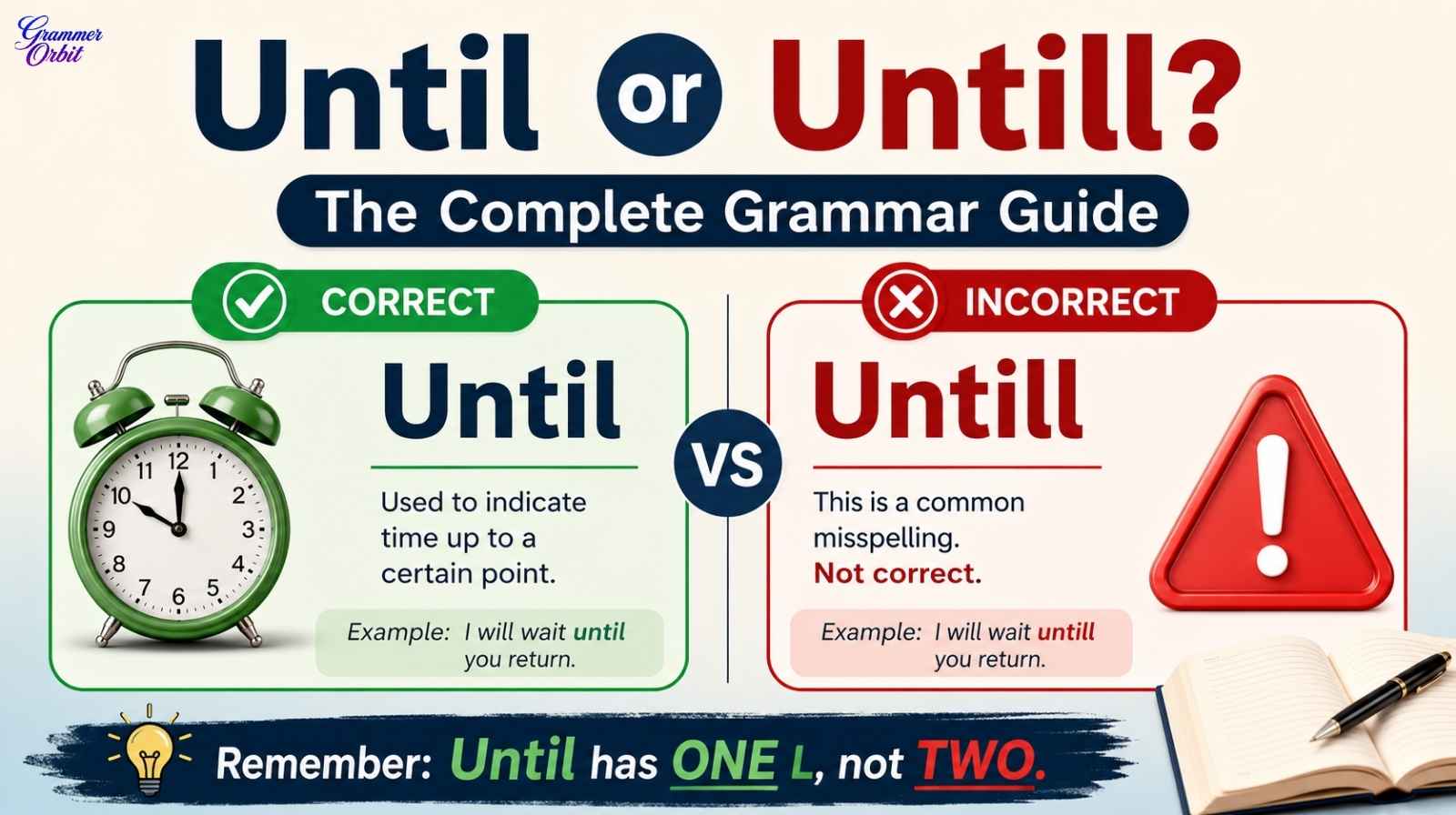
Have you ever typed “untill” and suddenly wondered if it was actually correct? You are not alone. Many English learners and even experienced writers confuse until or untill because the words sound almost identical when spoken.
However, only one spelling is grammatically correct in standard English. Using the wrong version can make your writing appear careless, especially in emails, academic work, blog posts, or professional communication.
In this complete grammar guide, you will learn the difference between until vs untill, why the confusion happens, how to remember the correct spelling easily, and how to use the word naturally in real sentences. By the end, you will never hesitate again when writing this common English word.
What Is the Difference Between Until and Untill?
The difference between until and untill is simple:
| Word | Correct or Incorrect? | Meaning |
|---|---|---|
| Until | ✅ Correct | Means up to a certain time or point |
| Untill | ❌ Incorrect | Misspelling of “until” |
The correct spelling is always until with one “L.”
What Does “Until” Mean?
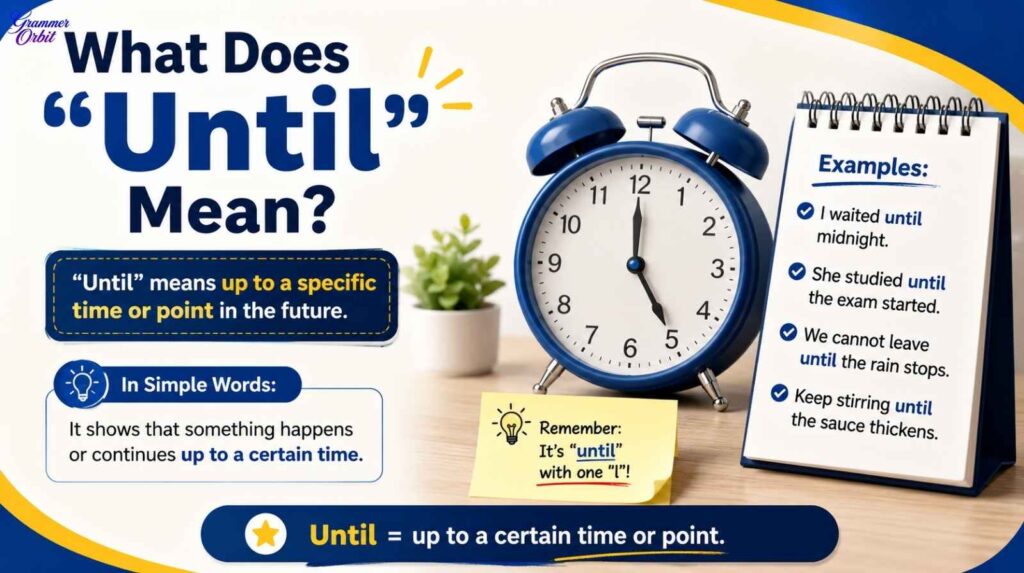
“Until” is a preposition and conjunction used to show time, duration, or a stopping point.
Examples of “Until”
- I waited until midnight.
- She studied until the exam started.
- We cannot leave until the rain stops.
- Keep stirring until the sauce thickens.
In all these examples, until indicates that something continues up to a specific moment.
Is “Untill” Ever Correct?
No, “untill” is not considered correct in standard English grammar.
It commonly appears because many English words ending with a short vowel sound use double consonants, such as:
- still
- hill
- fill
As a result, writers mistakenly assume “until” should also end with double “L.”
However, dictionaries, grammar books, and style guides recognize only until as correct.
Why Do People Misspell “Until” as “Untill”?
The confusion between until or untill usually happens because of pronunciation and spelling habits.
Double-L Pattern Confusion
Many English words naturally end with “ll,” which trains the brain to expect the same spelling pattern.
For example:
- well
- skill
- drill
- still
Because “until” sounds similar, many people unconsciously add an extra “L.”
Fast Typing and Autocorrect Mistakes
Typing quickly also increases spelling errors. Sometimes people accidentally type “untill” without noticing.
Although modern grammar tools often correct the mistake, it still appears frequently in:
- social media posts
- emails
- blog comments
- student assignments
Influence of Informal Writing
In casual online conversations, spelling accuracy is often ignored. Therefore, repeated exposure to incorrect spellings makes the mistake more common over time.
Until or Untill: Which Spelling Should You Use?
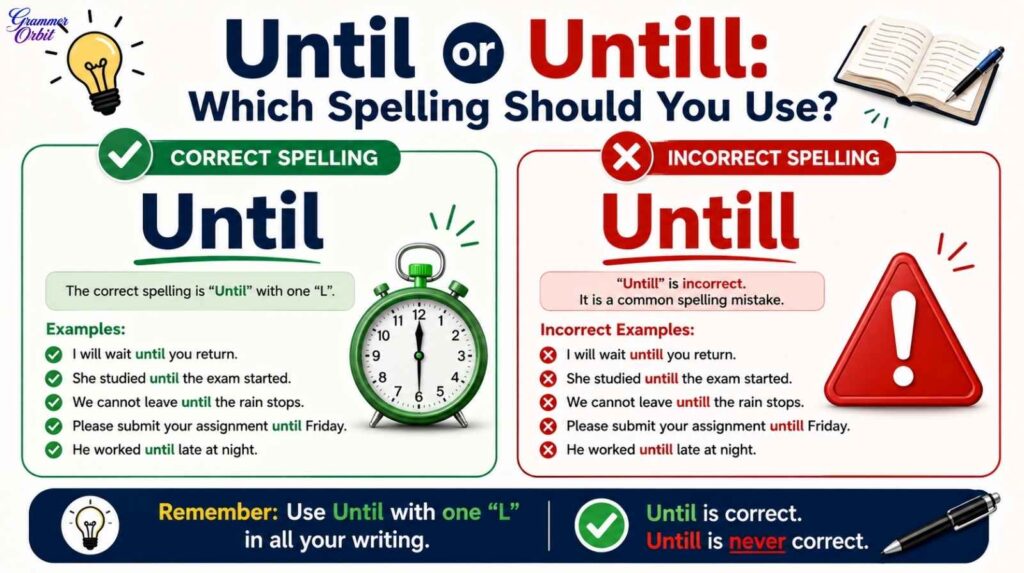
You should always use until in formal and informal writing.
Correct Usage of “Until”
Here are proper sentence examples:
In Daily Conversation
- I will stay here until you return.
- Wait until everyone arrives.
In Professional Writing
- The meeting was postponed until Monday.
- Access will remain restricted until further notice.
In Academic Writing
- The experiment continued until the temperature stabilized.
- Students must submit assignments until the stated deadline.
Incorrect Usage of “Untill”
These examples are wrong:
- ❌ I stayed untill midnight.
- ❌ Please wait untill tomorrow.
- ❌ She worked untill late evening.
The correct spelling in all cases is until.
Simple Rule to Remember the Correct Spelling
One of the easiest ways to remember the correct spelling is this:
“Until has only one ending point, so it uses one L.”
That small memory trick helps many writers avoid the extra “L.”
Another Easy Memory Technique
Think of these related words:
- until
- before
- after
- during
None of them end with double “L.”
This pattern can help your brain recognize that until should remain short and simple.
Common Grammar Patterns Using “Until”
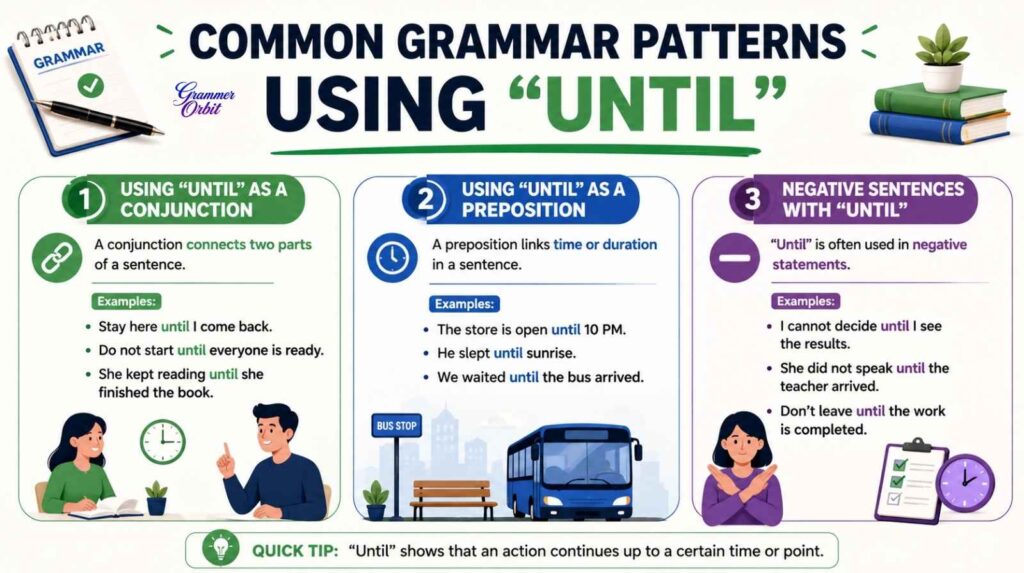
Understanding sentence structure makes the word easier to use naturally.
Using “Until” as a Conjunction
A conjunction connects two parts of a sentence.
Examples
- Stay here until I come back.
- Do not start until everyone is ready.
In these examples, “until” connects two actions.
Using “Until” as a Preposition
A preposition links time or duration.
Examples
- The store is open until 10 PM.
- He slept until sunrise.
Here, “until” introduces a time reference.
Negative Sentences with “Until”
“Until” often appears in negative statements.
Examples
- I cannot decide until I see the results.
- She did not speak until the teacher arrived.
This structure is extremely common in English conversation and writing.
Until vs Till: Are They the Same?
Many writers also confuse until with till.
The good news is that both are correct.
| Word | Correct? | Usage Style |
|---|---|---|
| Until | ✅ Yes | More formal and common |
| Till | ✅ Yes | Informal or conversational |
| Untill | ❌ No | Incorrect spelling |
When to Use “Till”
“Till” is shorter and more casual.
Examples
- Wait till tomorrow.
- I worked till late night.
When to Use “Until”
“Until” is usually preferred in:
- academic writing
- business communication
- articles
- professional emails
Therefore, “until” is generally the safer choice.
Real-Life Example: How a Small Spelling Mistake Affected Professional Writing
In 2025, a freelance content writer shared on a professional writing forum that one repeated spelling mistake significantly affected client trust. The writer consistently used “untill” instead of “until” in website copy for a business client.
At first, the error seemed minor. However, the client noticed the misspelling appearing multiple times across landing pages, email sequences, and blog articles. Since the content represented the company publicly, the mistake reduced the perceived professionalism of the brand.
The client eventually requested a complete proofreading revision before publishing the project. According to the writer, correcting small grammar errors improved client satisfaction and increased repeat work opportunities afterward.
This example highlights an important reality in digital communication: tiny spelling mistakes can shape how readers judge expertise and credibility. Even though readers may understand the intended meaning, repeated grammar errors can weaken trust, especially in professional environments.
That is why understanding the correct form of until or untill matters more than many people realize.
Language Statistics and Spelling Trends (2025–2026)
Recent language-analysis tools and search trend reports show that spelling confusion remains extremely common online.
According to data from grammar platforms and educational keyword research tools in 2025:
- “Until or untill” receives thousands of monthly searches globally.
- “Untill” continues to appear frequently in informal social media writing.
- Grammar correction software identifies “untill” as a common spelling mistake among English learners.
In addition, educational platforms report that short everyday words often create more spelling confusion than longer vocabulary because writers type them automatically without thinking carefully.
This explains why “untill” still appears regularly despite widespread grammar-checking tools.
Common Mistakes to Avoid
Here are the most common errors writers make when using “until.”
Adding an Extra “L”
Incorrect
- untill
Correct
- until
This is the most frequent mistake.
Using “Till” in Formal Writing Excessively
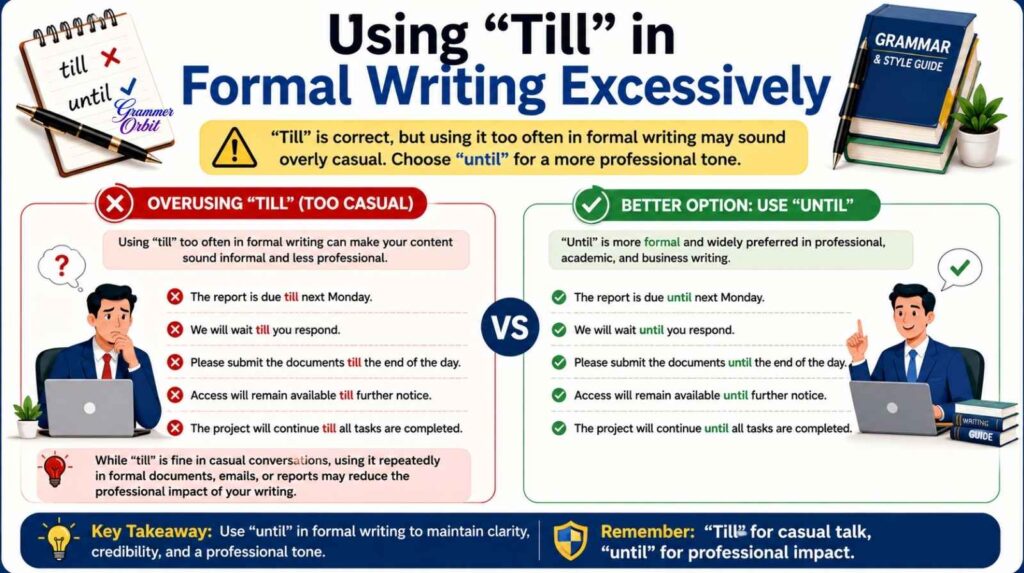
While “till” is correct, using it too often in professional documents may sound overly casual.
Better Option
- until
Mixing Tense Structures
Incorrect:
- I waited until he arrive.
Correct:
- I waited until he arrived.
Proper grammar matters just as much as spelling.
Quick Checklist for Using “Until” Correctly
Before publishing your writing, check these points:
✔ Use until with one “L”
✔ Avoid writing “untill”
✔ Use “until” in formal writing
✔ Use “till” only when conversational tone fits
✔ Double-check grammar after “until” clauses
✔ Proofread emails and professional documents carefully
FAQs
Q.Is “untill” a real word?
A: No, “untill” is not a correct English word. The proper spelling is always until.
Q.Why do people spell “until” incorrectly?
A: Most people add the extra “L” because many English words end with “ll,” making the spelling feel natural.
Q.Is “till” wrong?
A: No, “till” is grammatically correct. It is simply a shorter and more informal version of “until.”
Q.Which is more professional: till or until?
A: “Until” is usually considered more professional and formal.
Q.Can I use “until” at the beginning of a sentence?
Yes.
Example:
A: Until yesterday, I had never visited London.
Q.Does autocorrect fix “untill”?
A: Most grammar and spell-check tools correct “untill” automatically, but not always.
Q.Is “until” used in American and British English?
A: Yes. Both American and British English use “until” as the standard spelling.
Conclusion
The debate around until or untill is actually very simple once you know the rule. The only correct spelling is until with one “L.” Meanwhile, “untill” is a common misspelling caused by pronunciation habits and spelling patterns in English.
Understanding this small grammar detail can improve your writing clarity, professionalism, and confidence. Whether you are writing emails, academic papers, blog posts, or social media captions, using the correct spelling helps your communication appear polished and trustworthy.
So the next time you pause while typing, remember this simple rule:
“Until has one ending point, so it needs only one L.”
For more grammar guides, spelling comparisons, and writing tips, keep exploring trusted English-learning resources and continue practicing clear, confident writing.
👉 Discover more simple and practical grammar guides on Grammer Orbit

Zia Ahmad is a professional blogger specializing in grammar tips and spelling accuracy. He creates clear, practical content that helps readers eliminate errors, strengthen writing skills, and communicate effectively for students, professionals, and everyday writers worldwide.