
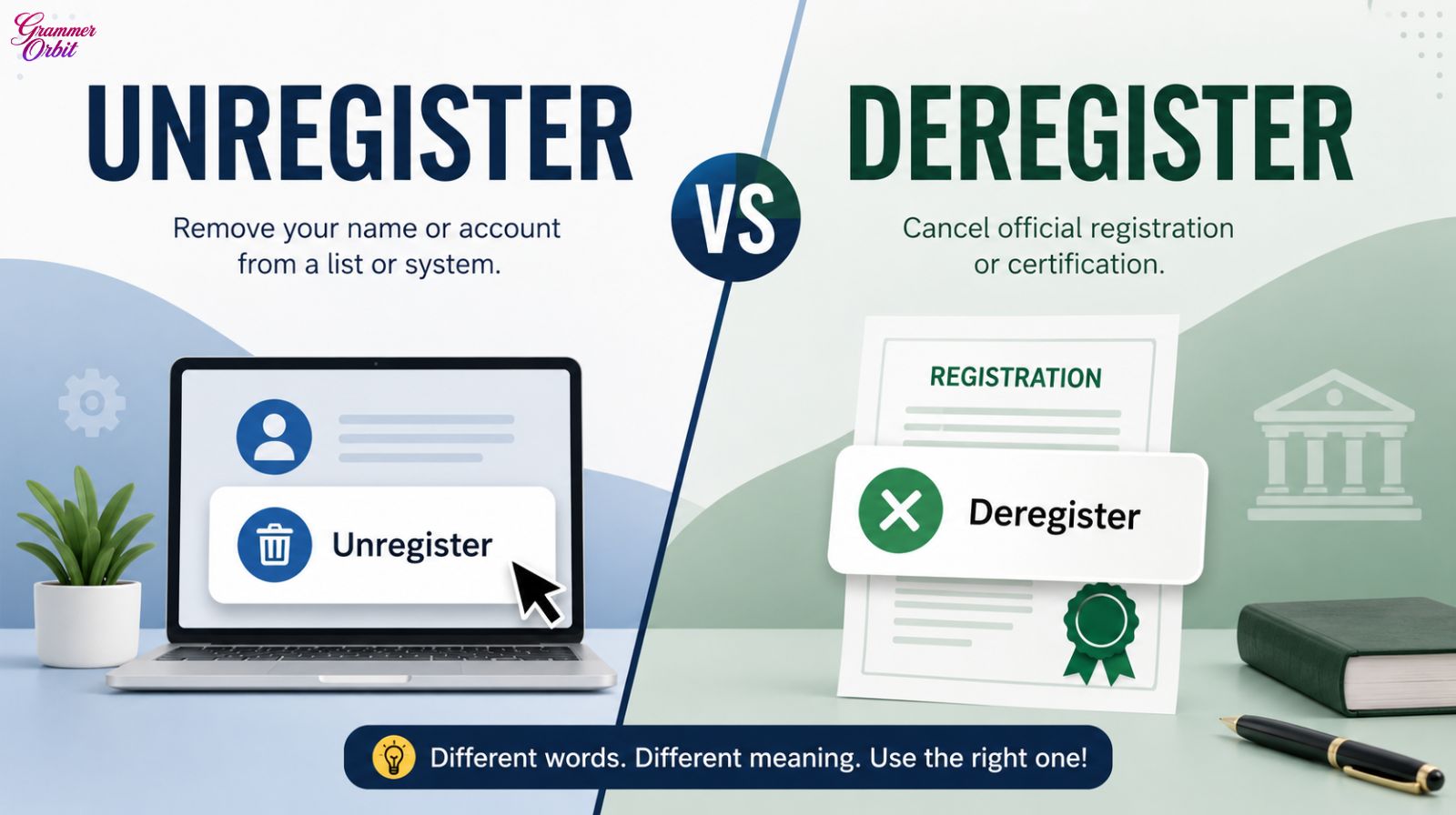
Choosing between unregister vs deregister can seem surprisingly difficult. Both words describe removing something from a registration system, and in many situations they can even function as synonyms. However, the two words are not always equally natural or appropriate.
The simplest distinction is this: unregister usually emphasizes undoing or reversing a previous registration, while deregister often sounds more formal and is commonly used when something is officially removed from a register, list, or regulatory system.
That difference matters when you’re writing about accounts, software, organizations, vehicles, licenses, databases, subscriptions, or official records.
Let’s examine unregister vs deregister with clear definitions, examples, usage rules, and a practical comparison so you can choose the right word confidently.
Unregister vs Deregister: What Is the Difference?

At a glance, the words appear almost identical. Both can communicate the idea of removing something that was previously registered.
However, their typical contexts differ.
What Does “Unregister” Mean?
Unregister means to undo a registration or remove something from a system in which it was previously registered.
It is especially common in technical, software, digital, and account-related contexts.
For example:
- You can unregister a device from an application.
- A developer can unregister a software component.
- A user can unregister from a service.
- You may need to unregister an email address from a notification system.
The word can describe either a person taking themselves out of a registration system or a system administrator removing something that was registered.
Dictionary usage also supports this general meaning: unregister can mean to undo the process of registration.
What Does “Deregister” Mean?
Deregister generally means to officially remove a person, organization, vehicle, business, or other item from a register.
It tends to sound more formal, administrative, regulatory, or institutional.
For example:
- The company was deregistered from the official register.
- The vehicle was deregistered after being permanently taken off the road.
- The professional was deregistered by the regulatory authority.
- The organization applied to deregister from the official scheme.
Dictionary.com defines deregister as removing oneself or something such as a car from a register.
The Quick Rule
A useful rule is:
Unregister = undo/remove a registration.
Deregister = formally remove something from a register.
This is a guideline rather than an absolute grammatical rule because the two words overlap considerably.
When Should You Use “Unregister”?
The word unregister is often the better choice when you’re talking about reversing a registration, particularly in technology or everyday digital situations.
Unregister in Technology
Technical writing frequently uses unregister because software components can be registered and then removed from a system.
For example:
“Unregister the plugin before uninstalling the application.”
Here, unregister clearly describes reversing the registration of the plugin.
Other examples include:
- Unregister the device from your account.
- The application automatically unregisters the old session.
- You can unregister the callback when it is no longer needed.
- The software allows users to unregister a device remotely.
Unregister for Accounts and Services
You may also encounter unregister when describing a user leaving a digital service.
For example:
“If you no longer use the platform, you can unregister your account.”
However, depending on the service, unsubscribe, deactivate, delete, or close may be more precise.
That’s important because removing a registration does not necessarily mean deleting an account or erasing personal information.
Unregister Examples
Correct:
“Please unregister this device from my account.”
Correct:
“The developer needs to unregister the event listener.”
Correct:
“Users can unregister from the training portal.”
These examples focus on reversing or removing a previous registration.
See also In Person vs In-Person: A Complete Guide To Correct Usage
When Should You Use “Deregister”?
Deregister is generally preferable when the situation involves an official register, authority, regulatory body, or formal administrative record.
Deregister in Official Contexts
Consider this sentence:
“The organization was deregistered from the official register.”
The formal tone makes deregistered a natural choice.
You might also see:
- deregister a company
- deregister a vehicle
- deregister a business
- deregister a professional
- deregister for tax purposes
- deregister from an official program
In these contexts, the word often implies more than simply clicking an “unregister” button. It can indicate a formal administrative action.
Deregister Does Not Always Mean “Delete”
This distinction is particularly important.
If an organization is deregistered, that does not necessarily mean every historical record about it disappears.
For example, an organization may be removed from an active register while historical information remains available in archived records.
Therefore, avoid treating deregister as a universal synonym for delete.
Deregister Examples
Correct:
“The business applied to deregister from the government register.”
Correct:
“The vehicle was deregistered after it was permanently removed from service.”
Correct:
“The professional body decided to deregister the member.”
The formal administrative context makes deregister appropriate.

Unregister vs Deregister: A Side-by-Side Comparison
| Feature | Unregister | Deregister |
|---|---|---|
| Basic meaning | Undo or remove a registration | Officially remove from a register |
| Typical tone | General or technical | Formal or administrative |
| Common contexts | Software, devices, accounts, systems | Businesses, vehicles, licenses, official records |
| Implies official action? | Not necessarily | Often |
| Common in technical writing? | Yes | Sometimes |
| Common in regulatory writing? | Sometimes | Yes |
| Means “delete everything”? | No | No |
| Can they overlap? | Yes | Yes |
Which Word Is More Formal?
In general, deregister has a more formal or institutional feel.
For example:
“Please unregister your device.”
sounds like an ordinary technical instruction.
Compare it with:
“The company was deregistered from the national register.”
The second sentence clearly belongs to a more official or administrative setting.
Are Unregister and Deregister Always Interchangeable?
No.
Although dictionaries may treat the words as synonyms in some circumstances, natural usage matters.
For example:
“Unregister the software component.”
sounds much more natural than:
“Deregister the software component.”
On the other hand:
“The company was deregistered from the official register.”
sounds more natural than:
“The company was unregistered from the official register.”
The surrounding context should determine your choice.
A Real-World Case Study: Why the Distinction Matters

Consider a small business owner who operates a company that is no longer trading.
The owner tells an employee, “We need to unregister the company.”
That statement may sound understandable, but it is potentially too vague in a formal business context. The owner may actually need to complete an official deregistration, dissolution, tax closure, or other regulatory process, depending on the jurisdiction.
This distinction is important because simply removing a company’s details from one online account does not necessarily end its legal obligations.
The UK’s Companies House data illustrates how significant official register changes can be. Its 2024–25 figures reported 726,813 dissolved companies, compared with 663,167 in 2023–24.
Now imagine that the owner tells a colleague, “I’ve unregistered the company,” when all they actually did was remove a company profile from an internal software system. The colleague might incorrectly assume that the company’s official legal status has changed.
The safer wording would be specific:
“I’ve removed the company from our internal system.”
or, if the formal process really occurred:
“We’ve completed the company’s deregistration/dissolution process.”
The lesson is simple: the wrong word can create ambiguity about whether a technical action or an official legal action has actually taken place.
What Recent Data Tells Us About Registration and Deregistration
Registration systems are not merely linguistic concepts. They are used at enormous scale by governments, businesses, websites, financial institutions, software platforms, and other organizations.
See also Better Than vs Better Then: The Ultimate Grammar Guide
2025–2026 Registration Data
Companies House provides a useful real-world example of how important official registers remain.
During the UK financial year ending in 2026, Companies House recorded 787,120 company dissolutions, an 8.31% increase from the previous financial year. The total register contained 5,479,045 companies at the end of FYE 2026, including companies undergoing dissolution or liquidation.
Earlier, between October and December 2025, the UK recorded 176,716 company dissolutions and 184,888 incorporations.
Digital registration also operates on a global scale. The International Telecommunication Union estimated that approximately 6 billion people were using the Internet in 2025, representing around three-quarters of the world’s population.
These figures show why precise terminology matters. Registration and removal processes affect millions of organizations and billions of digital users.
Common Mistakes With Unregister and Deregister

The biggest mistake is assuming that the words are completely interchangeable in every situation.
Mistake 1: Using “Unregister” for Every Official Process
Someone might write:
“The government unregistered the company.”
The sentence is understandable, but deregistered may be more natural if the government formally removed the company from an official register.
Better:
“The company was deregistered from the official register.”
Mistake 2: Using “Deregister” for Simple Software Actions
Consider:
“Deregister your phone from the app.”
This may be grammatically possible, but if the application documentation normally uses unregister, changing the terminology can make the instruction sound unnatural.
Better:
“Unregister your phone from the app.”
Mistake 3: Confusing Deregistration With Deletion
Deregistering something does not automatically mean that every record has been permanently deleted.
A system may retain:
- historical records
- transaction history
- audit logs
- archived documents
- legal records
Therefore, use delete, erase, or destroy only when those actions actually occur.
Mistake 4: Ignoring the Organization’s Official Terminology
If a government agency, software platform, or professional organization officially uses deregister, follow its terminology.
Likewise, if a technical manual consistently says unregister, don’t replace it simply because deregister sounds more formal.

How to Choose Between Unregister and Deregister
Use this simple decision process before writing.
Step 1: Identify What Is Being Removed
Ask:
Is it a software component, device, account, or digital connection?
If yes, unregister is often a strong choice.
If it is a company, license, vehicle, professional status, or official record, deregister may be more appropriate.
Step 2: Ask Whether the Register Is Official
If an authority or institution maintains the register and the removal is a formal administrative action, deregister is usually the safer choice.
Step 3: Check the Context
For technical instructions:
“Unregister the device.”
For formal administration:
“Deregister the vehicle.”
For a company-specific process:
Use whatever terminology the relevant authority officially uses.
Step 4: Check Whether You Actually Mean “Delete”
If your intended meaning is permanent destruction of information, neither word may be precise enough.
Instead, consider:
- delete
- erase
- remove
- cancel
- deactivate
- terminate
- unsubscribe
The exact verb depends on what actually happens.
Unregister vs Deregister: Which One Is Correct?
Neither word is universally “more correct.”
The correct choice depends on the context and the process being described.
Use unregister when you want to emphasize reversing a registration, especially in technical or digital contexts.
Use deregister when you want to emphasize formal removal from an official register or administrative system.
See also Forest vs Forrest The Complete Guide To Never Confuse Them Again
Quick Examples
Technical:
“Unregister the device before transferring ownership.”
Official:
“The vehicle was deregistered after being permanently retired.”
Software:
“The application unregisters the callback when the session ends.”
Administrative:
“The company applied to deregister from the official register.”
This distinction is more about usage and context than a strict grammatical rule.
FAQs
Q1: Is “unregister” the same as “deregister”?
A: They can mean essentially the same thing in some contexts: removing something from a registration system. However, deregister is often more formal and associated with official registers, while unregister is common in technical and digital contexts.
Q2: Is deregister a proper English word?
A: Yes. Deregister is an established English verb meaning to remove someone or something from a register. It is especially common in formal, administrative, and regulatory contexts.
Q3: Is unregister grammatically correct?
A: Yes. Unregister is a standard English verb meaning to undo or reverse a registration. It is particularly common in computing, software, and digital services.
Q4: Should I say “unregister an account” or “deregister an account”?
A: Usually, unregister an account is more natural when discussing a digital service or technical system. However, if the service itself officially uses deregister, follow its terminology.
Q5: Is “deregister” more formal than “unregister”?
A: Generally, yes. Deregister often has a more formal or institutional tone, while unregister is common in everyday technical instructions. This is a tendency rather than an absolute rule.
Q6: Does deregister mean delete?
A: No. Deregistration means removal from a register or registration system. It does not necessarily mean that all related records, history, or personal data have been permanently deleted.
Q7: Can a company be unregistered?
A: It can be described that way in some contexts, but deregistered, removed from the register, or dissolved may be more precise depending on the legal process involved. Always check the terminology used by the relevant authority.
Q8: Which is better for formal writing: unregister or deregister?
A: For formal administrative or regulatory writing, deregister is often the better choice. For technical documentation involving software, devices, or system registrations, unregister is frequently more natural.
Conclusion:
The difference between unregister vs deregister is subtle but useful.
Unregister generally focuses on undoing or removing a registration, particularly in technical, software, digital, or everyday contexts.
Deregister generally suggests formal removal from an official register and is therefore common in administrative, regulatory, business, and institutional contexts.
Remember the practical rule:
Unregister = reverse a registration.
Deregister = formally remove from a register.
But don’t treat this as an unbreakable rule. Because the meanings overlap, the terminology used by the relevant software, company, government agency, or professional body should always take priority.
If you’re writing an article, business document, technical guide, or official communication, choosing the contextually precise word can make your meaning much clearer.
Bookmark this guide and share it with anyone who regularly gets confused by similar English word pairs.
👉 Discover more simple and practical grammar guides on Grammer Orbit

Zia Ahmad is a professional blogger specializing in grammar tips and spelling accuracy. He creates clear, practical content that helps readers eliminate errors, strengthen writing skills, and communicate effectively for students, professionals, and everyday writers worldwide.