
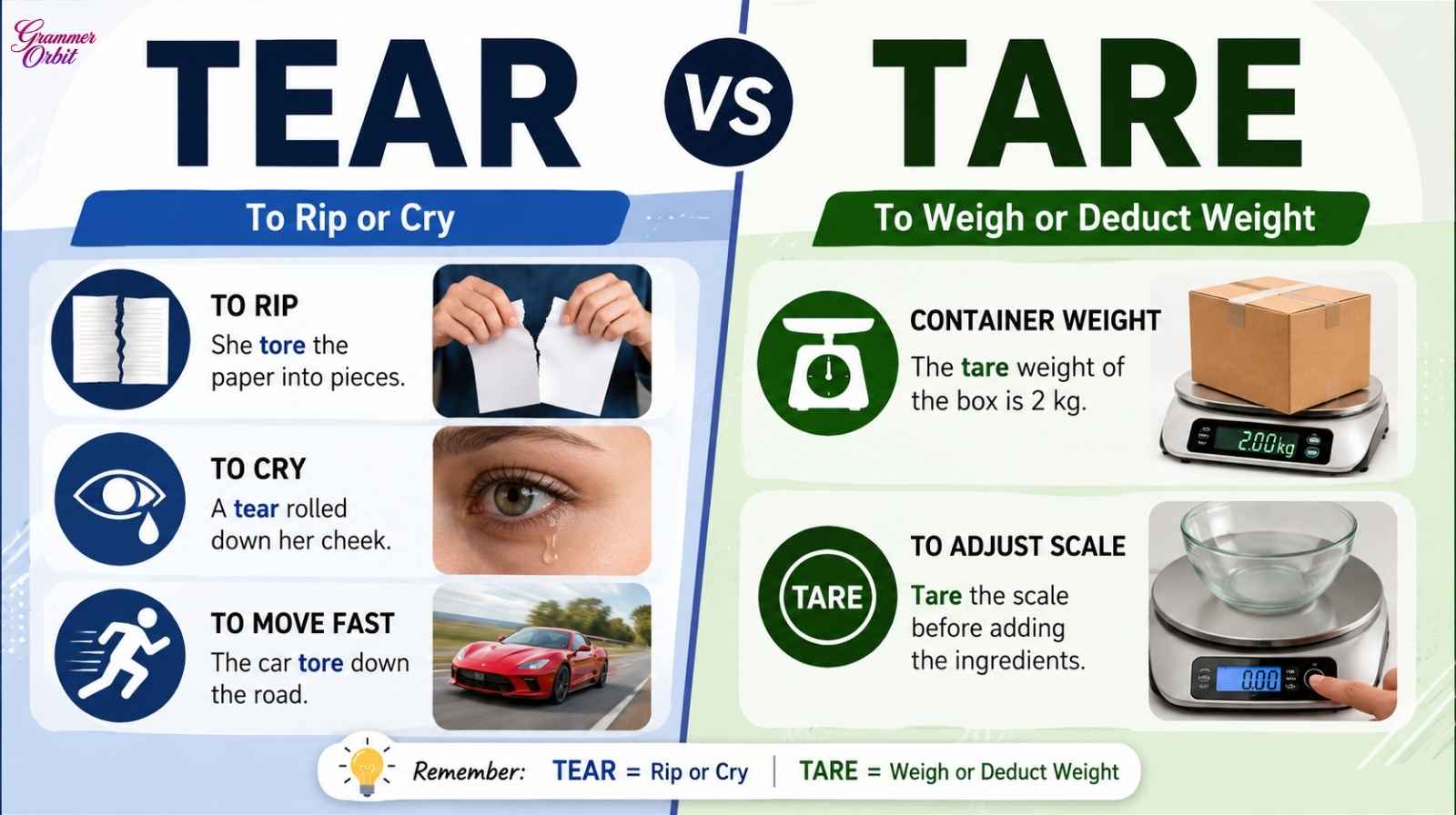
If you have ever wondered about tear vs tare, you are not alone. These two words look and sound remarkably similar, but they have completely different meanings and uses. Tear can refer to ripping something apart or a drop from your eye, while tare is mainly associated with weight, measurement, containers, and scales.
Understanding the tear and tare difference is important because using the wrong word can completely change the meaning of a sentence. For example, you can tear a piece of paper, but you tare a scale.
In this guide, you will learn the meaning, pronunciation, grammar, examples, common mistakes, and an easy way to remember tear vs tare.
Tear vs Tare: What Is the Difference?

The simplest way to remember the difference is this:
Tear is commonly related to ripping, crying, or moving quickly, while tare is related to weighing and the weight of a container.
Although the words can sound alike in some pronunciations, they are not interchangeable.
| Word | Main Meaning | Common Use | Example |
|---|---|---|---|
| Tear | Rip or pull apart | Paper, clothing, objects | Don’t tear the paper. |
| Tear | Drop of liquid from the eye | Crying or emotion | A tear rolled down her cheek. |
| Tear | Move very quickly | Informal expression | The car tore down the road. |
| Tare | Weight of a container | Scales and measurement | Tare the container before weighing. |
| Tare | Deduct container weight | Shipping and commerce | The tare weight is 2 kg. |
Merriam-Webster defines tare as a deduction from gross weight or the weight of a container and also as a verb meaning to adjust a scale to zero after placing an empty container on it.
Tear vs Tare at a Glance
Think of these memory associations:
- Tear → rip or cry
- Tare → scale or weight
- Tear → paper, clothes, eyes
- Tare → container, package, measurement
That distinction solves most tear vs tare confusion immediately.
See also Pajamas vs Pyjamas: The Real Difference, History, Usage, And Correct Spelling
What Does Tear Mean?
Tear has several meanings in English, which makes it especially important to understand the context.
Tear Meaning: To Rip or Pull Apart
As a verb, tear means to pull something apart or damage it by force.
Examples:
- Be careful not to tear the paper.
- I accidentally tore my shirt.
- The child tore the page from the notebook.
- The old fabric tears easily.
The past tense of this meaning is tore, and the past participle is torn.
Present: tear
Past: tore
Past participle: torn
Cambridge Dictionary defines this sense of tear as pulling something apart or pulling pieces from it.
Tear Meaning: A Drop From the Eye
Tear can also be a noun referring to the salty liquid produced by the eyes, particularly during sadness, happiness, pain, or strong emotion.
Examples:
- A tear rolled down his cheek.
- She had tears in her eyes.
- The movie brought a tear to my eye.
- He wiped away a tear.
This meaning has a different pronunciation from the “rip” meaning in many varieties of English.
Tear Meaning: Move Very Quickly
There is another informal use of tear as a verb.
For example:
The ambulance came tearing down the street.
Here, tearing means moving very quickly. Cambridge Dictionary also lists this informal meaning.
Pronunciation of Tear
One reason tear can be confusing is that the spelling represents different pronunciations.
- tear = to rip → commonly pronounced like tair
- tear = liquid from the eye → commonly pronounced like teer
Therefore, context is essential when understanding the word.
What Does Tare Mean?
Tare is a less common everyday word, but it is important in weighing, shipping, manufacturing, cooking, and commerce.
Tare as a Weight
Tare refers to the weight of a container or packaging that must be accounted for when determining the actual weight of its contents.
For example, imagine a box weighs 1 kg, while the products inside weigh 9 kg.
- Gross weight = 10 kg
- Tare weight = 1 kg
- Net weight = 9 kg
So, the container’s 1 kg is the tare weight.
Tare as a Verb
As a verb, tare means to adjust a scale so that the container’s weight is excluded from the measurement.
For example:
Place the empty bowl on the kitchen scale and tare it before adding flour.
Once the scale is tared, the display can show the weight of the ingredients rather than the bowl.
Merriam-Webster specifically defines tare as adjusting a scale with an empty container on it so the displayed weight returns to zero.
Tare in Everyday Measurement
You may encounter tare when:
- Using a kitchen scale
- Weighing products
- Shipping packages
- Measuring goods
- Reading vehicle specifications
- Working with industrial scales
- Calculating gross and net weight
For example:
The package has a gross weight of 15 kg and a tare weight of 2 kg.
Its net contents therefore weigh 13 kg.

Tear vs Tare: Real Examples You Can Copy
The easiest way to master tear vs tare is to see the words in natural sentences.
Examples With Tear
Tear = rip
Please don’t tear the envelope.
Tear = rip apart
The dog tore my jacket.
Tear = liquid from the eye
A single tear appeared in her eye.
Tear = move quickly
The motorcycle came tearing down the road.
Examples With Tare
Tare = container weight
The tare weight of the box is 500 grams.
Tare = reset a scale
Tare the scale before adding the ingredients.
Tare = account for packaging
The machine automatically calculates the tare weight.
A Simple Comparison
Consider these two sentences:
Don’t tear the package.
This means don’t rip or damage it.
Record the tare weight of the package.
This means record the weight of the empty packaging.
The spelling is only one letter apart, but the meanings are completely different.
Common Mistakes With Tear and Tare

Because tear and tare are similar in spelling and pronunciation, people sometimes substitute one for the other.
Mistake 1: Using Tare for Ripping
See also Traveler vs Traveller: Which Spelling Is Correct?
❌ Please don’t tare the paper.
✅ Please don’t tear the paper.
The correct word is tear because the sentence describes ripping.
Mistake 2: Using Tear for a Scale
❌ Tear the scale before weighing the flour.
✅ Tare the scale before weighing the flour.
The correct word is tare because you are resetting the scale.
Mistake 3: Confusing Tare Weight With Net Weight
Tare weight is not the weight of the contents.
For example:
- Container = 2 kg
- Contents = 8 kg
- Gross weight = 10 kg
- Tare weight = 2 kg
- Net weight = 8 kg
This distinction is particularly important in shipping, manufacturing, and commercial measurement.
A Quick Rule to Avoid Errors
Ask yourself:
Am I talking about ripping or crying?
Use tear.
Am I talking about a scale, container, or weight?
Use tare.
This simple question works in most everyday situations.
2025–2026 Data and Usage Insights
There is an important point about statistics for a word-comparison article: authoritative sources do not publish a reliable annual percentage showing how many people confuse tear with tare. Therefore, it would be misleading to invent a search-volume or error-rate statistic.
However, current 2025–2026 language and search guidance gives useful evidence about how this type of content should be presented.
Current Dictionary Evidence
As of 2026, Merriam-Webster continues to list tare with separate meanings relating to a vetch/weed and, importantly for this comparison, the weight of a container and the act of adjusting a scale. Its entry also records the verb’s first known use as 1812.
Cambridge’s current dictionary entry shows multiple meanings for tear, including ripping, moving quickly, and the noun referring to liquid from the eye.
What Google’s 2025–2026 Guidance Says
Google’s current Search Central documentation emphasizes helpful, reliable, people-first content and specifically recommends providing substantial, original value rather than simply rewriting information from other websites. The guidance was updated on December 10, 2025.
Google also published guidance in May 2025 explaining that unique, valuable content remains important as Search expands into AI-powered experiences and that longer, more specific user questions are increasingly relevant.
So, for a tear vs tare guide, the useful data-driven takeaway is clear: accurate definitions, contextual examples, trustworthy sources, and genuinely useful explanations are more valuable than stuffing the page with repeated keywords.
See also Excell vs Excel: Which Spelling Is Correct?
A Real-Life Example: Using Tare at a Kitchen Scale
Imagine you’re following a recipe that requires 300 grams of flour.
You place an empty mixing bowl on a digital kitchen scale. The bowl weighs 650 grams. If you simply add flour without resetting the scale, the display will include the bowl’s weight.
Instead, you press the tare button.
The scale resets its displayed weight to zero while the bowl remains on it. You then add flour until the display reaches 300 grams.
In this situation, tare is exactly the right word because you’re excluding the bowl’s weight from the measurement. The bowl’s 650 grams is the tare weight, while the 300 grams of flour represents the ingredient weight you’re trying to measure.
Now imagine writing a sentence about the same kitchen experience:
“I accidentally tore the recipe card while preparing the ingredients.”
Here, tear is correct because the recipe card was physically damaged.
This example shows why tear vs tare is more than a spelling issue. The correct word depends on the action or concept you’re describing. Tear belongs to ripping, crying, and related contexts; tare belongs primarily to weighing and measurement.

How to Remember Tear vs Tare Easily
If you repeatedly mix up these words, use a visual memory trick.
Remember Tear With “Rip”
Associate tear with:
Tear → rip
Imagine tearing a sheet of paper in half.
You can also associate it with:
Tear → eye
Think of a tear falling from someone’s eye.
Remember Tare With “Scale”
Associate tare with:
Tare → scale
Imagine putting an empty bowl on a digital scale and pressing the TARE button.
The 5-Second Test
Before writing the word, ask:
- Is something being ripped? → tear
- Is someone crying? → tear
- Is something moving extremely quickly? → tear
- Is a scale being reset? → tare
- Am I talking about container weight? → tare
If the situation involves a scale or container, tare is usually the word you need.
FAQs
Q1: Is tear and tare the same word?
A: No. Tear and tare are different words with different meanings. Tear can mean to rip, a drop from the eye, or move quickly. Tare commonly refers to the weight of a container or adjusting a scale.
Q2: What is the difference between tear and tare?
A: The main difference is their meaning. Tear is associated with ripping, crying, and rapid movement, while tare is associated with weighing, containers, and measurement.
Q3: Is tare a real English word?
A: Yes. Tare is a standard English word. It can refer to the weight of a container or the process of adjusting a scale to exclude the container’s weight.
Q4: Do tear and tare sound the same?
A: They can sound the same or very similar depending on the meaning and pronunciation of tear and the speaker’s accent. The “rip” meaning of tear is commonly pronounced differently from the “crying” meaning.
Q5: What does tare mean on a weighing scale?
A: On a weighing scale, tare means resetting the scale so the weight of an empty container is excluded. For example, you can place a bowl on a kitchen scale and press the tare button before adding ingredients.
Q6: What is tare weight?
A: Tare weight is the weight of a container or packaging. If a loaded package weighs 20 kg and the packaging weighs 3 kg, the tare weight is 3 kg and the net contents weigh 17 kg.
Q7: What is the past tense of tear?
A: When tear means “rip,” its past tense is tore, and its past participle is torn.
For example:
I tear the paper.
I tore the paper yesterday.
I have torn the paper.
Q8: How can I remember tear vs tare?
A: Remember:
Tear = rip or cry
Tare = scale or weight
If you’re dealing with paper, clothing, or tears from your eyes, choose tear. If you’re dealing with a weighing scale or container weight, choose tare.
Conclusion:
The difference between tear vs tare becomes easy once you connect each word with its main meaning.
Tear is used for ripping, crying, and certain expressions involving fast movement. Tare, on the other hand, is mainly used for weighing and refers to the weight of a container or adjusting a scale to exclude that weight.
The easiest memory trick is:
Tear = rip or cry.
Tare = scale or weight.
Keep that distinction in mind, and you’ll be much less likely to confuse these two words in emails, schoolwork, professional writing, recipes, or everyday conversations.
For more clear word-vs-word explanations, bookmark this guide and check back whenever you encounter another confusing English word pair.
👉 Discover more simple and practical grammar guides on Grammer Orbit

Zia Ahmad is a professional blogger specializing in grammar tips and spelling accuracy. He creates clear, practical content that helps readers eliminate errors, strengthen writing skills, and communicate effectively for students, professionals, and everyday writers worldwide.