
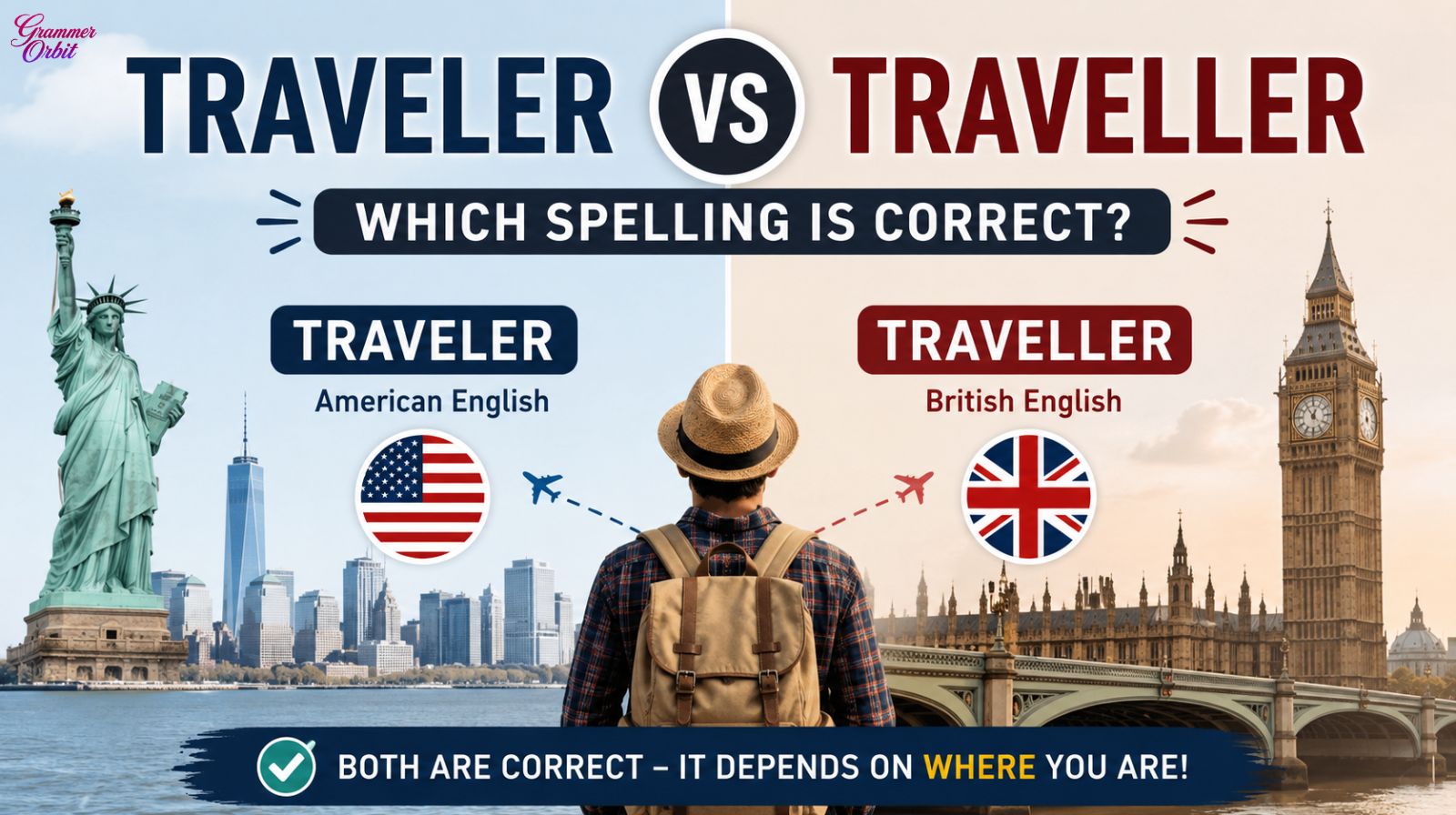
Have you ever typed traveler only to have your spell checker suggest traveller or the other way around? You’re not alone. This spelling difference confuses students, writers, bloggers, and even professionals because both words appear in books, websites, and official documents.
The good news is that both spellings are correct. The difference depends on the variety of English you’re using. In this guide, you’ll learn when to use traveler vs traveller, why the spellings differ, and how to avoid mistakes in formal writing.
Traveler vs Traveller: What’s the Difference?
The only real difference between traveler and traveller is the regional spelling.
| Word | Used In | Correct? |
|---|---|---|
| Traveler | American English | ✅ Yes |
| Traveller | British English, Australian English, Canadian English (commonly) | ✅ Yes |
Both words mean:
A person who travels from one place to another.
The meaning never changes only the spelling does.
Quick Answer
If you’re writing for an American audience, use traveler.
If you’re writing for readers in the UK, Australia, or many Commonwealth countries, use traveller.
Why Are There Two Spellings?
American English often simplifies spellings by using one consonant instead of two.
Examples include:
- Traveler (US) → Traveller (UK)
- Traveled (US) → Travelled (UK)
- Traveling (US) → Travelling (UK)
This spelling pattern became common after American spelling reforms promoted by lexicographer Noah Webster.
See also Feal vs Feel: What’s The Real Difference And Which One Should You Use?
When Should You Use “Traveler”?
Use traveler whenever you’re writing in American English.
It’s the standard spelling used in:
- American newspapers
- U.S. schools
- Government publications
- Business writing
- Most American websites
Examples
- She is an experienced traveler.
- Every traveler must show identification.
- The traveler booked a direct flight to Chicago.
Common American Phrases
- frequent traveler
- business traveler
- solo traveler
- international traveler
- traveler information
These phrases appear regularly across American publications.
When Should You Use “Traveller”?
Choose traveller when writing in British English or for audiences in countries that follow British spelling conventions.
You’ll commonly see it in:
- United Kingdom
- Australia
- New Zealand
- Ireland
- Many Commonwealth nations
Examples
- Every traveller should carry travel insurance.
- The experienced traveller visited over fifty countries.
- A smart traveller always keeps copies of important documents.
Common British Expressions
- frequent traveller
- seasoned traveller
- solo traveller
- traveller advice
- traveller information
Traveler vs Traveller: Side-by-Side Comparison
| Feature | Traveler | Traveller |
|---|---|---|
| Meaning | Person who travels | Person who travels |
| English Style | American English | British English |
| Correct Spelling | Yes | Yes |
| Pronunciation | Same | Same |
| Preferred in USA | ✅ Yes | Rare |
| Preferred in UK | Rare | ✅ Yes |
See also Forest vs Forrest The Complete Guide To Never Confuse Them Again
Why Does American English Use One “L”?
American English follows simplified spelling rules introduced during the early 1800s.
Words ending with -el often keep a single L before adding endings.
For example:
| American | British |
|---|---|
| traveled | travelled |
| traveling | travelling |
| traveler | traveller |
British English generally doubles the L before adding suffixes.
This is simply a spelling convention not a grammar rule.
Real-Life Example: Choosing the Right Spelling for an International Travel Blog
Imagine Sarah, a freelance travel writer, launches a website aimed at readers in the United States. She consistently writes “traveller” because that’s the spelling she learned while studying British English. After publishing dozens of articles, she notices that many American readers comment on the unusual spelling, and her editor recommends changing it to “traveler” for consistency.
Sarah updates her content to match American English because her audience is primarily based in the U.S. A few months later, she starts a second version of the website targeting readers in the United Kingdom and Australia. This time, she intentionally uses “traveller” throughout the site to align with local spelling expectations.
Neither version is incorrect. In fact, both are grammatically accurate. The key lesson is that successful writers don’t choose one spelling because it’s “better” they choose the spelling that matches their audience. Whether you’re writing blog posts, marketing copy, academic papers, or travel guides, maintaining consistent spelling throughout your content improves readability, professionalism, and trust with readers.
Usage Statistics and Language Trends (2025–2026)
Language usage continues to reflect regional preferences rather than one universally “correct” spelling.
- American publishers overwhelmingly use traveler in books, news articles, and educational materials.
- British publishers consistently prefer traveller in newspapers, government websites, and travel resources.
- Search trends in 2025–2026 show traveler receives significantly higher global search volume because of the large U.S. online audience, while traveller remains dominant in the UK and several Commonwealth countries.
- Modern grammar tools generally recognize both spellings and recommend one based on the selected English variant.
The takeaway: choose the spelling that matches your audience and use it consistently throughout your writing.
Common Mistakes to Avoid
Mixing Both Spellings
❌ The traveler met another traveller.
✅ Choose one spelling style and stay consistent.
See also Better Than vs Better Then: The Ultimate Grammar Guide
Assuming One Is Wrong
Many people believe only one spelling is correct.
Actually:
- Traveler ✅
- Traveller ✅
Both are accepted depending on regional English.
Ignoring Your Audience
Always consider who will read your content before choosing a spelling style.
FAQs
Q1: Is traveler or traveller correct?
A: Both are correct. Traveler is American English, while traveller is British English.
Q2: Which spelling does the United States use?
A: American English uses traveler.
Q3: Which spelling does the UK use?
A: British English prefers traveller.
Q4: Is traveller considered incorrect in America?
A: No. Americans recognize it, although traveler is the standard spelling.
Q5: Which spelling should bloggers use?
A: Use whichever spelling matches your target audience and keep it consistent throughout the article.
Q6: Does pronunciation change?
A: No. Both words are pronounced exactly the same.
Q7: Is traveler more common online?
A: Globally, yes. Much of that usage comes from American websites and publications.
Q8: Can I switch between the two spellings?
A: It’s better not to. Consistency improves readability and professionalism.
Conclusion
When comparing Traveler vs Traveller, the answer is simple: both spellings are correct. The only difference is regional English. Use traveler for American audiences and traveller for British and many Commonwealth audiences.
By matching your spelling to your readers and staying consistent, your writing will appear more natural, professional, and trustworthy.
Whether you’re writing a travel blog, school assignment, or business content, understanding this small spelling difference can make a big impact on clarity and credibility.
👉 Discover more simple and practical grammar guides on Grammer Orbit

Zia Ahmad is a professional blogger specializing in grammar tips and spelling accuracy. He creates clear, practical content that helps readers eliminate errors, strengthen writing skills, and communicate effectively for students, professionals, and everyday writers worldwide.