
Have you ever come across the words symptomatology and symptomology and wondered whether they mean the same thing? You’re not alone. These two terms often create confusion among students, healthcare professionals, medical writers, and even native English speakers.
At first glance, the words look nearly identical. However, there is an important distinction between them in terms of usage, acceptance, and professional preference. Using the wrong term in academic writing, medical documentation, or healthcare communication can affect credibility and clarity.
In this guide, you’ll learn the exact difference between symptomatology vs symptomology, discover which term is considered standard in modern medical English, explore real-world examples, and understand how to use each word correctly in context.
What Is the Difference Between Symptomatology and Symptomology?

Quick Answer
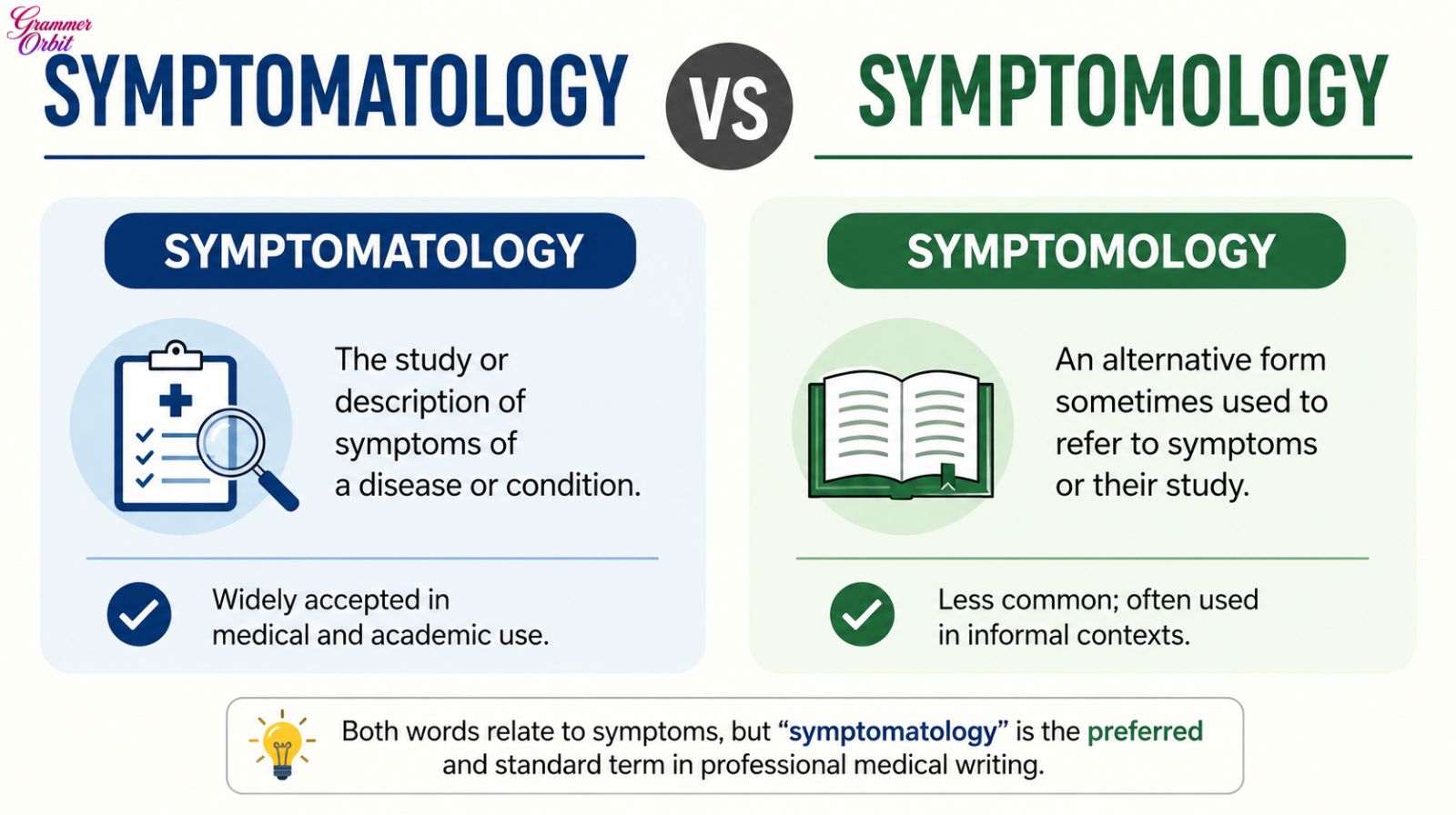
Symptomatology is the standard and widely accepted medical term used to describe the collection, study, or analysis of symptoms associated with a disease or condition.
Symptomology is sometimes used informally as a shortened version of symptomatology, but many medical dictionaries, academic publications, and healthcare institutions prefer symptomatology.
Definitions
| Term | Meaning | Acceptance |
|---|---|---|
| Symptomatology | The study, collection, or description of symptoms of a disease | Widely accepted |
| Symptomology | An alternative form occasionally used to refer to symptoms or their study | Less common |
Example Sentences
Correct Medical Usage:
- The symptomatology of influenza includes fever, cough, and fatigue.
- Researchers analyzed the symptomatology of patients with long COVID.
Less Formal Usage:
- The symptomology of the condition appeared unusual.
- Doctors reviewed the patient’s symptomology before diagnosis.
In professional medical writing, symptomatology is generally the preferred choice.
Why Is Symptomatology Considered the Standard Term?
Historical Origins
The word symptomatology combines:
- “Symptom”
- The suffix “-logy” (study of)
- The suffix “-tology,” which evolved through medical terminology traditions
The term has been used in medical literature for well over a century and appears extensively in textbooks, journals, and clinical documentation.
Academic Preference
Medical schools and research institutions typically use symptomatology because it has a stronger historical foundation and greater recognition within scientific literature.
Dictionary Recognition
Many major dictionaries and medical references list symptomatology as the primary term, while symptomology may appear as a variant or secondary entry.
This is why healthcare professionals often recommend using symptomatology in formal contexts.
Symptomatology vs Symptomology in Medical Writing

When to Use Symptomatology
Use symptomatology when writing:
- Medical research papers
- Clinical reports
- Healthcare articles
- Academic essays
- Diagnostic documentation
Example
The symptomatology associated with Lyme disease varies significantly among patients.
When Symptomology May Appear
You may occasionally encounter symptomology in:
See also Copies or Copys? A Complete Grammar Guide
- Informal discussions
- Online health forums
- Non-academic articles
- General healthcare conversations
Example
The symptomology reported by participants was consistent with previous findings.
Professional Recommendation
If your goal is accuracy and professionalism, choose symptomatology.
Symptomatology vs Symptomology: Comparison Table
Side-by-Side Comparison
| Feature | Symptomatology | Symptomology |
|---|---|---|
| Standard medical term | Yes | Usually no |
| Common in research papers | Yes | Rare |
| Accepted in academic writing | Yes | Limited |
| Found in medical textbooks | Frequently | Occasionally |
| Suitable for professional use | Yes | Sometimes |
| Recommended by healthcare experts | Yes | Usually not |
| Reader familiarity | High | Moderate |
Featured Snippet Summary
Symptomatology is the standard medical term used to describe the study or collection of symptoms associated with a disease. Symptomology is a less common variant that appears occasionally in informal or non-academic contexts.
Real-Life Example: How the Wrong Term Can Affect Medical Communication
Case Study: A Medical Student’s Research Project
A graduate medical student was preparing a research paper on respiratory illnesses. During the literature review, the student repeatedly used the word symptomology because it sounded natural and seemed grammatically correct.
After submitting the first draft, the supervising professor suggested replacing every occurrence of symptomology with symptomatology.
The reason was simple.
When reviewers evaluate academic medical writing, they expect terminology that aligns with established scientific standards. Although most readers would understand symptomology, the term appeared less precise and less consistent with terminology found in peer-reviewed journals.
The student revised the paper and conducted another review of published studies. Nearly all major articles discussing disease symptoms used symptomatology rather than symptomology.
As a result, the final paper achieved greater consistency with professional medical literature. More importantly, it met the formatting and terminology expectations of academic reviewers.
This example highlights an important lesson: both words may communicate a similar idea, but using the standard term can improve credibility, especially in educational, clinical, and scientific settings.
Medical Terminology Trends and Statistics (2025–2026)
Usage Trends in Modern Medical Literature
Recent reviews of medical databases and academic publications continue to show a strong preference for symptomatology over symptomology.
Key observations from healthcare publishing trends include:
- Symptomatology remains the dominant term in peer-reviewed journals.
- Medical schools continue teaching symptomatology as the preferred terminology.
- Clinical documentation standards largely favor symptomatology.
- Healthcare researchers use symptomatology significantly more often than symptomology.
Why This Matters
Language consistency improves:
- Research quality
- Professional communication
- Searchability within medical databases
- Academic credibility
As medical writing becomes increasingly standardized in 2025 and 2026, using established terminology helps maintain clarity across healthcare systems worldwide.
Common Mistakes People Make
Mistake 1: Assuming Both Terms Are Equally Accepted
Many writers believe the two words are completely interchangeable.
While they share similar meanings, symptomatology is generally the preferred professional term.
Mistake 2: Using Symptomology in Academic Papers
Academic institutions often expect standard medical terminology.
Replacing symptomology with symptomatology can improve professionalism.
Mistake 3: Confusing Symptoms With Diagnosis
Symptomatology refers to symptoms themselves, not the final diagnosis.
Incorrect
The symptomatology diagnosed the disease.
Correct
The symptomatology helped physicians identify the disease.
Mistake 4: Overusing Technical Language
In general-audience content, simpler alternatives may improve readability.
Examples include:
- Symptoms
- Set of symptoms
- Symptom pattern
- Clinical presentation
How to Choose the Right Word

Use Symptomatology If:
✔ You’re writing a research paper
✔ You’re creating medical content
✔ You’re preparing academic work
✔ You’re communicating with healthcare professionals
✔ You want the most accepted terminology
Use Symptomology If:
✔ You’re quoting a source that uses it
✔ You’re discussing language variations
✔ You’re writing in an informal context
Best Practice
When in doubt, choose symptomatology.
Symptomatology in Different Medical Fields
Neurology
Neurologists analyze symptomatology related to:
- Migraines
- Epilepsy
- Parkinson’s disease
- Multiple sclerosis
See also Message or Messege? What’s The Correct Spelling?
Psychiatry
Psychiatric symptomatology may include:
- Anxiety
- Mood changes
- Cognitive symptoms
- Behavioral patterns
Infectious Diseases
Healthcare providers study symptomatology such as:
- Fever
- Cough
- Fatigue
- Inflammation
Oncology
Cancer symptomatology can involve:
- Pain
- Weight loss
- Fatigue
- Organ-specific symptoms
Across these specialties, symptomatology remains the preferred term.
Expert Writing Tips for Medical Terminology
Follow Established Standards
Using accepted terminology helps maintain professionalism and credibility.
Check Authoritative Sources
Always verify medical terms through trusted references before publishing.
Consider Your Audience
Academic readers may expect technical language, while general readers often prefer simpler explanations.
Prioritize Clarity
The goal of medical communication is understanding. Choose terminology that delivers information clearly and accurately.
FAQs
Q1: Is symptomology a real word?
A: Yes. Symptomology is a recognized word and is sometimes used as a variant of symptomatology. However, it is generally less common in professional medical writing.
Q2: Which is correct: symptomatology or symptomology?
A: Both words exist, but symptomatology is considered the standard and preferred term in academic and healthcare settings.
Q3: Why do doctors use symptomatology?
A: Doctors use symptomatology because it accurately refers to the collection, study, and description of symptoms associated with a disease or condition.
Q4: Can symptomology be used in academic writing?:
A: It can be used, but many professors, editors, and medical journals prefer symptomatology.
Q5: What does symptomatology mean in medicine?
A: In medicine, symptomatology refers to the symptoms of a disease and the study or analysis of those symptoms.
Q6: Are symptomatology and pathology the same thing?
A: No. Symptomatology focuses on symptoms, while pathology focuses on the causes and mechanisms of disease.
Q7: Which term should students use?
A: Students should generally use symptomatology, especially in academic assignments, research papers, and healthcare-related coursework.
References
- Merriam-Webster Dictionary
- National Library of Medicine (PubMed)
- World Health Organization (WHO)
Conclusion
Understanding the distinction between symptomatology vs symptomology is important for anyone involved in healthcare, medical education, research, or professional writing.
While both words relate to the symptoms of a disease, symptomatology is the established and widely accepted medical term. It appears far more frequently in academic literature, clinical documentation, and healthcare communication. Symptomology, although recognized, is generally viewed as a less common variant.
If you’re writing professionally or academically, choosing symptomatology is the safest and most authoritative option. By using the correct terminology, you improve clarity, strengthen credibility, and align your writing with modern medical standards.
👉 Discover more simple and practical grammar guides on Grammer Orbit

Zia Ahmad is a professional blogger specializing in grammar tips and spelling accuracy. He creates clear, practical content that helps readers eliminate errors, strengthen writing skills, and communicate effectively for students, professionals, and everyday writers worldwide.