
Have you ever typed “shinning” and wondered whether it should actually be “shining”? You’re not alone. Many English learners, writers, students, and professionals confuse these two words because they look similar and sound almost identical.
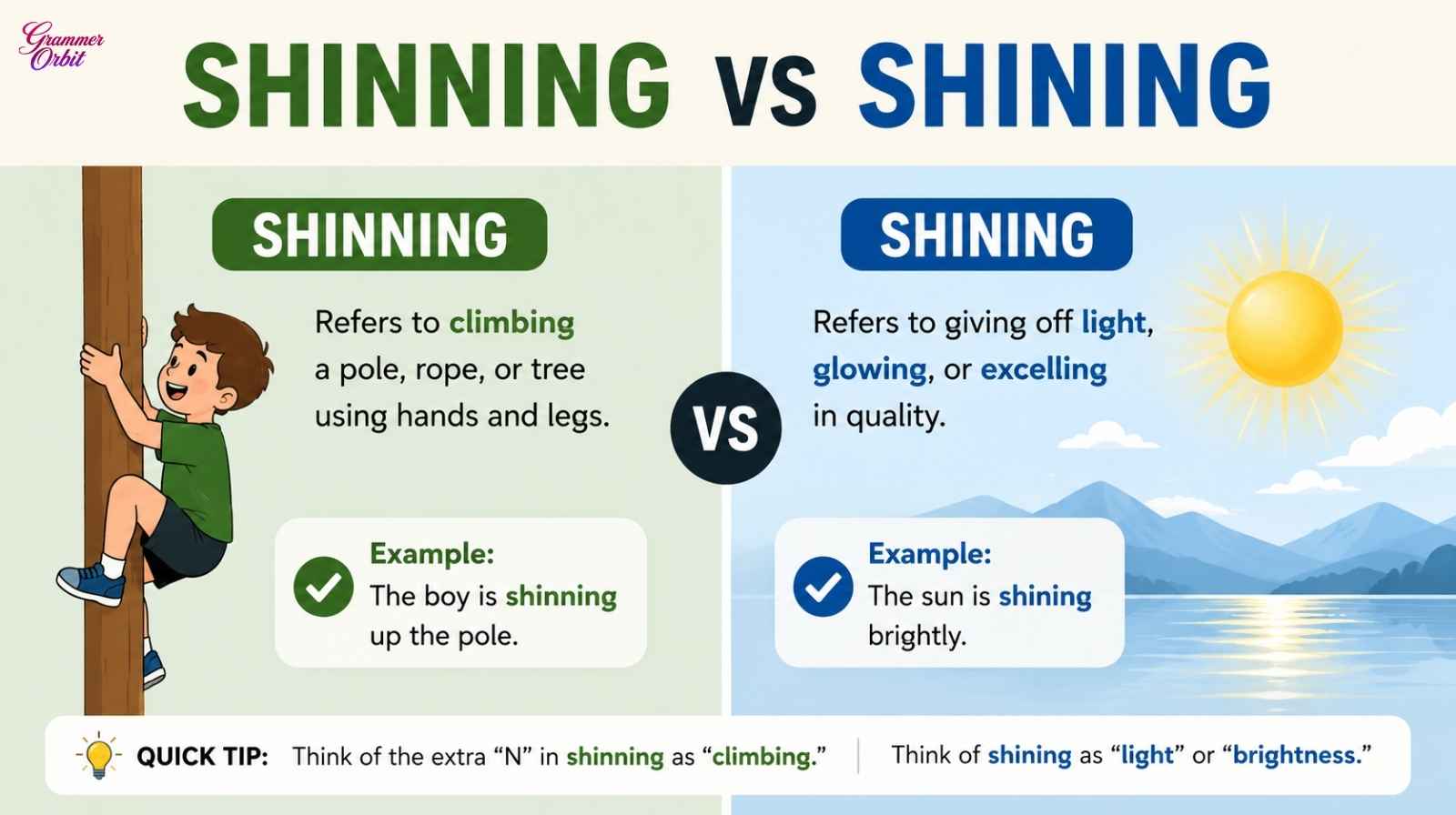
The good news is that understanding the difference is simple. While shining is the commonly used and correct form in most situations, shinning is a real word with a completely different meaning.
In this guide, you’ll learn the difference between shinning vs shining, when to use each word, common mistakes to avoid, and practical examples that make the distinction easy to remember.
What Is the Difference Between Shinning and Shining?
The primary difference is their meaning and usage.
| Word | Meaning | Common Usage |
|---|---|---|
| Shining | Giving off light, glowing, or excelling | Very common |
| Shinning | Climbing using hands and legs around an object | Rare |
| Shining | Present participle of “shine” | Everyday English |
| Shinning | Present participle of “shin” (to climb) | Specialized contexts |
Quick Answer
If you’re talking about light, brightness, success, or something glowing, shining is almost always the correct word.
Examples:
See also Whether or “Whether or Not”? (When To Use Each Correctly
- The sun is shining brightly.
- Her eyes were shining with happiness.
- He is a shining example of leadership.
When Is Shinning Correct?
Shinning is correct only when referring to climbing a pole, rope, tree, or similar object using the hands and legs.
Examples:
- The firefighter was shinning up the pole.
- The child enjoyed shinning up the tree.
Because this meaning is uncommon, most people rarely encounter the word.
Understanding the Word “Shining”
The word shining comes from the verb shine, meaning to emit light, reflect brightness, or stand out positively.
Shining as Physical Light
This is the most common usage.
Examples:
- The stars were shining all night.
- A flashlight was shining in the distance.
- The moon is shining over the lake.
Shining as Excellence
The word can also describe outstanding performance or character.
Examples:
- She is a shining example of honesty.
- The student delivered a shining performance.
- Their company remains a shining success story.
Common Expressions with Shining
Some popular phrases include:
- Shining star
- Shining example
- Shining moment
- Shining light
- Keep shining
These expressions are widely used in business, education, and everyday communication.
Understanding the Word “Shinning”
Although many assume shinning is simply a misspelling of shining, it is actually a legitimate English word.
Origin of Shinning
The verb shin means to climb by gripping with the arms and legs.
See also Grately vs Greatly: What’s The Difference And Which Word Is Correct?
Historically, sailors, workers, and children often used this technique to climb ropes, poles, and trees.
Examples of Correct Usage
- The sailor was shinning up the mast.
- The boy spent the afternoon shinning up trees.
- Workers practiced shinning up utility poles.
Why Most People Rarely Use It
Modern English uses the word infrequently because climbing methods and terminology have evolved. As a result, many writers never encounter it outside specialized contexts.
Shinning vs Shining: Common Writing Mistakes
One of the most common spelling mistakes occurs when writers accidentally add an extra “n” while trying to write shining.
Incorrect Examples
❌ The sun is shinning today.
❌ Her smile was shinning brightly.
❌ The stars are shinning tonight.
Correct Examples
✅ The sun is shining today.
✅ Her smile was shining brightly.
✅ The stars are shining tonight.
Easy Memory Trick
Ask yourself:
“Am I talking about light or brightness?”
See also Offered vs Offerred: Which Spelling Is Correct And Why It Matters
If yes, use shining.
“Am I talking about climbing a pole or tree?”
If yes, use shinning.
Real-Life Example: How a Small Spelling Mistake Changed a Blog’s Performance
A content writer managing a travel blog published an article titled:
“The Sun Was Shinning Over the Mountains.”
Initially, the article received little search traffic despite having quality content. During a content audit, the writer discovered that “shinning” was being interpreted as a different word entirely. Search engines and readers expected content related to climbing rather than sunlight.
After updating the title and content to use “shining”, user engagement improved significantly. Readers spent more time on the page because the wording matched their expectations and search intent.
This example highlights an important lesson for content creators and SEO professionals: even a single spelling error can affect readability, credibility, and search performance. Correct word choice helps both users and search engines understand your content more accurately.
For bloggers, students, and business writers, verifying commonly confused words like shinning vs shining can prevent misunderstandings and improve overall communication quality.
Language Trends and Usage Data (2025–2026)
Modern language usage data shows a significant preference for shining over shinning.
Key Findings
- Dictionaries consistently list shining as the standard form related to light.
- Search volume for “shining” is dramatically higher than for “shinning.”
- Educational platforms report that spelling confusion between these words remains a common learner mistake.
- Most style guides recommend verifying context before choosing either term.
According to language resources and writing platforms in 2025–2026, shining appears overwhelmingly more often in books, articles, websites, and professional communication than shinning.
This trend reflects real-world English usage, where references to brightness and excellence occur far more frequently than references to climbing poles or trees.
How to Choose the Correct Word Every Time
Step 1: Identify the Context
Determine what action is being described.
Step 2: Look for References to Light
If the sentence involves brightness, use shining.
Step 3: Check for Climbing
If the sentence involves climbing a pole, rope, or tree, use shinning.
Step 4: Read the Sentence Aloud
Most mistakes become obvious when you read the sentence in context.
Step 5: Verify Before Publishing
Writers, students, and professionals should always proofread commonly confused words.
FAQs
Q1: Is “shinning” a real word?
A: Yes. Shinning is the present participle of the verb shin, meaning to climb using hands and legs around a pole, rope, or tree.
Q2: Which spelling is correct: shinning or shining?
A: For references to light, brightness, or excellence, shining is correct.
Q3: Why do people confuse shinning and shining?
A: The words look and sound similar, leading many writers to accidentally add an extra “n.”
Q4: Can I say “the sun is shinning”?
A: No. The correct sentence is:
“The sun is shining.”
Q5: Is shining always related to light?
A: Not always. It can also describe excellence, success, or positive qualities.
Q6: Is shinning commonly used today?
A: No. It is considered relatively rare and appears mainly in specialized contexts involving climbing.
Q7: How can I remember the difference?
A: Remember:
- Shining = light, glow, success
- Shinning = climbing
Conclusion
Understanding shinning vs shining is easier once you know the context. In most everyday situations, shining is the correct spelling because it refers to light, brightness, success, or excellence. Meanwhile, shinning is a legitimate but uncommon word used specifically for climbing a pole, rope, or tree with the hands and legs.
When in doubt, ask yourself whether the sentence relates to light or climbing. This simple check will help you choose the correct word every time.
Whether you’re a student, blogger, business professional, or English learner, mastering distinctions like shinning vs shining improves your writing accuracy, credibility, and communication skills. Keep practicing, and your writing will continue shining brighter with every sentence.
👉 Discover more simple and practical grammar guides on Grammer Orbit

Zia Ahmad is a professional blogger specializing in grammar tips and spelling accuracy. He creates clear, practical content that helps readers eliminate errors, strengthen writing skills, and communicate effectively for students, professionals, and everyday writers worldwide.