
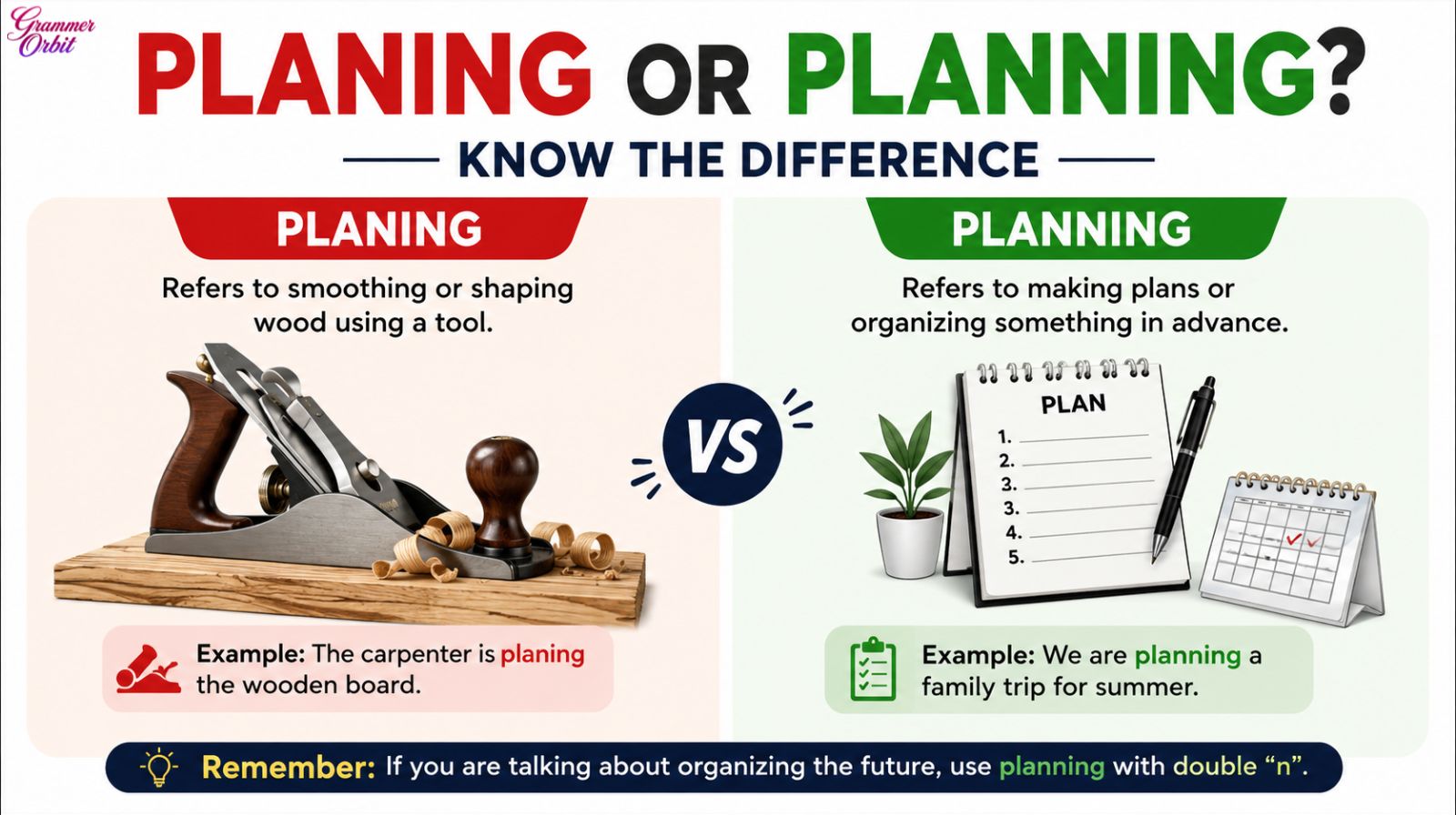
Have you ever typed “planing” when you actually meant “planning”? You are not alone. Thousands of English learners and even native speakers get confused between these two words. Since both look similar, many people assume they are interchangeable. However, they have completely different meanings and uses.
Understanding the difference between planing or planning is important because one small spelling mistake can completely change the meaning of your sentence. Whether you are writing emails, school assignments, blog posts, or professional documents, using the correct word helps your writing look more polished and trustworthy.
In this complete guide, you will learn the meaning of both words, the grammar rule behind the spelling, real-life examples, common mistakes, and simple tricks to remember the correct usage forever.
What Is the Difference Between Planing and Planning?
The main difference between planing and planning is their meaning and usage.
| Word | Meaning | Usage |
|---|---|---|
| Planing | Smoothing or shaping wood using a tool | Woodworking term |
| Planning | Making plans or organizing something | Daily English usage |
Most of the time, people actually want to write planning when discussing goals, schedules, projects, or future activities.
What Does “Planning” Mean?
Planning refers to the process of organizing or preparing something in advance.
Examples:
- We are planning a family trip for summer.
- She is planning her career carefully.
- The company is planning a new marketing campaign.
In everyday English, this is the version most people need.
What Does “Planing” Mean?
Planing is a woodworking term. It comes from the verb “plane,” which means smoothing or flattening a surface using a tool called a plane.
Examples:
- The carpenter is planing the wooden board.
- He spent hours planing the table surface.
Therefore, unless you are talking about woodworking, construction, or carpentry, you probably mean planning.
Why Do People Confuse Planing and Planning?
English spelling rules can sometimes feel inconsistent. The confusion usually happens because both words come from the base word “plan” or “plane,” and they differ by only one letter.
The Double Consonant Rule
When adding “-ing” to some verbs, English often doubles the final consonant.
For example:
| Base Word | Correct Form |
|---|---|
| Run | Running |
| Sit | Sitting |
| Plan | Planning |
The word “plan” becomes planning because the final consonant “n” is doubled before adding “-ing.”
Why “Planing” Looks Wrong in Most Sentences
If you write:
“I am planing my future.”
See also Writen or Written? Which Form Is Correct?
the sentence is technically incorrect because “planing” refers to woodworking, not organizing your future.
The correct sentence is:
“I am planning my future.”
This spelling rule is one of the most common grammar mistakes among English learners.
Planning Meaning in Daily English
The word planning is widely used in education, business, travel, productivity, and personal development.
Academic Planning
Students often use planning to organize:
- Study schedules
- Exams
- Assignments
- Career goals
Example:
Good planning helps students reduce stress before exams.
Business Planning
Businesses rely heavily on planning for growth and success.
Examples include:
- Financial planning
- Marketing planning
- Project planning
- Event planning
Personal Life Planning
People also use planning in everyday situations.
Examples:
- Planning a wedding
- Planning meals
- Planning vacations
- Planning workouts
Because the word appears so often in modern communication, spelling it correctly matters.
Planing Meaning in Woodworking
Although less common, planing is still a real English word.
What Is a Plane Tool?
A plane is a woodworking tool used to smooth rough surfaces.
Common Uses of Planing
Woodworkers use planing for:
- Flattening wood
- Reducing thickness
- Smoothing rough surfaces
- Shaping wooden edges
Example sentence:
The craftsman is planing the oak board before painting it.
Modern vs Traditional Planing
Today, many carpenters use electric planers instead of traditional hand planes because they are faster and more efficient.
According to woodworking industry reports published in 2025, the global woodworking machinery market continues to grow due to increased demand for custom furniture and home improvement projects.
Grammar Rule Behind “Planning”
Understanding the grammar rule makes the spelling much easier to remember.
When Do We Double the Final Letter?
English doubles the final consonant when:
- The word has one syllable
- It ends in consonant-vowel-consonant
- You add a suffix like “-ing” or “-ed”
The word “plan” follows this pattern.
\text{plan} + \text{ing} = \text{planning}
More Examples
| Incorrect | Correct |
|---|---|
| Planing a party | Planning a party |
| Planing my week | Planning my week |
| Planing a meeting | Planning a meeting |
Easy Memory Trick
Remember this simple rule:
If you are talking about organizing the future, use planning with double “n.”
See also Soo vs So: What’s the Difference and Which One Is Correct?
If you are talking about wood, use planing with one “n.”
This trick helps learners avoid mistakes instantly.
Real-Life Case Study: How a Small Spelling Mistake Changed Professional Communication
In 2025, a small startup company published a job advertisement online for a “Project Planing Manager.” At first glance, many readers thought the company specialized in construction or woodworking because of the word “planing.”
The company later discovered that applicants were confused about the role. Some candidates even emailed the hiring team asking whether woodworking experience was required.
After correcting the title to “Project Planning Manager,” the confusion disappeared, and application quality improved significantly.
This example shows how a single missing letter can change meaning completely. In professional communication, spelling errors can affect:
- Brand credibility
- Search engine rankings
- User trust
- Job opportunities
- Academic performance
According to recent digital communication studies, users judge online professionalism within seconds, and spelling mistakes are among the top reasons people lose trust in written content. Clear writing creates authority and improves readability.
Therefore, learning the difference between planing or planning is not just about grammar. It also affects communication quality and professional image.
Common Mistakes Learners Make
Many learners repeat the same errors because they rely only on pronunciation.
Mistake #1: Using “Planing” for Future Goals
Incorrect:
I am planing my career.
Correct:
I am planning my career.
Mistake #2: Forgetting the Double “N”
People often forget consonant doubling rules.
Examples:
- Swim → Swimming
- Begin → Beginning
- Plan → Planning
Mistake #3: Auto-Correct Dependence
Some writers rely completely on spell-check tools. However, spell-check may not catch the mistake because “planing” is still a valid English word.
That is why understanding meaning is important.
Planning vs Planing: Quick Comparison Guide
Simple Checklist
Use this checklist whenever you feel confused.
| Question | Correct Word |
|---|---|
| Talking about organizing something? | Planning |
| Talking about future goals? | Planning |
| Talking about schedules or projects? | Planning |
| Talking about smoothing wood? | Planing |
| Discussing carpentry tools? | Planing |
This quick method helps writers choose the right spelling immediately.
SEO and Writing Importance of Correct Spelling
Correct spelling matters for more than grammar.
Better Search Engine Rankings
Search engines like Google prioritize high-quality content with proper spelling and readability.
Poor spelling can:
- Reduce credibility
- Increase bounce rates
- Hurt SEO performance
- Lower reader trust
Better User Experience
Readers stay longer on content that feels professional and easy to understand.
Stronger Professional Image
Correct grammar improves:
- Emails
- Resumes
- Blog posts
- Social media captions
- Academic writing
According to content marketing research from HubSpot, clear and readable content performs better in engagement and trust metrics. HubSpot
FAQs
Q1: Is planing a real word?
A: Yes, “planing” is a real word. It refers to smoothing or shaping wood using a plane tool.
Q2: Which is correct: planing or planning?
A: If you are talking about organizing or preparing something, the correct spelling is planning.
Q3: Why does planning have double “n”?
A: The word follows the English consonant doubling rule when adding “-ing” to “plan.”
Q4: What does planning mean?
A: Planning means preparing, organizing, or arranging something in advance.
Q5: What is wood planing?
A: Wood planing is the process of smoothing wood surfaces using a hand plane or electric planer.
Q6: Can spell-check detect this mistake?
A: Not always. Since both words are valid English terms, grammar tools may miss the error depending on the sentence.
Q7: How can I remember the correct spelling?
Remember:
A: Future organization = planning
- Woodworking = planing
Conclusion
The confusion between planing or planning is extremely common, but the difference becomes simple once you understand the meanings.
- Planning means organizing or preparing for the future.
- Planing refers to smoothing wood in carpentry.
In most everyday situations, you will need planning with double “n.” Learning this small grammar rule can improve your writing, professionalism, and communication skills significantly.
Whether you are writing emails, articles, assignments, or business documents, using the correct spelling helps readers trust your content more.
So next time you type the word, pause for a second and ask yourself:
“Am I talking about future organization or woodworking?”
That one question will help you choose the correct spelling every time.
External References
👉 Discover more simple and practical grammar guides on Grammer Orbit

Zia Ahmad is a professional blogger specializing in grammar tips and spelling accuracy. He creates clear, practical content that helps readers eliminate errors, strengthen writing skills, and communicate effectively for students, professionals, and everyday writers worldwide.