
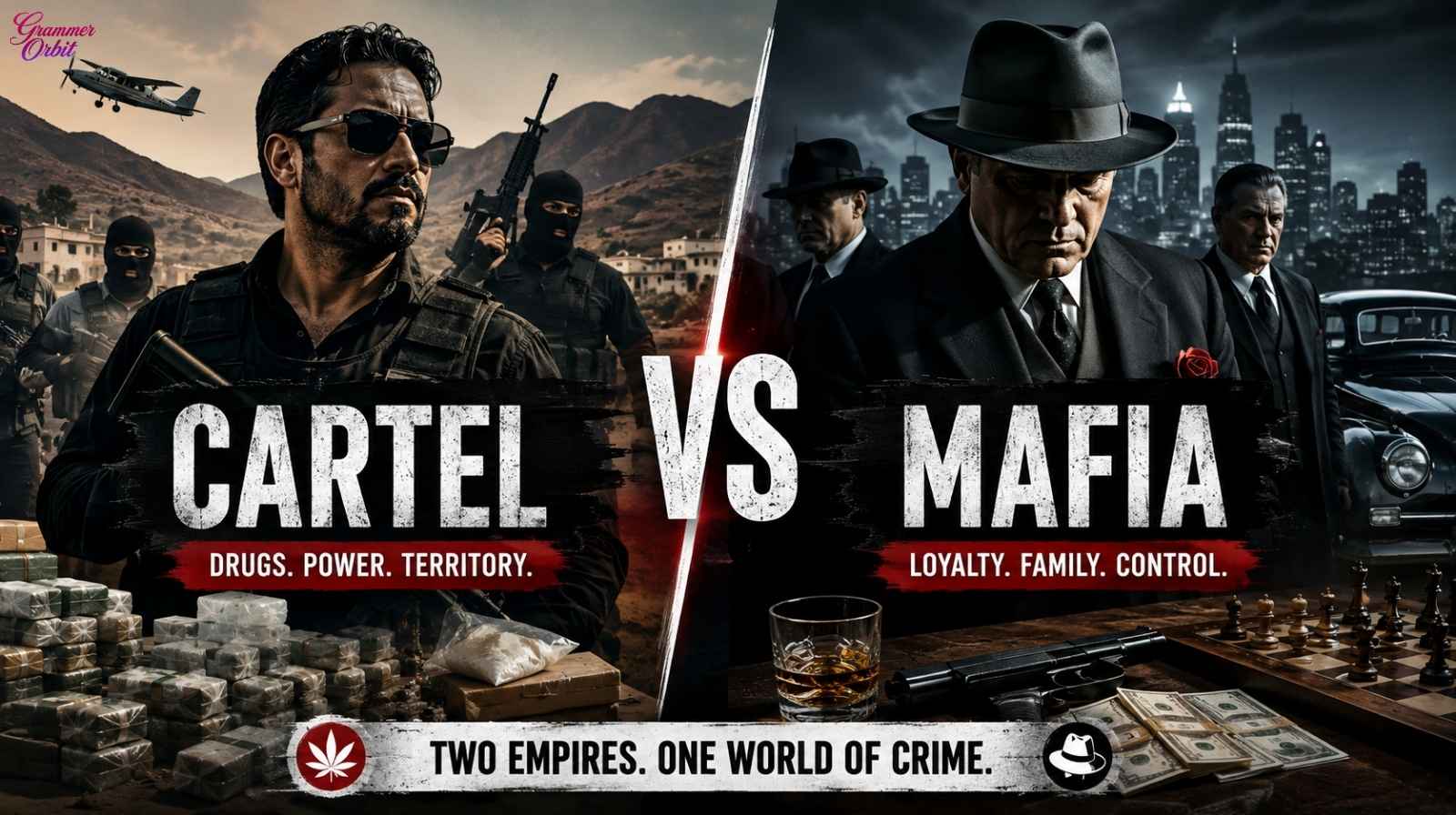
Organized crime is often portrayed in movies, TV shows, and news headlines. As a result, many people assume that cartel vs mafia mean exactly the same thing. Although both involve criminal organizations, they are not interchangeable. They differ in structure, purpose, operations, and even history.
If you’ve ever wondered “What’s the difference between a cartel and a mafia?”, you’re in the right place. This guide explains the distinction in simple language, provides real-world examples, and clears up one of the internet’s most common misconceptions.
Cartel vs Mafia: What’s the Main Difference?
Featured Snippet Answer
A cartel is an organized criminal group primarily focused on controlling illegal markets, especially drug trafficking, through large-scale production and distribution. A mafia, on the other hand, is a secret criminal organization that earns money through activities such as extortion, protection rackets, gambling, fraud, and sometimes drug trafficking while often influencing local businesses and politics.
Although both use violence and intimidation, their origins, structures, and main goals are different.
Cartel Definition
A cartel is a highly organized criminal network that controls the production, transportation, and sale of illegal goods. Most modern cartels are associated with international drug trafficking.
Examples include:
- Sinaloa Cartel
- Jalisco New Generation Cartel (CJNG)
- Gulf Cartel
These organizations often operate across several countries and maintain complex smuggling routes.
See also Pre vs Post: Understand The Difference And Use Them Correctly
Mafia Definition
A mafia is a secret criminal society built around loyalty, family ties, and long-term control of territory or communities.
Well-known examples include:
- Sicilian Mafia (Cosa Nostra)
- Camorra
- ‘Ndrangheta
- American Mafia
Mafia organizations usually profit from extortion, illegal gambling, corruption, loan sharking, and other criminal enterprises.
Cartel vs Mafia Comparison Table
| Feature | Cartel | Mafia |
|---|---|---|
| Primary Goal | Control illegal markets | Control territory and criminal businesses |
| Main Activities | Drug trafficking, smuggling | Extortion, gambling, fraud, racketeering |
| Structure | Large criminal networks | Family or clan-based hierarchy |
| Geographic Focus | International operations | Regional or local influence |
| Origins | Latin America | Italy |
| Violence Level | Often extremely high | Strategic and targeted violence |
| Public Influence | Drug trade | Community, business, and political influence |
Origins of Cartels and Mafias
Understanding their history makes the differences much clearer.
How the Mafia Began
The mafia traces its roots to Sicily during the 19th century. Weak government control allowed local criminal groups to gain power by offering “protection” to businesses and landowners.
Over time, these groups became sophisticated criminal organizations with strict codes of conduct and family-based leadership.
See also Choosing or Chosing: Which One Is Correct?
How Cartels Emerged
Modern drug cartels developed much later, particularly during the late 20th century in Mexico and parts of South America.
Their rapid growth was fueled by international demand for illegal drugs, allowing them to build massive transportation and distribution networks.
Why Their Origins Matter
The mafia developed from local social and political conditions, while cartels expanded because of global illegal markets. This historical difference explains why their operations look very different today.
How Cartels and Mafias Make Money

Although both organizations generate illegal profits, they often rely on different business models.
Cartel Income Sources
- Drug production
- Drug trafficking
- Human trafficking
- Arms smuggling
- Money laundering
Mafia Income Sources
- Protection rackets
- Illegal gambling
- Construction fraud
- Loan sharking
- Political corruption
- Drug trafficking in some cases
Many modern mafia groups have diversified their criminal activities, but extortion and territorial control remain defining characteristics.
Real-Life Example: Why Cartels and Mafias Are Not the Same
A common misunderstanding occurs when news reports describe every organized crime group as a “mafia.” However, experts make clear distinctions because these organizations function differently.
For example, Mexico’s drug cartels are structured around controlling production, transportation routes, and international drug distribution. Their power often depends on securing smuggling corridors, maintaining supply chains, and competing with rival organizations for access to lucrative markets. This has led to intense conflicts between rival groups over territory used for trafficking.
In contrast, traditional Italian mafia organizations historically focused on embedding themselves within local communities. Instead of relying solely on trafficking, they built influence through extortion, illegal gambling, public contract manipulation, and corruption. Their strength came from maintaining long-term relationships with businesses, political figures, and local networks while enforcing loyalty through secrecy and intimidation.
This distinction matters because law enforcement agencies develop different strategies for combating each type of organization. A cartel investigation may prioritize disrupting international trafficking routes, whereas a mafia investigation often targets financial crimes, corruption, and local criminal enterprises. Understanding these differences helps readers interpret news reports more accurately instead of treating all organized crime groups as identical.
See also Village vs Subdivision: Which One Is Correct?
Organized Crime Statistics (2025–2026)
Recent international reports continue to show that organized crime remains one of the world’s largest illicit economies.
Key Findings
- Drug trafficking remains among the most profitable forms of transnational organized crime.
- Criminal organizations increasingly use encrypted communication and digital financial tools to hide operations.
- International cooperation between law enforcement agencies has expanded significantly during 2025–2026 to disrupt cross-border criminal networks.
- Financial investigations and anti-money laundering efforts are becoming as important as traditional policing.
These trends highlight that organized crime continues to evolve alongside technology and globalization.
Why People Confuse Cartels and Mafias
Several factors contribute to the confusion.
Movies and Television
Hollywood often uses the terms interchangeably, even when they describe different organizations.
Media Headlines
News reports sometimes simplify complex criminal groups for general audiences.
Similar Criminal Activities
Both organizations may participate in:
- Drug trafficking
- Violence
- Corruption
- Money laundering
However, sharing some activities does not make them identical.
FAQs
Q1: Is a cartel the same as a mafia?
A: No. A cartel mainly controls illegal markets such as drug trafficking, while a mafia traditionally controls territories and criminal businesses through organized family structures.
Q2: Which is older, the cartel or the mafia?
A: The mafia is much older, originating in Sicily during the 19th century, whereas modern drug cartels became prominent in the late 20th century.
Q3: Can a mafia sell drugs?
A: Yes. Some mafia organizations participate in drug trafficking, but it is only one of many criminal activities they conduct.
Q4: Why are Mexican groups called cartels?
A: They are called cartels because they historically coordinated control over illegal drug production and distribution networks.
Q5: Are all organized crime groups mafias?
A: No. Organized crime includes cartels, mafias, gangs, triads, yakuza groups, and many other criminal organizations with different structures.
Q6: Which is more dangerous?
A: Both can be extremely dangerous. The level of violence depends on the organization, its activities, and the region where it operates.
Q7: Why does terminology matter?
A: Using the correct term helps people better understand news reports, history, and law enforcement strategies related to organized crime.
Conclusion
Understanding Cartel vs Mafia is about more than vocabulary it helps explain how different criminal organizations operate around the world.
While both engage in organized crime, cartels primarily dominate illegal markets such as drug trafficking, whereas mafias traditionally build long-term territorial influence through extortion, corruption, and other criminal enterprises.
The next time you read a news article or watch a crime documentary, you’ll know that these terms are not synonyms. Recognizing the distinction makes it easier to understand global crime, law enforcement efforts, and the history behind these organizations.
👉 Discover more simple and practical grammar guides on Grammer Orbit

Zia Ahmad is a professional blogger specializing in grammar tips and spelling accuracy. He creates clear, practical content that helps readers eliminate errors, strengthen writing skills, and communicate effectively for students, professionals, and everyday writers worldwide.