
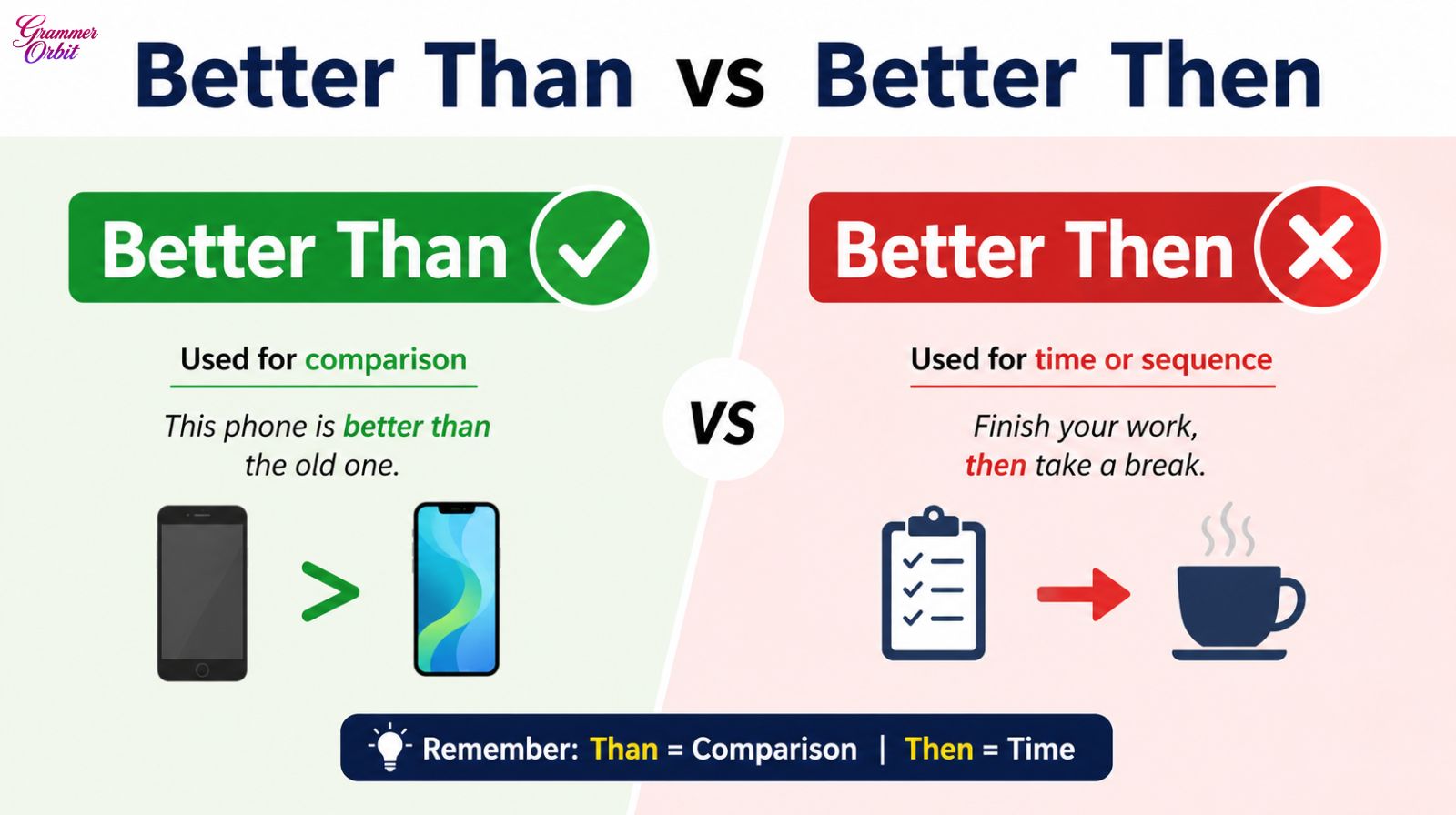
Have you ever typed “better then” and wondered if it was actually correct? You’re definitely not alone. This is one of the most common grammar mistakes in English because than vs then look similar but serve completely different purposes.
The good news is that once you understand their roles, you’ll never confuse them again. In this guide, you’ll learn the difference between better than vs better then, see real-life examples, discover why people make this mistake, and learn an easy trick to remember the correct phrase forever.
What Is the Difference Between Better Than and Better Then?
The phrase better than is the correct expression when making a comparison.
The phrase better then is usually a grammar mistake unless then refers to time in a completely different sentence.
Better Than (Correct)
Use than when comparing two people, things, places, or ideas.
Examples:
- Coffee is better than tea.
- This laptop is better than my old one.
- She sings better than anyone in the class.
- Reading books is better than scrolling social media.
Better Then (Usually Incorrect)
Using better then is incorrect in comparisons.
❌ This movie is better then the first one.
✅ This movie is better than the first one.
See also Requester vs Requestor: Correct Spelling, Meaning & Usage
Why Do People Confuse Than and Then?
Although the words differ by only one letter, they have completely different meanings.
Than = Comparison
Think of than whenever you’re comparing.
Examples:
- Older than
- Faster than
- Better than
- Smaller than
- More expensive than
Then = Time or Sequence
Use then when talking about what happens next.
Examples:
- Finish your homework, then watch TV.
- We ate dinner, then went home.
- Back then, life was simpler.
A simple way to remember:
Than = Compare
Then = Time
Better Than vs Better Then Comparison Table
| Better Than | Better Then |
|---|---|
| Correct for comparisons | Usually incorrect in comparisons |
| Compares two things | Refers to time or sequence |
| Better than me | Better then me ❌ |
| Better than before | Better then before ❌ |
| Used after comparative adjectives | Used when talking about “next” |
Common Sentences and Their Correct Forms
Here are examples that people frequently search online.
❌ I feel better then yesterday.
✅ I feel better than yesterday.
❌ This phone is better then yours.
✅ This phone is better than yours.
❌ My grades are better then last semester.
✅ My grades are better than last semester.
❌ Our new office is better then the old one.
✅ Our new office is better than the old one.
❌ Your idea sounds better then mine.
✅ Your idea sounds better than mine.
See also Finaly or Finally? The Simple Answer Fully Explained
Real-Life Example: How One Small Word Can Change Professional Writing
Imagine Sarah, a marketing manager, sending an email to an important client. She writes:
“Our latest solution is better then the previous version.”
The client notices the mistake immediately. While the overall message is understandable, the grammatical error slightly reduces the professionalism of the email. In business communication, even small mistakes can affect credibility, especially when communicating with clients, employers, or international partners.
Sarah later updates the sentence to:
“Our latest solution is better than the previous version.”
The revised version reads naturally and professionally. This small correction improves clarity and leaves a stronger impression. The same applies to resumes, academic papers, blog posts, product descriptions, and social media captions. Using better than instead of better then helps your writing appear polished and trustworthy. Paying attention to these small grammar details can make a noticeable difference in how others perceive your communication.
Grammar Rule You Should Remember
Use “Than” After Comparative Words
Whenever you see words like:
- Better
- Worse
- More
- Less
- Bigger
- Smaller
- Faster
- Slower
- Easier
- Harder
the next word is usually than.
Examples:
- More than enough
- Bigger than expected
- Easier than before
- Better than ever
- Faster than lightning
Use “Then” for Time
Examples:
- First study, then relax.
- We finished breakfast, then left.
- Back then, smartphones didn’t exist.
See also Planing or Planning: A Complete Guide For Learners
Writing Tip: An Easy Memory Trick
Here’s an easy trick many English teachers recommend.
Than contains the letter A, which can remind you of Comparison (both have the sound “A”).
Then contains the letter E, which can remind you of Next Event.
Remember:
Comparison → Than
Next Event → Then
This simple association helps many learners avoid the mistake instantly.
Data & Statistics (2025–2026)
Grammar-related search trends continue to grow as more people write emails, social media posts, and professional content daily. Recent search trend analyses from Google Trends and leading SEO platforms in 2025–2026 show that grammar comparison queries—such as better than vs better then, their vs there, and your vs you’re—receive hundreds of thousands of searches globally each month. Educational websites also report that confusing than and then remains one of the most common mistakes among English learners because the words are similar in spelling but different in meaning. This highlights the importance of understanding the distinction for clear and professional communication.
FAQs
Q1: Is “better then” ever correct?
A: Only if then refers to time in a separate context. It is not correct when comparing two things.
Q2: Why is “better than” correct?
A: Because than is the conjunction used for comparisons.
Q3: Is “better then yesterday” correct?
A: No.
Correct:
Better than yesterday.
Q4: What’s the easiest way to remember the difference?
A: Think:
Than = Comparison
Then = Time
Q5: Do native English speakers make this mistake?
A: Yes. It’s a very common typing and spelling error, especially in informal writing.
Q6: Can grammar checkers detect this mistake?
A: Most modern grammar tools can detect it, but understanding the rule yourself is more reliable.
Q7: Is “better than ever” correct?
A: Yes. It’s a very common English expression.
Q8: Does this mistake affect SEO content?
A: Yes. Frequent grammar mistakes can reduce user trust, increase bounce rates, and hurt the perceived quality of your content.
Conclusion
Understanding the difference between better than vs better then is easier than it first appears. Whenever you’re making a comparison, always use better than. Reserve then for discussing time or the next event in a sequence. By remembering this simple rule and practicing with real examples, you’ll write with greater confidence and accuracy in emails, school assignments, blog posts, and everyday conversations.
If you found this guide helpful, bookmark it for future reference and share it with anyone who still mixes up than and then.
👉 Discover more simple and practical grammar guides on Grammer Orbit

Zia Ahmad is a professional blogger specializing in grammar tips and spelling accuracy. He creates clear, practical content that helps readers eliminate errors, strengthen writing skills, and communicate effectively for students, professionals, and everyday writers worldwide.