
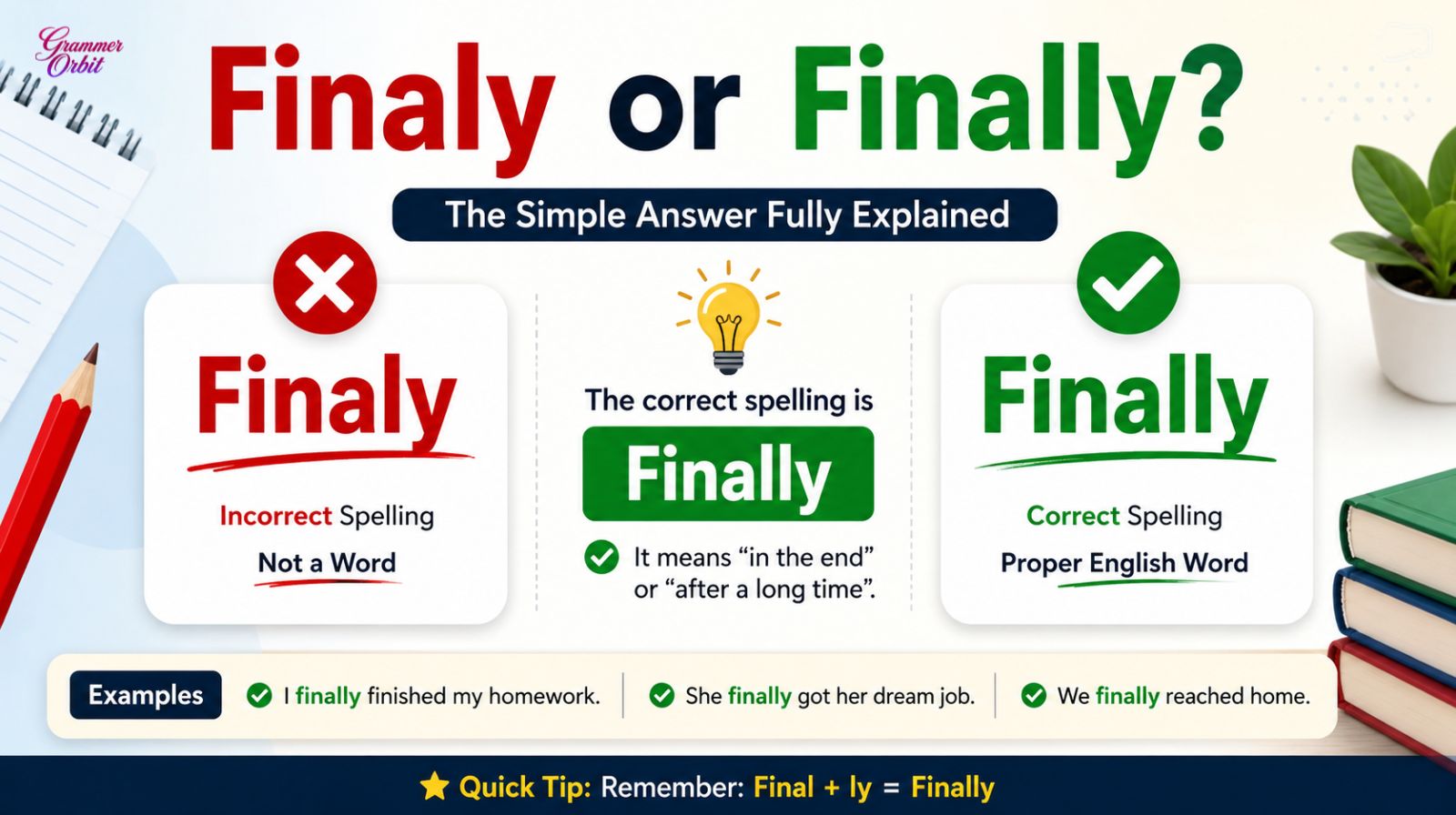
Have you ever typed “finaly” and suddenly seen a red underline appear on your screen? You are not alone. Thousands of English learners and even native speakers confuse Finaly or Finally because the words look almost identical. However, only one spelling is correct in standard English.
The good news is that this mistake is very easy to fix once you understand the simple grammar rule behind it.
In this guide, you will learn:
- The correct spelling
- Why people write “finaly”
- The meaning of “finally”
- Real examples in sentences
- Grammar rules explained simply
- Common mistakes to avoid
- Easy memory tricks
- FAQs people search on Google
By the end of this article, you will never confuse Finaly or Finally again.
Finaly or Finally: Which One Is Correct?
The correct spelling is finally.
❌ Finaly
✅ Finally
“Finaly” is a spelling mistake and is not considered a proper English word.
What Does “Finally” Mean?
The word “finally” is an adverb. It is used when something happens:
- At the end of a process
- After a long time
- As the last point in a discussion
Simple Definition
“Finally” means:
“In the end” or “after a long wait.”
Examples of Finally in Sentences
- I finally finished my homework.
- She finally answered my message.
- After three hours, the train finally arrived.
- We finally found the correct answer.
In all these examples, “finally” shows that something happened after delay, effort, or time.
Why Do People Write “Finaly” Instead of “Finally”?
This spelling mistake happens because English pronunciation can sometimes confuse learners.
When people hear the word, they may think it only needs one “l.” However, the correct spelling contains two Ls:
✅ Finally
❌ Finaly
The Real Grammar Rule
The word comes from:
- Final + ly = Finally
When adding “-ly” to “final,” the spelling keeps the double “l” sound naturally.
Similar Words That Follow the Same Pattern
- Actual → Actually
- Natural → Naturally
- Real → Really
- Final → Finally
Therefore, “finally” follows a normal English spelling pattern.
Finaly vs Finally: Quick Comparison Table
| Word | Correct? | Meaning | Usage |
|---|---|---|---|
| Finaly | ❌ No | Incorrect spelling | Should not be used |
| Finally | ✅ Yes | In the end / after a long time | Correct English word |
This is one of the easiest ways to remember the difference.
How to Remember the Correct Spelling of Finally
Many learners struggle with spelling because English words often sound different from how they are written. Fortunately, there are simple tricks that make “finally” easy to remember.
Remember the Base Word “Final”
Start with the word:
Final
Then simply add:
-ly
You get:
Finally
This trick works because “final” already ends with “l,” and adding “ly” creates the double “ll.”
Think of “Really”
Compare:
- Really
- Finally
Both use double “l.”
Use Visual Memory
Imagine writing:
Final + ly = Finally
Practicing this a few times helps your brain remember the correct spelling naturally.
Common Situations Where People Use “Finally”
The word “finally” is extremely common in daily English conversations, emails, blogs, and social media posts.
Here are the most popular situations where people use it.
After a Long Wait
- We finally got tickets to the concert.
- He finally bought his dream car.
Completing Something Difficult
- She finally passed the exam.
- I finally solved the problem.
Ending a Conversation or List
- Finally, I want to thank everyone for coming.
- Finally, let’s discuss the last point.
In this case, “finally” works as a transition word.
Is “Finaly” Ever Accepted in English?
No. “Finaly” is not accepted in modern English grammar.
Major dictionaries including:
only recognize “finally” as the correct spelling.
Therefore, if you write “finaly” in:
- School assignments
- Emails
- Blog posts
- Job applications
- Social media captions
it will usually be marked as incorrect.
Why Correct Spelling Matters Online
Some people think small spelling mistakes are harmless. However, online spelling accuracy matters more than ever in 2025 and 2026.
Poor spelling can affect:
- SEO rankings
- Reader trust
- Professional image
- Search visibility
- User experience
For example, if a blog repeatedly uses “finaly” instead of “finally,” readers may lose confidence in the content quality.
2025 Writing Statistics
According to recent digital communication studies, grammar and spelling errors still strongly influence online credibility.
A 2025 report from Grammarly found that users are significantly less likely to trust content containing repeated spelling mistakes.
Similarly, business communication surveys show that spelling errors can reduce professional trust during hiring and client communication.
See also Dought vs Doubt: Which Should You Use In Writing?
Therefore, learning small corrections like Finaly or Finally can improve both writing confidence and credibility.
Real-Life Example: How One Small Spelling Mistake Changed a Student’s Writing
A university student named Sara frequently wrote “finaly” in her essays and emails. She believed the spelling was correct because many people online used it casually in comments and chats.
However, during a writing workshop, her instructor pointed out the repeated error. At first, Sara thought it was just a minor issue. Later, she realized the mistake appeared in:
- Academic assignments
- Scholarship applications
- LinkedIn posts
- Professional emails
Because spell-check tools automatically corrected the word, she never truly learned the rule.
Her instructor gave her a simple memory trick:
Final + ly = Finally
After practicing for one week, Sara completely stopped making the mistake.
More importantly, her writing became more polished and professional. She later mentioned that understanding small grammar corrections improved her confidence while applying for internships.
This example shows how tiny spelling improvements can create a big impact over time.
Finally as a Transition Word
Besides showing delay or relief, “finally” is also used as a transition word in writing.
Example in Paragraphs
- First, gather your materials.
- Next, organize your ideas.
- Finally, start writing your draft.
In this structure, “finally” introduces the last step.
Why Writers Use It
Professional writers use transition words because they improve readability.
Words like:
- However
- Therefore
- Meanwhile
- Finally
help readers follow ideas more smoothly.
This is especially important in:
- SEO writing
- Blog articles
- Academic essays
- Business communication
Common Grammar Mistakes Related to Finally
People who confuse “finaly” and “finally” often make similar spelling mistakes with other words too.
Here are common examples:
| Incorrect | Correct |
|---|---|
| Realy | Really |
| Actualy | Actually |
| Basicly | Basically |
| Hopefuly | Hopefully |
| Finaly | Finally |
Notice the pattern?
Most of these words require an extra letter before “-ly.”
How Spell Checkers Handle “Finaly”
Modern spelling tools usually detect “finaly” automatically.
Popular tools include:
These tools instantly suggest:
✅ Finally
However, relying only on spell check is not enough. Learning the actual rule helps you write more confidently without depending entirely on software.
Finaly or Finally in SEO and Search Trends
Interestingly, many users search for incorrect spellings on Google every day.
Searches like:
- “finaly meaning”
- “finaly or finally”
- “how to spell finally”
- “is finaly correct”
continue to appear because people want quick grammar answers.
Why This Matters
Google now prioritizes:
- Helpful content
- Clear explanations
- Human-focused writing
- Accurate spelling
Therefore, grammar-focused articles remain highly valuable for readers and SEO publishers.
Easy Step-by-Step Method to Never Misspell Finally Again
Here is a simple process you can follow.
Step 1: Start With “Final”
Write:
Final
Step 2: Add “-ly”
Now add:
ly
Step 3: Read It Slowly
Final + ly = Finally
Step 4: Practice With Sentences
- I finally understand the rule.
- We finally arrived home.
- She finally completed the project.
Daily repetition builds long-term memory.
FAQs
Q1: Is Finaly a real word?
A: No. “Finaly” is not a real English word. The correct spelling is “finally.”
Q2: Why does finally have two Ls?
A: Because the word is formed from:
Final + ly = Finally
The original “l” from “final” combines with “ly.”
Q3: What part of speech is finally?
“Finally” is an adverb.
A: It describes when or how something happens.
Q4: Can I use finally at the beginning of a sentence?
A: Yes. Example:
Finally, we reached the hotel.
This is grammatically correct.
Q5: Is finally formal or informal?
“Finally” works in both formal and informal English.
A: You can use it in:
- Essays
- Emails
- Conversations
- Blog posts
- Business writing
Q6: What is another word for finally?
A: Common synonyms include:
- Eventually
- At last
- In the end
- Ultimately
However, the meaning can slightly change depending on context.
Q7: Why do people commonly misspell finally?
A: Mostly because of pronunciation confusion and fast typing habits.
Many people accidentally remove one “l.”
Conclusion
The confusion between Finaly or Finally is extremely common, but the correct answer is simple:
✅ Finally
❌ Finaly
“Finally” is the proper English spelling and should always be used in professional, academic, and everyday writing.
The easiest way to remember it is:
Final + ly = Finally
Once you understand this rule, the mistake becomes much easier to avoid.
Whether you are writing emails, blog posts, essays, or social media captions, correct spelling improves clarity, professionalism, and reader trust.
So the next time you type the word, you will confidently know that “finally” is the correct choice.
👉 Discover more simple and practical grammar guides on Grammer Orbit

Zia Ahmad is a professional blogger specializing in grammar tips and spelling accuracy. He creates clear, practical content that helps readers eliminate errors, strengthen writing skills, and communicate effectively for students, professionals, and everyday writers worldwide.