
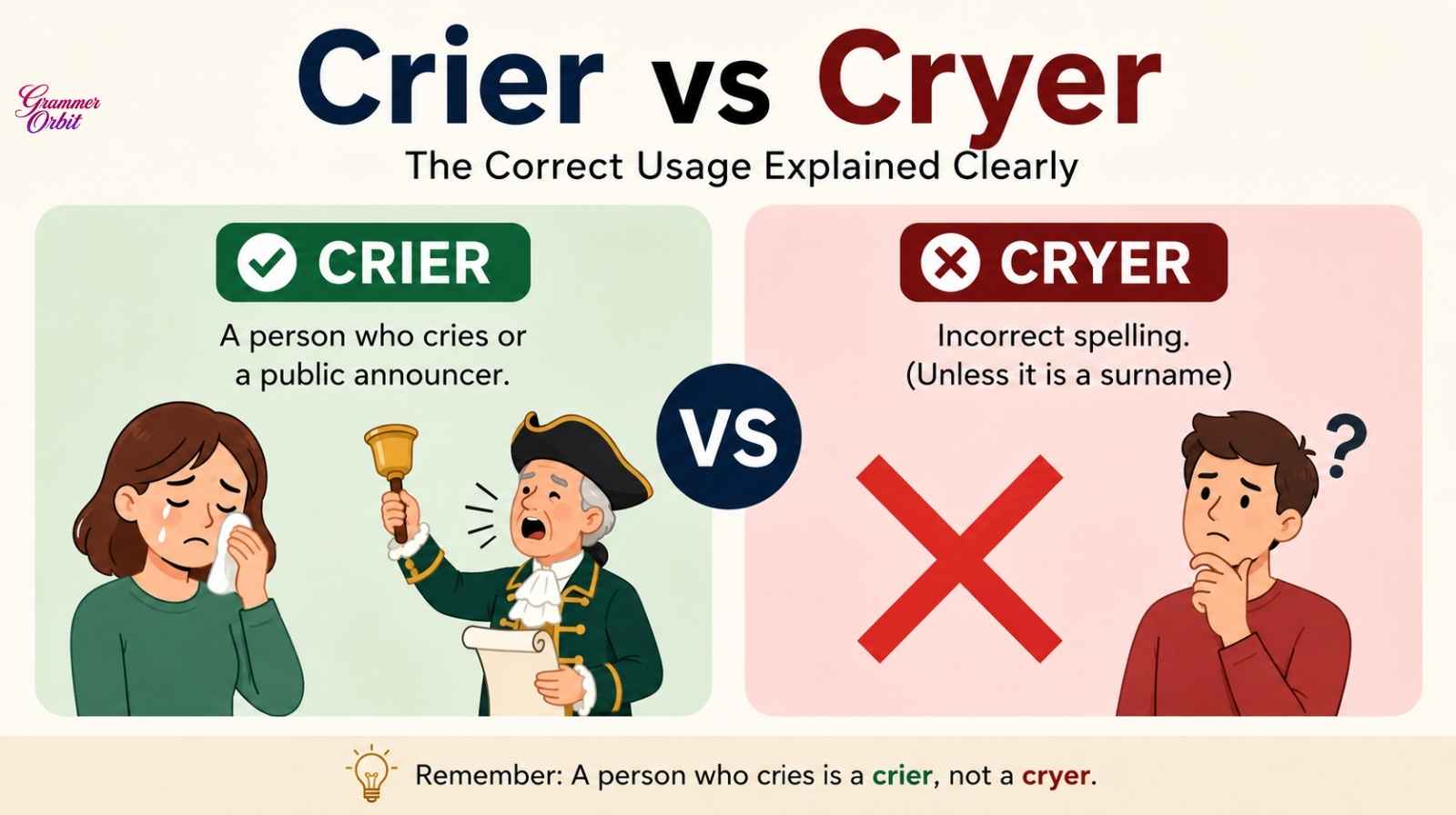
Have you ever paused while writing and wondered whether crier vs cryer is the correct spelling? You’re not alone. Many English learners, students, writers, and even native speakers make this mistake because both words look believable at first glance.
The confusion usually comes from the verb cry, which naturally makes some people think cryer should be correct. However, English spelling doesn’t always follow simple patterns.
In this guide, you’ll learn the difference between Crier vs Cryer, discover which spelling is correct, see real examples, understand the grammar rule behind it, and avoid making this common mistake in the future.
Crier vs Cryer: Which Spelling Is Correct?
The Short Answer
The correct spelling is crier.
Cryer is considered a misspelling in modern English unless it appears as a surname, such as actor Jon Cryer.
Quick Comparison
| Word | Correct? | Meaning |
|---|---|---|
| Crier | ✅ Yes | A person who cries or someone who publicly announces news |
| Cryer | ❌ No (usually) | Misspelling of crier or a family surname |
Whenever you’re referring to someone who cries or announces public messages, always use crier.
See also Transferred vs Transfered: Which Is Correct?
What Does “Crier” Mean?
The noun crier comes from the verb cry and has two common meanings.
A Person Who Cries Easily
This meaning describes someone who often becomes emotional.
Examples:
- Emma has always been a crier during emotional movies.
- My younger brother is not a crier, even when he’s upset.
- She’s a happy crier, especially at weddings.
A Public Announcer
Historically, a town crier announced news before newspapers and modern media existed.
Examples:
- The town crier rang a bell before making announcements.
- Every morning, the crier informed villagers of important events.
Why Do People Write “Cryer”?
It Looks Logical
Many people assume that because the verb is cry, adding -er should create cryer.
However, English follows a different spelling rule here.
The correct noun form changes cry → crier, not cry → cryer.
Similar Examples
| Verb | Correct Noun |
|---|---|
| Cry | Crier |
| Fly | Flier/Flyer (both accepted depending on context) |
| Try | Trier |
English sometimes changes spelling when suffixes are added, which is why relying only on pronunciation can lead to mistakes.
Grammar Rule Behind “Crier”
Why “Crier” Is Correct
When a verb ends in -y, adding -er doesn’t always produce the spelling people expect.
For the word cry, standard dictionaries recognize crier as the accepted noun.
Therefore:
- ✅ cry → crier
- ❌ cry → cryer
Remember This Tip
If you’re talking about someone who cries, think:
cry + person = crier
Not cryer.
This simple memory trick helps avoid the mistake.
Crier vs Cryer in Real Sentences
Correct Usage
- My sister is a crier whenever she watches romantic films.
- The town crier announced today’s festival.
- He’s never been much of a crier.
Incorrect Usage
- ❌ She’s a cryer.
- ❌ The cryer rang the town bell.
- ❌ He’s an emotional cryer.
Replace cryer with crier in every example above.
See also Symptomatology vs Symptomology: Differences, Meaning, And Correct Usage
Real-Life Example: Why Correct Spelling Matters
Sarah, a university student preparing an English assignment, wrote an essay describing a character as “a sensitive cryer.” Although her ideas were strong, her professor marked the word as incorrect because standard English dictionaries list crier as the proper spelling.
Curious about the correction, Sarah checked several trusted dictionaries and discovered that cryer isn’t recognized as the standard noun form of cry. She revised her paper, replacing every instance of cryer with crier.
Later, while updating her résumé and writing blog posts, she became much more confident about choosing the correct spelling. That single grammar lesson helped her avoid a mistake that many English learners continue to make online.
This example shows that even a small spelling error can affect academic writing, professional communication, and online credibility. Learning the correct form once can prevent repeated mistakes in the future.
Crier vs Cryer Comparison Table
| Feature | Crier | Cryer |
|---|---|---|
| Standard English spelling | ✅ Yes | ❌ No |
| Found in dictionaries | ✅ Yes | ❌ Usually No |
| Means someone who cries | ✅ Yes | ❌ No |
| Means public announcer | ✅ Yes | ❌ No |
| Common writing mistake | ❌ No | ✅ Yes |
| May appear as surname | Rarely | ✅ Yes |
Language Data and Dictionary References (2025–2026)
As of 2025–2026, leading English dictionaries including Merriam-Webster, Cambridge Dictionary, and the Oxford English Dictionary recognize crier as the standard noun meaning “a person who cries” or “a public announcer.” In contrast, cryer is generally not listed as the standard spelling for this noun and is most commonly encountered as a surname.
Language-analysis tools and spelling checkers also consistently flag cryer as a likely misspelling when used in ordinary writing. This reflects current editorial standards across educational, academic, and professional publications.
Common Mistakes to Avoid
Confusing Spelling With Pronunciation
Both words sound similar, but only crier is correct in standard English.
Assuming Every Verb Simply Adds “-er”
English has many spelling exceptions, so it’s always worth checking a trusted dictionary.
See also Commit vs Comit: Correct Spelling, Meaning & Usage Explained
Ignoring Context
If you’re referring to actor Jon Cryer, the spelling Cryer is correct because it’s his surname.
Otherwise, use crier.
FAQs
Q1: Is crier or cryer correct?
A: Crier is the correct English spelling. Cryer is generally a misspelling unless it refers to a surname.
Q2: What does crier mean?
A: A crier is someone who cries easily or a person who publicly announces news, such as a town crier.
Q3: Why do people spell it cryer?
A: People often assume adding -er to cry creates cryer, but standard English uses crier instead.
Q4: Is cryer in the dictionary?
A: Most major dictionaries do not list cryer as the standard noun form of cry. It mainly appears as a family name.
Q5: What is a town crier?
A: A town crier was an official who announced important public news before newspapers and broadcasting became common.
Q6: How can I remember the correct spelling?
A: Remember this simple phrase:
A person who cries is a crier not a cryer.
Conclusion
Understanding Crier vs Cryer is actually quite simple once you know the rule. Crier is the correct spelling recognized by major English dictionaries, while cryer is usually a spelling mistake unless it’s someone’s surname.
Whenever you’re writing about a person who cries or a historical public announcer, choose crier with confidence. Paying attention to small spelling details like this can make your writing clearer, more professional, and more accurate.
The next time you see cryer, you’ll know exactly when it’s wrong and when it’s simply someone’s last name.
👉 Discover more simple and practical grammar guides on Grammer Orbit

Zia Ahmad is a professional blogger specializing in grammar tips and spelling accuracy. He creates clear, practical content that helps readers eliminate errors, strengthen writing skills, and communicate effectively for students, professionals, and everyday writers worldwide.