
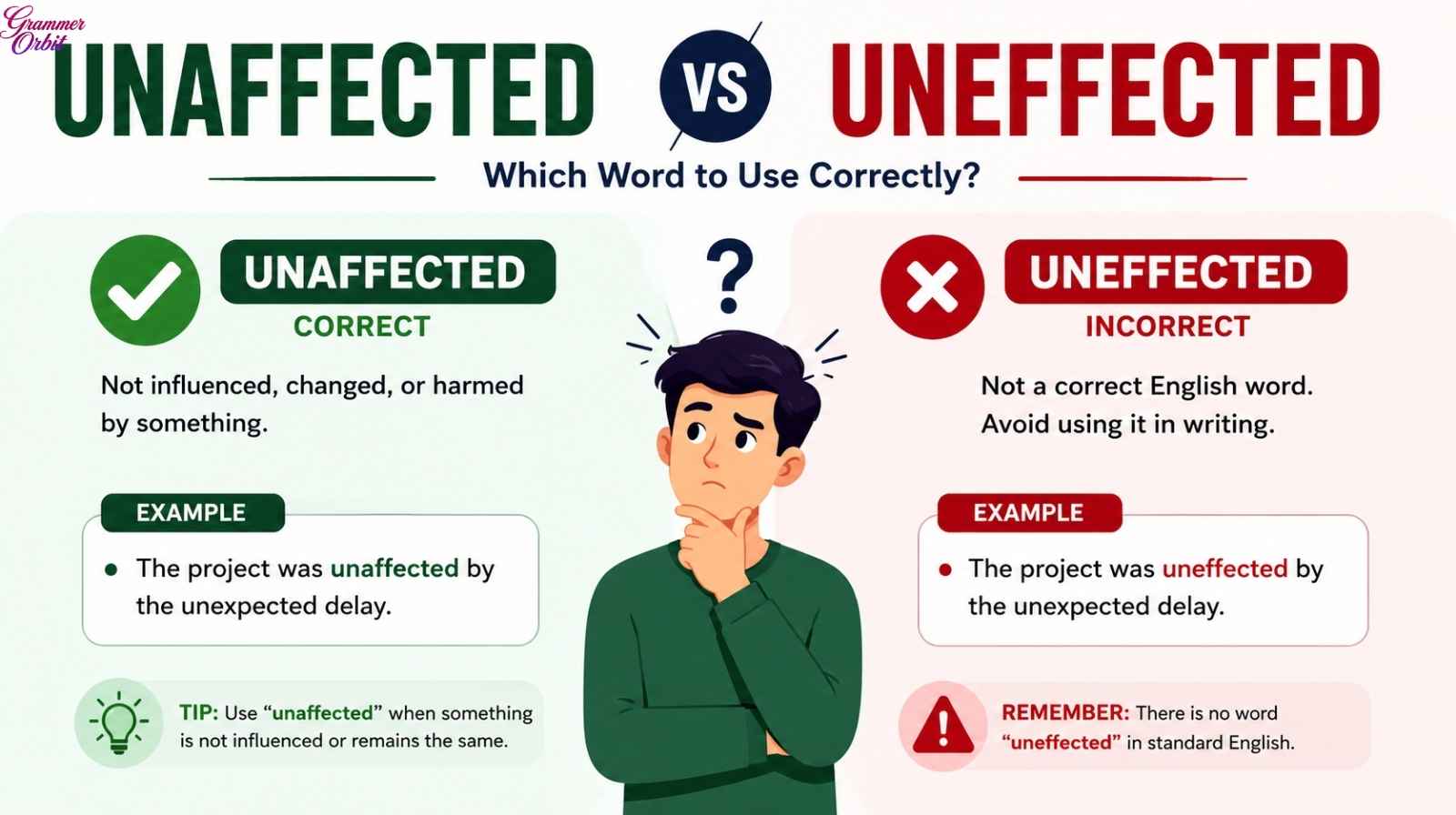
Have you ever typed uneffected and wondered if it was actually a real English word? You’re not alone. Many English learners and even native speakers get confused by Unaffected vs Uneffected because both words look similar, but only one is correct in standard English.
The simple answer is this: unaffected is the correct spelling, while uneffected is considered a spelling mistake in almost every context. Understanding why can help you write with more confidence and avoid common grammar errors.
In this guide, you’ll learn the difference between these words, their meanings, real-life examples, memory tips, and when to use unaffected correctly.
What Is the Difference Between Unaffected and Uneffected?
The biggest difference is surprisingly simple.
| Word | Is It Correct? | Meaning |
|---|---|---|
| Unaffected | ✅ Yes | Not influenced, changed, or harmed by something |
| Uneffected | ❌ No | Incorrect spelling in standard English |
In modern English dictionaries, unaffected is the accepted word. If you write uneffected, spell-check tools such as Google Docs, Microsoft Word, and Grammarly will usually mark it as incorrect.
Quick Answer
If you’re wondering which word to use, remember:
Always choose “unaffected.” Avoid “uneffected.”
See also Fair vs Good: What’s The Difference?
What Does “Unaffected” Mean?
The adjective unaffected describes someone or something that has not been changed, influenced, or damaged by an event, action, or situation.
It Can Mean:
- Not influenced by outside factors
- Remaining the same
- Genuine or natural (especially a person’s behavior)
- Not emotionally impacted
Examples
- Despite the heavy rain, the indoor event was unaffected.
- Her decision remained unaffected by public criticism.
- The backup server was unaffected during the cyberattack.
- His calm attitude remained unaffected throughout the meeting.
In every sentence, unaffected means something stayed unchanged.
Why Is “Uneffected” Incorrect?
Many people assume that because effect is a real word, uneffected must also be correct.
However, English doesn’t form the adjective this way.
Instead, the adjective comes from the verb affect, producing:
- affect → affected → unaffected
Not:
- effect → effected → ❌ uneffected
Although effected exists as the past tense of effect (meaning to bring about), English does not use uneffected as the opposite.
Common Mistake
❌ The building was uneffected by the storm.
✅ The building was unaffected by the storm.
Unaffected vs Uneffected: Side-by-Side Comparison
| Feature | Unaffected | Uneffected |
|---|---|---|
| Correct English word | ✅ Yes | ❌ No |
| Found in dictionaries | ✅ Yes | ❌ No |
| Used in formal writing | ✅ Yes | ❌ No |
| Accepted in academic writing | ✅ Yes | ❌ No |
| Safe to use in professional emails | ✅ Yes | ❌ Never |
How to Remember the Correct Word
Confusing these words is easy because affect and effect are already difficult for many writers.
A simple memory trick can help.
Think of “Affected”
Since the opposite of affected is unaffected, simply add un- to the front.
affected → unaffected ✅
There is no standard English word formed as:
effected → uneffected ❌
Whenever you’re unsure, ask yourself:
“Am I trying to say something wasn’t changed?”
If yes, the answer is almost always unaffected.
See also Smoke Show Meaning: What It Really Means In Modern Slang
Real-Life Example: A Student’s Essay Mistake
During an English writing workshop, a college student submitted an essay describing how local businesses recovered after severe flooding. One sentence read:
“Several shops remained uneffected by the flood.”
Although the overall essay was well written, the instructor highlighted the word uneffected as a spelling error. The student had confused affect with effect, a mistake that many learners make because both words sound similar and often appear in discussions about cause and result.
After correcting the sentence to:
“Several shops remained unaffected by the flood.”
the meaning became grammatically correct and more professional. The instructor also explained that spell-check tools, academic style guides, and major dictionaries recognize unaffected as the proper adjective, while uneffected is not accepted in standard English.
This example shows how a single spelling mistake can reduce the credibility of otherwise strong writing. Learning the correct form helps students, professionals, and content writers communicate more clearly and confidently.
Why This Mistake Happens
Several factors contribute to the confusion.
Similar Pronunciation
The words affect and effect sound alike in everyday speech.
Similar Spelling
Only one letter changes, making typing mistakes very common.
Grammar Confusion
Many learners memorize the rule for affect vs effect but mistakenly create the non-existent adjective uneffected.
Fortunately, once you know that unaffected is the only correct adjective, the confusion usually disappears.
Language Data and Dictionary Evidence (2025–2026)
According to major English dictionaries and writing tools updated through 2025–2026, unaffected is recognized as the correct adjective meaning “not influenced or changed.” In contrast, uneffected does not appear as a standard English word and is consistently flagged as a spelling error by grammar and spell-checking platforms.
Modern writing assistants such as Grammarly and Microsoft Editor also recommend replacing uneffected with unaffected whenever it appears in professional or academic writing. This consistent guidance across dictionaries and editing tools reinforces the importance of using the correct form.
Common Sentences Using “Unaffected”
Here are examples you can confidently use.
- The flight schedule was unaffected by the weather.
- Her confidence remained unaffected despite criticism.
- The software update left user files unaffected.
- Most employees were unaffected by the policy change.
- The children’s enthusiasm was unaffected by the delay.
- The neighboring towns were largely unaffected by the earthquake.
See also Encode vs Incode: Which One Is The Correct Word?
FAQs
Q1: Is “uneffected” a real English word?
A: No. Uneffected is considered an incorrect spelling in standard English.
Q2: Which is correct: unaffected or uneffected?
A: Unaffected is the correct word.
Q3: Why do people write “uneffected”?
A: People often confuse affect and effect, leading them to create the incorrect spelling uneffected.
Q4: Does Grammarly recognize “uneffected”?
A: Yes. Grammarly typically flags uneffected as a spelling error and recommends unaffected instead.
Q5: Can I use “uneffected” in academic writing?
A: No. Academic, business, and professional writing should always use unaffected.
Q6: What does “unaffected” mean?
A: It means not influenced, changed, harmed, or altered by something.
Conclusion
Understanding Unaffected vs Uneffected is much easier once you know the basic rule: unaffected is the only correct spelling, while uneffected is a common mistake. Whether you’re writing an essay, email, blog post, or professional report, using unaffected will make your writing more accurate and credible.
The next time you’re unsure, remember this simple tip: if you mean “not changed or influenced,” always choose unaffected. Building small grammar habits like this can significantly improve your writing skills over time.
👉 Discover more simple and practical grammar guides on Grammer Orbit

Zia Ahmad is a professional blogger specializing in grammar tips and spelling accuracy. He creates clear, practical content that helps readers eliminate errors, strengthen writing skills, and communicate effectively for students, professionals, and everyday writers worldwide.