
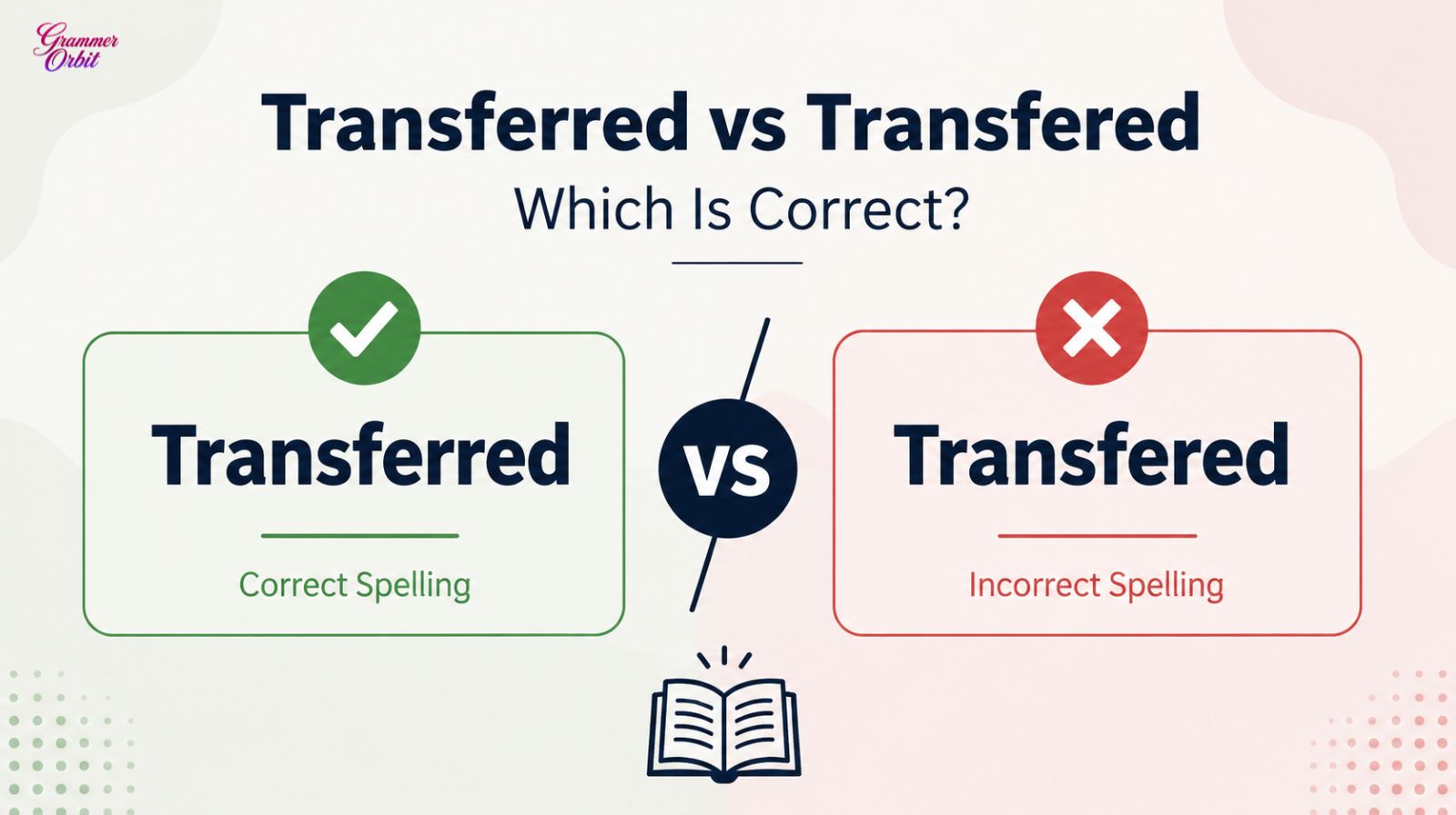
Have you ever written “transfered” and wondered whether it looked right? You’re not alone. Many English learners, students, professionals, and even native speakers get confused when spelling the past tense of transfer.
The confusion usually comes from English spelling rules. Some words double the final consonant before adding -ed, while others do not. As a result, many people are unsure whether the correct form is transferred or transfered.
In this guide, you’ll learn the correct spelling, the grammar rule behind it, common mistakes to avoid, real-life examples, and practical tips to help you remember the difference. By the end, you’ll never have to guess again.
Is It Transferred or Transfered?
The Correct Spelling Is “Transferred”
The correct past tense and past participle form of transfer is:
✅ Transferred
The spelling “transfered” is incorrect in standard English.
Quick Answer
| Word | Correct? |
|---|---|
| Transferred | ✅ Yes |
| Transfered | ❌ No |
Example Sentences
- The company transferred the funds yesterday.
- She was transferred to another department.
- The files were successfully transferred to the new server.
Incorrect:
- ❌ The company transfered the funds yesterday.
- ❌ She was transfered to another department.
Why Is “Transferred” Correct?
The reason comes from a common English spelling rule involving stressed syllables and consonant doubling.
Understanding the Rule
When a verb:
- Ends with a vowel followed by a consonant
- Has stress on the final syllable
You usually double the final consonant before adding -ed or -ing.
Transfer Follows This Rule
Word: transfer
Syllables:
trans-FER
The stress falls on FER, the final syllable.
Therefore:
transfer + ed
becomes
transfer + r + ed
=
transferred
Similar Examples
| Base Verb | Correct Past Tense |
|---|---|
| Prefer | Preferred |
| Refer | Referred |
| Transfer | Transferred |
| Confer | Conferred |
Notice that each word doubles the final r before adding -ed.
Common Reasons People Write “Transfered”
1. Assuming Every Verb Simply Adds -ed
Many verbs form the past tense by adding -ed.
See also Imbed vs Embed: Meaning, Usage, And Key Differences
Examples:
- Walk → Walked
- Jump → Jumped
- Play → Played
Because of this pattern, writers often assume:
Transfer → Transfered
However, transfer belongs to a different spelling category.
2. Fast Typing Errors
Writers frequently omit one r while typing quickly.
For example:
- transferred → transfered
Spell-check tools usually catch this mistake immediately.
3. Influence from Other Languages
Some languages have simpler verb spelling systems. English learners may naturally apply those rules when writing English words.
Transferred vs Transfered: Side-by-Side Comparison
| Feature | Transferred | Transfered |
|---|---|---|
| Correct English spelling | ✅ Yes | ❌ No |
| Accepted in dictionaries | ✅ Yes | ❌ No |
| Used in professional writing | ✅ Yes | ❌ No |
| Used in academic writing | ✅ Yes | ❌ No |
| Recommended by grammar guides | ✅ Yes | ❌ No |
Featured Snippet Answer
Transferred is the correct spelling. Transfered is a misspelling. The verb transfer follows the consonant-doubling rule because the final syllable is stressed, resulting in the correct form “transferred.”
Real-Life Example: How a Spelling Error Caused Confusion
A project coordinator at a multinational company was preparing a report documenting employee movements between departments. Throughout the report, she repeatedly used the spelling “transfered.”
At first glance, the mistake seemed minor. However, the report was later reviewed by senior management and external auditors. Because the document contained multiple spelling errors, reviewers questioned the overall accuracy and professionalism of the report.
The coordinator had to revise and resubmit the entire document. Although the information itself was correct, the spelling issue created unnecessary delays and reduced confidence in the document’s quality.
This example highlights an important lesson. Small spelling mistakes can affect credibility, especially in professional environments where accuracy matters. Using the correct spelling “transferred” helps ensure your writing appears polished and trustworthy.
Whether you’re writing emails, reports, academic papers, or website content, mastering common spelling rules can significantly improve the quality of your communication.
Transferred in Different Contexts
Business Communication
Examples:
- The funds were transferred to the client account.
- Ownership was transferred after the agreement was signed.
Education
Examples:
- The student was transferred to another school.
- Credits were transferred successfully.
Technology
Examples:
- The files were transferred to cloud storage.
- Data was transferred securely between systems.
Healthcare
Examples:
- The patient was transferred to a specialized facility.
- Medical records were transferred electronically.
Using the correct spelling is essential in all these contexts.
Data and Language Trends (2025–2026)
Language usage data from major writing and grammar platforms continues to show that “transferred” is overwhelmingly the accepted form in modern English.
Recent spelling analysis tools used by businesses, universities, and publishing platforms consistently flag “transfered” as an error while recognizing “transferred” as the standard spelling.
Additionally, major dictionaries and language resources such as:
- Google Dictionary
- Merriam-Webster
- Cambridge Dictionary
- Oxford Learner’s Dictionaries
all list “transferred” as the correct form.
As digital communication continues to grow in 2025 and 2026, accurate spelling remains a key factor in professional credibility and online content quality.
How to Remember the Correct Spelling
Simple Memory Trick
Think about these words:
- Refer → Referred
- Prefer → Preferred
- Confer → Conferred
Since transfer follows the same pattern, it becomes:
Transfer → Transferred
Easy Formula
Stress on final syllable + vowel + consonant = double consonant
Transfer
↓
Transferred
Practice Sentence
“The documents were transferred yesterday.”
Writing this sentence a few times can help reinforce the correct spelling.
Common Mistakes Related to Transferred
Mistake 1: Transfered
❌ Incorrect
✅ Transferred
See also Zeroes or Zeros: Complete Guide To The Correct Plural Form Of Zero
Mistake 2: Transfering
❌ Incorrect
✅ Transferring
Mistake 3: Transfers
❌ Incorrect in some contexts
✅ Transfers
Always double the r when adding -ed or -ing.
FAQs
Q1: Is transfered ever correct?
A: No. Standard English dictionaries and style guides consider transfered a misspelling.
Q2: Why does transferred have two r’s?
A: Because transfer follows the consonant-doubling rule. The final syllable is stressed, so the final r is doubled before adding -ed.
Q3: Is transferred American or British English?
A: Transferred is correct in both American and British English.
Q4: What is the present participle of transfer?
A: The present participle is:
✅ transferring
❌ transfering
Q5: How do I spell transferred correctly?
A: Remember that words like refer, prefer, and transfer all double the final r before adding suffixes.
Q6: Is transfered accepted in formal writing?
A: No. Professional, academic, and business writing should always use transferred.
Conclusion
When comparing transferred vs transfered, the answer is simple: transferred is the correct spelling, while transfered is a spelling mistake.
The reason is that transfer follows the English consonant-doubling rule. Because the stress falls on the final syllable, the final r must be doubled before adding -ed or -ing.
Remember this formula:
Transfer → Transferred
Using the correct spelling will make your writing more professional, accurate, and credible. The next time you’re writing an email, report, essay, or blog post, you’ll know exactly which version to use.
👉 Discover more simple and practical grammar guides on Grammer Orbit

Zia Ahmad is a professional blogger specializing in grammar tips and spelling accuracy. He creates clear, practical content that helps readers eliminate errors, strengthen writing skills, and communicate effectively for students, professionals, and everyday writers worldwide.