
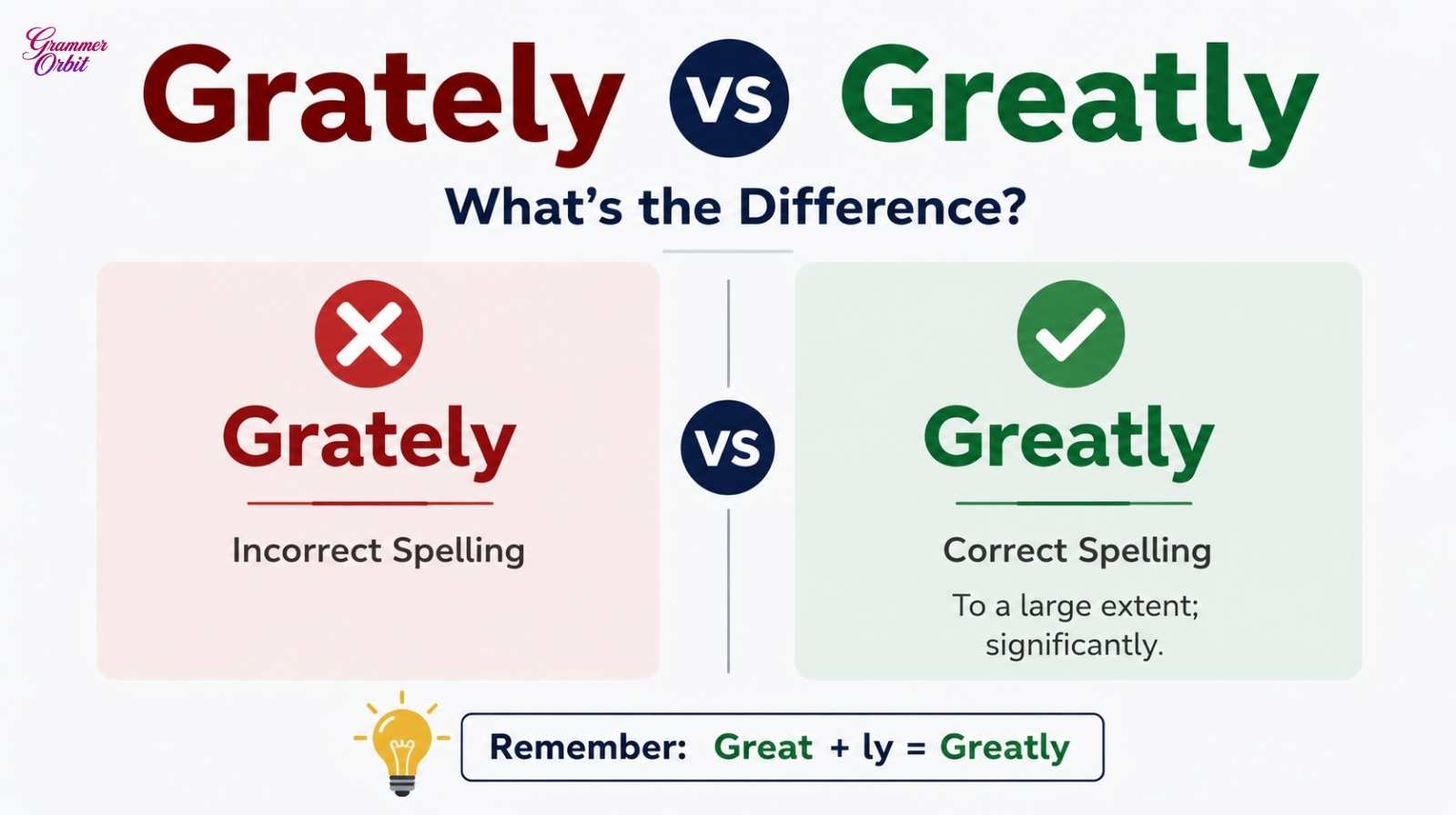
Have you ever written “grately” when you meant “greatly”? You’re not alone. Many English learners and even native speakers occasionally misspell common adverbs, especially when typing quickly.
The confusion between Grately vs Greatly often appears in emails, academic writing, blog posts, and social media content. However, only one of these words is recognized as standard English.
In this guide, you’ll learn the difference between grately and greatly, discover which spelling is correct, see real-world examples, and learn practical tips to avoid this mistake in your writing.
What Is the Difference Between Grately and Greatly?
The difference is simple:
| Word | Correct? | Meaning |
|---|---|---|
| Grately | ❌ No | Misspelling of “greatly” |
| Greatly | ✅ Yes | To a large extent; significantly |
Greatly is a proper English adverb used to describe something happening to a large degree.
Grately, on the other hand, is not recognized in standard English dictionaries and is considered a spelling error.
Why Do People Write “Grately”?
The mistake usually happens because:
- The words sound similar when spoken quickly.
- Autocorrect may not always catch the error.
- Writers confuse it with words ending in “-ly.”
- Fast typing can lead to letter omissions.
Quick Answer
If you’re wondering which word to use, the answer is always greatly.
“Your support is greatly appreciated.” ✅
“Your support is grately appreciated.” ❌
What Does Greatly Mean?
Greatly means:
- To a significant extent
- Very much
- Considerably
- Substantially
It modifies verbs, adjectives, or other adverbs.
Examples of Greatly in Sentences
- We greatly appreciate your feedback.
- The new software greatly improved productivity.
- Her confidence greatly increased after the training.
- The company was greatly affected by market changes.
Common Phrases Using Greatly
Some frequently used expressions include:
- Greatly appreciated
- Greatly improved
- Greatly reduced
- Greatly influenced
- Greatly benefited
These phrases appear regularly in professional and academic writing.
Why Is “Grately” Incorrect?
The English language follows established spelling conventions, and grately simply isn’t one of them.
Dictionary Recognition
Major dictionaries such as:
- Merriam-Webster
- Oxford English Dictionary
- Cambridge Dictionary
list greatly as a valid word but do not recognize grately as a standard English term.
Spelling Pattern Explanation
The adverb greatly comes from:
Great + ly = Greatly
The root word remains intact when the suffix -ly is added.
Because the base word is great, removing the letter “a” creates an incorrect spelling.
Memory Trick
Think:
Great → Greatly
If the word starts with great, the spelling should keep all letters from the original word.
Grately vs Greatly Comparison Table
The following table provides a quick overview.
| Feature | Grately | Greatly |
|---|---|---|
| Valid English Word | ❌ No | ✅ Yes |
| Found in Dictionaries | ❌ No | ✅ Yes |
| Appropriate for Formal Writing | ❌ No | ✅ Yes |
| Used in Academic Content | ❌ No | ✅ Yes |
| Meaning | None | To a large extent |
When to Use Greatly
Use greatly whenever you want to express a significant degree of something.
Examples:
- We were greatly encouraged by the results.
- Sales greatly exceeded expectations.
- The policy greatly benefited employees.
Real-Life Example: How a Small Spelling Error Hurt Professional Communication
A freelance writer was preparing a proposal for a potential client. Throughout the document, he repeatedly wrote:
“Your assistance would be grately appreciated.”
Although the proposal contained valuable information, the client noticed the spelling error appearing multiple times.
The mistake seemed minor, but it created concerns about the writer’s attention to detail. In professional communication, spelling errors can affect credibility because readers often associate accurate writing with competence and professionalism.
After receiving feedback, the writer reviewed the proposal and replaced every instance of grately with greatly.
The revised sentence became:
“Your assistance would be greatly appreciated.”
The correction immediately improved the document’s professionalism and readability.
This example highlights an important lesson: even a single-letter spelling mistake can influence how others perceive your expertise. Whether you’re writing business emails, academic papers, website content, or social media posts, using the correct spelling helps build trust and authority.
Language Data and Usage Trends (2025–2026)
Language monitoring tools and search trend platforms continue to show that spelling-related searches remain among the most common grammar queries online.
Key Findings
- Millions of users search for spelling corrections every month.
- Commonly confused words generate significant educational traffic.
- Grammar and spelling content continues to perform strongly in search results during 2025 and 2026.
- Professional communication studies consistently show that spelling errors can reduce perceived credibility.
According to resources from Google Search documentation and writing platforms such as HubSpot, clear and accurate language improves user trust, readability, and content quality.
Why This Matters
A simple spelling correction like replacing grately with greatly can improve:
- Professional image
- Reader confidence
- Academic accuracy
- Content quality
- Search engine trust signals
How to Avoid Confusing Grately and Greatly
Remember the Root Word
Start with the adjective:
Great
Then add:
-ly
Result:
Greatly
Use Spell Check Tools
Modern writing tools can catch spelling errors before publishing.
Read Aloud Before Publishing
Reading your content aloud often helps identify spelling and grammar mistakes that are easy to miss during typing.
Proofread Important Documents
Always review:
- Emails
- Cover letters
- Blog posts
- Academic assignments
- Business reports
A final proofreading pass can prevent embarrassing mistakes.
FAQs
Q1: Is grately a real word?
A: No. Grately is not recognized as a standard English word and is considered a misspelling of greatly.
Q2: What does greatly mean?
A: Greatly means to a large extent, significantly, or very much.
Q3: Why do people confuse grately and greatly?
A: The confusion usually comes from pronunciation similarities and typing mistakes.
Q4: Can I use grately in formal writing?
A: No. Formal writing should always use greatly, not grately.
Q5: Is greatly appreciated grammatically correct?
A: Yes. The phrase “greatly appreciated” is widely used and grammatically correct.
Q6: What part of speech is greatly?
A: Greatly is an adverb because it modifies verbs, adjectives, or other adverbs.
Q7: How can I remember the correct spelling?
A: Remember that greatly comes from the word great. Keep the entire root word and simply add -ly.
Conclusion
When comparing Grately vs Greatly, the answer is straightforward: greatly is the correct spelling, while grately is a misspelling.
Because greatly means to a significant extent or very much, it is commonly used in professional, academic, and everyday communication. Understanding this distinction helps you write with greater accuracy and confidence.
The next time you’re tempted to write grately, remember the root word great and use greatly instead. Small spelling improvements can greatly enhance your credibility, professionalism, and overall writing quality.
👉 Discover more simple and practical grammar guides on Grammer Orbit

Zia Ahmad is a professional blogger specializing in grammar tips and spelling accuracy. He creates clear, practical content that helps readers eliminate errors, strengthen writing skills, and communicate effectively for students, professionals, and everyday writers worldwide.