
Have you ever typed “layed” in a message, email, or school assignment and wondered if it looked right? You are not alone. Many English learners and even native speakers get confused between laid and layed because both seem like they could be correct.
The confusion usually comes from the verb lay, whose past tense does not follow the pattern many people expect. As a result, countless writers accidentally use layed when they actually mean laid.
The good news is that the rule is simple once you understand it.
In this guide, you’ll learn the difference between laid and layed, discover which spelling is correct, see real-world examples, understand the grammar behind the words, and learn easy tricks to remember the correct form every time.
What Is the Difference Between Laid and Layed?
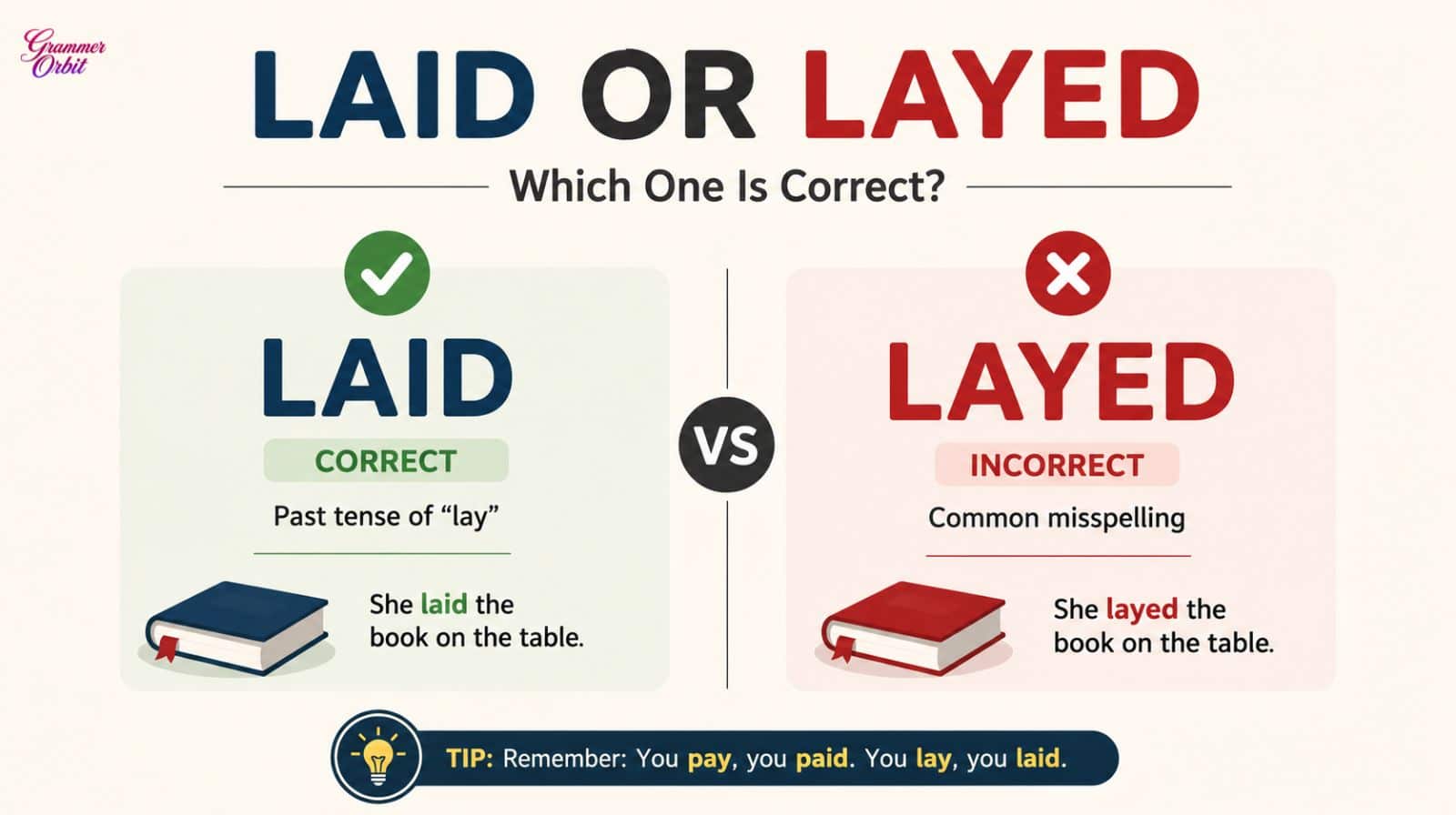
Quick Answer
Laid is the correct past tense and past participle of the verb lay.
Layed is usually considered a misspelling in modern English.
| Word | Correct? | Meaning |
|---|---|---|
| Laid | ✅ Yes | Past tense of “lay” |
| Layed | ❌ Usually No | Common misspelling |
Featured Snippet Answer
Laid is the correct spelling. It is the past tense and past participle of the verb lay, meaning to put or place something down. Layed is generally incorrect and should be avoided in standard English writing.
Examples
✅ She laid the book on the table.
✅ The workers laid the foundation yesterday.
✅ He has laid out a detailed plan.
❌ She layed the book on the table.
❌ They layed new carpet last week.
See also Bony vs Boney: Which Spelling Is Correct?
Understanding the Verb “Lay”
To understand why laid is correct, you first need to understand the verb lay.
What Does “Lay” Mean?
The verb lay means:
- To put something down
- To place something somewhere
- To set something in a particular position
Examples of Lay
- Please lay the keys on the counter.
- I always lay my phone beside the bed.
- Workers will lay new pipes tomorrow.
Notice that lay normally requires an object. In other words, something is being placed somewhere.
Verb Forms of Lay
| Tense | Form |
|---|---|
| Base Verb | Lay |
| Past Tense | Laid |
| Past Participle | Laid |
| Present Participle | Laying |
Examples
- Present: I lay the documents on the desk.
- Past: I laid the documents on the desk.
- Present Perfect: I have laid the documents on the desk.
- Continuous: I am laying the documents on the desk.
This table explains why laid is the correct choice instead of layed.
Why Do People Write “Layed”?
The Influence of Regular Verb Patterns
Many English verbs form their past tense by adding -ed.
For example:
- Play → Played
- Stay → Stayed
- Delay → Delayed
Because of these patterns, many writers assume:
- Lay → Layed
However, English contains many irregular verbs that do not follow standard rules.
Similar Irregular Verbs
| Present | Past |
|---|---|
| Say | Said |
| Pay | Paid |
| Lay | Laid |
The verb lay belongs to this group of irregular verbs.
Why the Mistake Is So Common
Several factors contribute to the confusion:
- The pronunciation sounds believable.
- Many people rarely study verb forms.
- Spell-check tools sometimes fail to catch contextual errors.
- Social media posts often contain incorrect spellings.
As a result, layed appears frequently online even though it is not considered standard English.
Laid vs Layed: Side-by-Side Comparison
Quick Comparison Table
| Feature | Laid | Layed |
|---|---|---|
| Correct English spelling | ✅ | ❌ |
| Past tense of lay | ✅ | ❌ |
| Accepted in formal writing | ✅ | ❌ |
| Used in academic writing | ✅ | ❌ |
| Found in dictionaries as standard form | ✅ | ❌ |
| Recommended by grammar experts | ✅ | ❌ |
Correct Usage Examples
✅ The farmer laid fresh straw in the barn.
✅ She laid her jacket on the chair.
✅ The company laid new cables underground.
Incorrect Usage Examples
❌ The farmer layed fresh straw in the barn.
❌ She layed her jacket on the chair.
See also Smoke Show Meaning: What It Really Means In Modern Slang
❌ The company layed new cables underground.
Real-Life Example: How One Small Spelling Error Changed a Professional Email
Imagine a job applicant sending an important email to a hiring manager.
The applicant writes:
“I have layed out my qualifications in the attached document.”
The hiring manager immediately notices the mistake.
While one spelling error may not automatically cost someone a job, language mistakes can influence first impressions. Recruiters often review dozens or even hundreds of applications. Small grammar errors may suggest a lack of attention to detail, especially for positions involving communication, writing, teaching, marketing, administration, or customer service.
Now compare the corrected version:
“I have laid out my qualifications in the attached document.”
The sentence appears polished, professional, and grammatically accurate.
A similar situation can happen in:
- Business emails
- College applications
- Blog posts
- Website content
- Reports
- Marketing materials
Professional writers, editors, and content creators understand that seemingly minor spelling differences can affect credibility. Using laid instead of layed helps ensure your writing meets standard English expectations.
This example demonstrates why learning the correct form matters in both academic and professional settings.
The Difference Between Lay and Lie
Another reason people struggle with laid is because they also confuse lay and lie.
Lay
Means to place something down.
Examples:
- Lay the blanket on the couch.
- Please lay the papers here.
Lie
Means to recline or rest.
Examples:
- I need to lie down.
- The cat likes to lie on the sofa.
Comparison Table
| Verb | Meaning | Past Tense |
|---|---|---|
| Lay | Put something down | Laid |
| Lie | Recline or rest | Lay |
Example Sentences
- Today I lay the book on the desk.
- Yesterday I laid the book on the desk.
But:
- Today I lie on the couch.
- Yesterday I lay on the couch.
This overlap is one reason English learners often find these verbs challenging.
How to Remember the Correct Spelling
Trick #1: Think of “Paid”
Consider this pair:
- Pay → Paid
- Lay → Laid
Both verbs change similarly.
Trick #2: Remember the Phrase
“You pay, you paid. You lay, you laid.”
This simple pattern is easy to remember.
Trick #3: Spot the Object
Ask yourself:
Am I placing something somewhere?
If yes, you’re probably using the verb lay, and the past tense will be laid.
Examples
- She laid the keys on the table.
- They laid new flooring.
- We laid the plans out clearly.
Language Usage Trends and Modern Writing Data (2025–2026)
Recent language analysis from major writing platforms and digital publishing tools shows that laid overwhelmingly dominates professional and academic writing.
Grammar-checking services process millions of documents each day and consistently flag layed as a spelling or grammar issue in standard contexts. Educational resources, dictionaries, and style guides also identify laid as the accepted past tense of lay.
The continued growth of online content has increased visibility of spelling mistakes, which partly explains why layed appears frequently in searches. Search engines record thousands of monthly searches from users asking whether laid or layed is correct.
This trend demonstrates an important reality:
Many people search for layed, but professional writers use laid.
That distinction is essential for anyone creating content, writing emails, publishing articles, or preparing academic work.
Common Phrases That Use “Laid”
Frequently Used Expressions
Laid Out
- She laid out the proposal clearly.
- The architect laid out the design plans.
Laid Off
- The company laid off several employees.
Laid Back
- He has a very laid-back personality.
Laid Down
- The teacher laid down new classroom rules.
Laid the Foundation
- Engineers laid the foundation for the bridge.
These common expressions further reinforce the correct spelling.
Common Mistakes to Avoid
Mistake #1: Adding “-ed” Automatically
Incorrect:
❌ I layed the package on the porch.
Correct:
✅ I laid the package on the porch.
Mistake #2: Confusing Lay and Lie
Incorrect:
❌ I am going to lay down for a nap.
Correct:
✅ I am going to lie down for a nap.
Mistake #3: Using Layed in Formal Writing
Academic papers, professional emails, and business reports should always use laid.
FAQs
Q1: Is layed ever correct?
A: In standard modern English, layed is generally considered incorrect when used as the past tense of lay. The accepted form is laid.
Q2: Why do people write layed?
A: People often assume the verb follows the regular -ed pattern used by words such as played and stayed.
Q3: Is laid the past tense of lay?
A: Yes. The correct past tense and past participle of lay is laid.
Q4: How do you use laid in a sentence?
Example:
A: She laid the notebook on the desk before leaving.
Q5: Is layed in the dictionary?
A: Some dictionaries may mention layed as a variant or historical form in specialized contexts, but it is not the standard past tense of lay.
Q6: Which spelling should I use in professional writing?
A: Always use laid.
Q7: Is “have laid” correct?
Yes.
Example:
A: I have laid the documents on your desk.
Conclusion
When comparing laid and layed, the answer is straightforward: laid is the correct spelling in standard English. It serves as both the past tense and past participle of the verb lay, while layed is generally regarded as a misspelling.
Understanding this difference can improve your writing, strengthen your grammar skills, and help you avoid common mistakes in emails, academic papers, blog posts, and professional communication.
Whenever you’re tempted to write layed, remember the simple pattern:
Pay → Paid
Lay → Laid
Use laid with confidence, and your writing will immediately look more polished, accurate, and professional.
References
- Merriam-Webster Dictionary
- Cambridge Dictionary
- Oxford Learner’s Dictionaries
👉 Discover more simple and practical grammar guides on Grammer Orbit

Zia Ahmad is a professional blogger specializing in grammar tips and spelling accuracy. He creates clear, practical content that helps readers eliminate errors, strengthen writing skills, and communicate effectively for students, professionals, and everyday writers worldwide.