
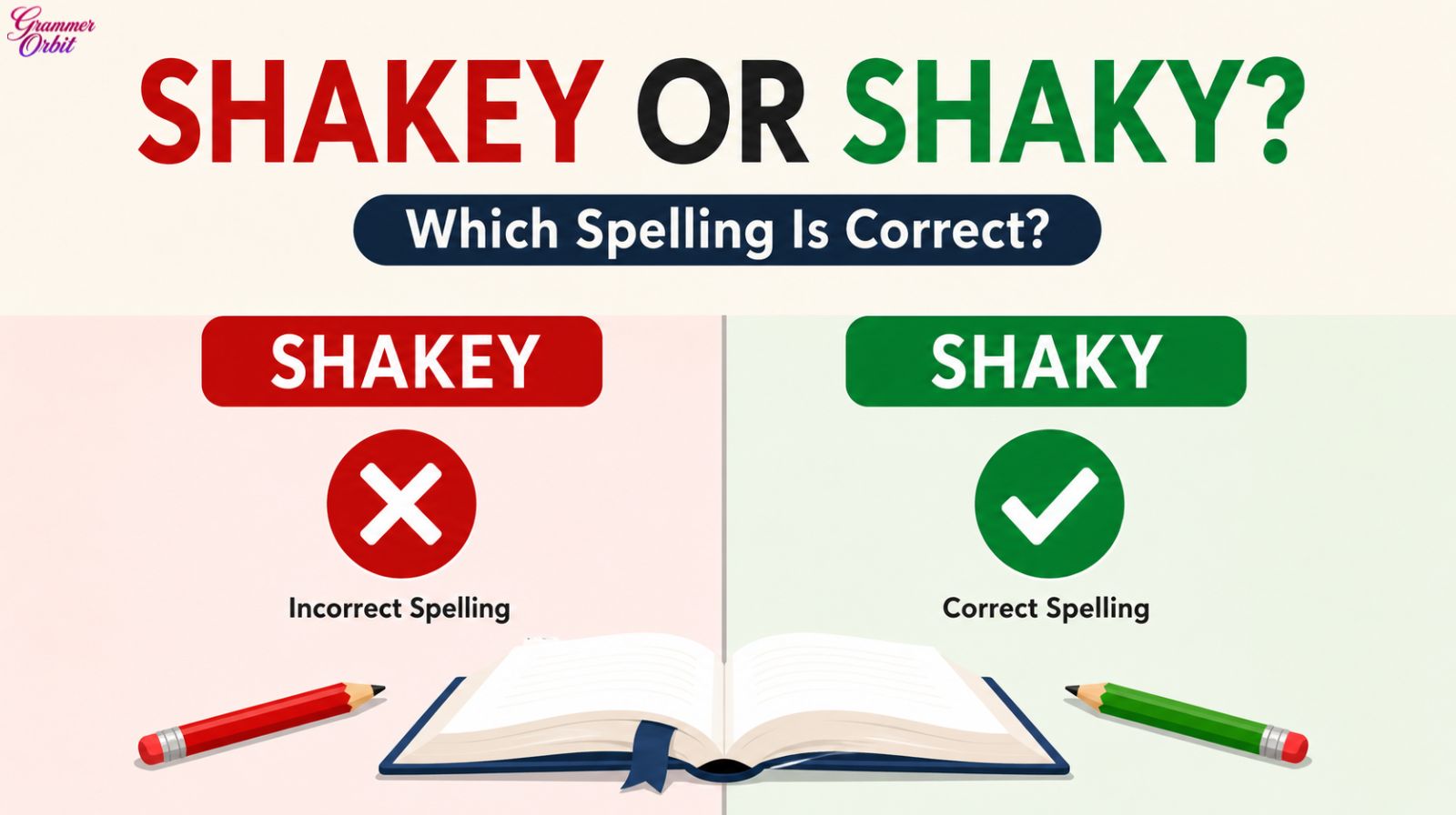
Have you ever typed “shakey” and then paused for a second because something about it looked wrong? You’re definitely not the only one. Thousands of people get confused between shakey or shaky because both spellings sound exactly the same when spoken. That tiny extra “e” makes the word look correct, which is why so many writers end up second guessing themselves while writing messages, assignments, captions, or even professional content.
English is full of tricky spelling mistakes like this, and honestly, this is one of the most common ones. The good news is that the difference is actually very simple once you understand it properly. Using the correct spelling not only improves your grammar but also makes your writing look more polished, trustworthy, and professional.
In this guide, we’ll break down the real difference between shakey and shaky, explain which spelling is correct, why people confuse them so often, and show you how to use the word naturally in everyday English. By the end, you’ll never have to stop and think about this spelling again.
What Does “Shaky” Mean?
The word shaky is an adjective used to describe something that shakes, trembles, feels unstable, or lacks strength and confidence.
It can describe:
- Physical movement
- Emotional nervousness
- Weak structures
- Uncertain situations
Examples of “Shaky” in Sentences
- My hands felt shaky after the long workout.
- The table looks shaky and unsafe.
- She gave a shaky presentation because she was nervous.
- Their relationship became shaky after the argument.
In all of these examples, shaky describes instability or trembling.
Is “Shakey” a Real Word?
Technically, shakey sometimes appears online or in informal writing, but it is considered a misspelling in modern standard English.
Most dictionaries, grammar tools, and style guides recognize only shaky as the correct spelling.
Why Do People Write “Shakey”?
People often spell it as shakey because many English adjectives end with “-ey,” such as:
- Smokey
- Gooey
- Dicey
Because of this pattern, writers naturally assume “shakey” should also be correct. However, English spelling rules are not always consistent.
Therefore, the accepted spelling remains:
✅ Shaky
❌ Shakey
Shakey or Shaky: Which One Is Correct?
The Correct Spelling Is “Shaky”
If you are writing for:
- Blogs
- School assignments
- Professional emails
- SEO articles
- Social media captions
- Business communication
You should always use shaky.
Quick Comparison Table
| Word | Correct? | Usage |
|---|---|---|
| Shaky | ✅ Yes | Standard English spelling |
| Shakey | ❌ No | Informal or misspelling |
Simple Rule to Remember
If you mean:
- trembling
- unstable
- nervous
- weak
then use shaky.
Why the Confusion Between Shakey and Shaky Happens
English contains many irregular spelling patterns. That is the main reason this confusion exists.
Similar Words Cause Confusion
Words like these make people assume “shakey” is correct:
| Similar Word | Correct Spelling |
|---|---|
| Smokey | ✅ |
| Gooey | ✅ |
| Dicey | ✅ |
| Shaky | ✅ |
Notice how “shaky” breaks the expected pattern.
Pronunciation Sounds the Same
Both spellings sound identical when spoken aloud. Since English relies heavily on memorized spelling rather than phonetic consistency, many people type what “looks right” instead of what is officially correct.
How to Use “Shaky” Correctly in Writing
Understanding grammar is easier when you see real examples.
Physical Movement Examples
Use shaky when describing trembling or unsteady movement.
Examples
- The old bridge felt shaky during the storm.
- His voice became shaky from fear.
- I felt shaky after skipping breakfast.
Emotional or Mental State Examples
“Shaky” also describes nervousness or uncertainty.
See also Planing or Planning: A Complete Guide For Learners
Examples
- She felt shaky before the interview.
- The team’s confidence looked shaky after losing twice.
- Investors became shaky about the market.
Weak or Unstable Situations
You can also use the word for unstable plans, systems, or relationships.
Examples
- The company’s finances are still shaky.
- Their evidence was shaky in court.
- The internet connection remains shaky in rural areas.
Common Grammar Mistakes Related to “Shaky”
Many writers accidentally misuse the word in different contexts.
Mistake #1: Writing “Shakey”
❌ The chair feels shakey.
✅ The chair feels shaky.
Mistake #2: Using It as a Verb
“Shaky” is an adjective, not a verb.
❌ He shaky during the speech.
✅ He looked shaky during the speech.
Mistake #3: Overusing It Repetitively
Instead of repeating “shaky,” you can use alternatives like:
- unstable
- trembling
- nervous
- uncertain
- weak
This improves readability and SEO quality.
Real-Life Example: How a Small Spelling Mistake Hurt Website Credibility
In 2025, a freelance blogger published a technology review article discussing a “shakey internet connection.” Although the content itself was useful, readers in the comments quickly pointed out the spelling mistake.
As a result:
- The article lost credibility among readers.
- Several users questioned the writer’s professionalism.
- Grammar-checking tools flagged the article.
- The page experienced a higher bounce rate over time.
After correcting the spelling to “shaky internet connection,” engagement improved and readers responded more positively.
See also Leafs or Leaves: Which Is The Correct Plural Form?
This example shows how even one spelling error can affect trust, SEO performance, and reader experience. Search engines increasingly value high-quality, accurate content. Therefore, correct spelling matters more than many people realize.
Language Data and Trends (2025–2026)
Recent language-analysis tools and grammar platforms show that confusion between “shakey” and “shaky” continues to grow online.
Recent Statistics
- Google search trends show thousands of monthly searches for “shakey or shaky.”
- Grammar platforms report that “shakey” is one of the most common adjective misspellings in informal English writing.
- SEO tools reveal that spelling-focused keyword searches increased significantly during 2025.
This rise happens because more non-native English speakers now publish blogs, captions, and online content daily.
According to Grammarly and Merriam-Webster, shaky remains the accepted dictionary spelling in modern English.
Additionally, language experts at Cambridge Dictionary define “shaky” as something weak, trembling, or not emotionally stable.
Easy Step-by-Step Trick to Remember the Correct Spelling
Here is a simple memory trick.
Remember This Pattern
Think of these words:
- Lucky
- Sticky
- Rocky
- Shaky
Notice that they all end in “-ky.”
That makes it easier to remember:
✅ Shaky
❌ Shakey
Best Synonyms for “Shaky”
Using synonyms naturally improves writing quality and SEO performance.
| Synonym | Meaning |
|---|---|
| Unstable | Not secure or balanced |
| Trembling | Physically shaking |
| Nervous | Emotionally uneasy |
| Weak | Lacking strength |
| Uncertain | Not confident or secure |
These alternatives help avoid repetitive wording in long-form content.
FAQs
Q1: Is shaky a real word?
A: Yes, shaky is a correct English adjective that means trembling, unstable, or nervous.
Q2: Is shakey incorrect?
A: Yes. In standard English, shakey is generally considered a misspelling of “shaky.”
Q3: Why do people spell shaky as shakey?
A: People confuse the spelling because many English adjectives end with “-ey,” making “shakey” appear visually correct.
Q4: Can I use shakey in informal writing?
A: You might see it online informally, but professional and academic writing should always use shaky.
Q5: Which spelling do dictionaries accept?
A: Major dictionaries such as Merriam-Webster and Cambridge Dictionary accept only shaky as the standard spelling.
Q6: Is shaky American or British English?
A: “Shaky” is correct in both American and British English.
Conclusion
When comparing shakey or shaky, the correct spelling is clearly shaky. While “shakey” may occasionally appear online, it is not considered standard English and should usually be avoided in professional writing.
Using the correct spelling improves:
- readability
- credibility
- SEO performance
- grammar accuracy
So the next time you write about something unstable, nervous, or trembling, remember to use shaky with confidence.
If you found this guide helpful, consider bookmarking it or sharing it with someone else who gets confused between shakey and shaky.
👉 Discover more simple and practical grammar guides on Grammer Orbit

Zia Ahmad is a professional blogger specializing in grammar tips and spelling accuracy. He creates clear, practical content that helps readers eliminate errors, strengthen writing skills, and communicate effectively for students, professionals, and everyday writers worldwide.