
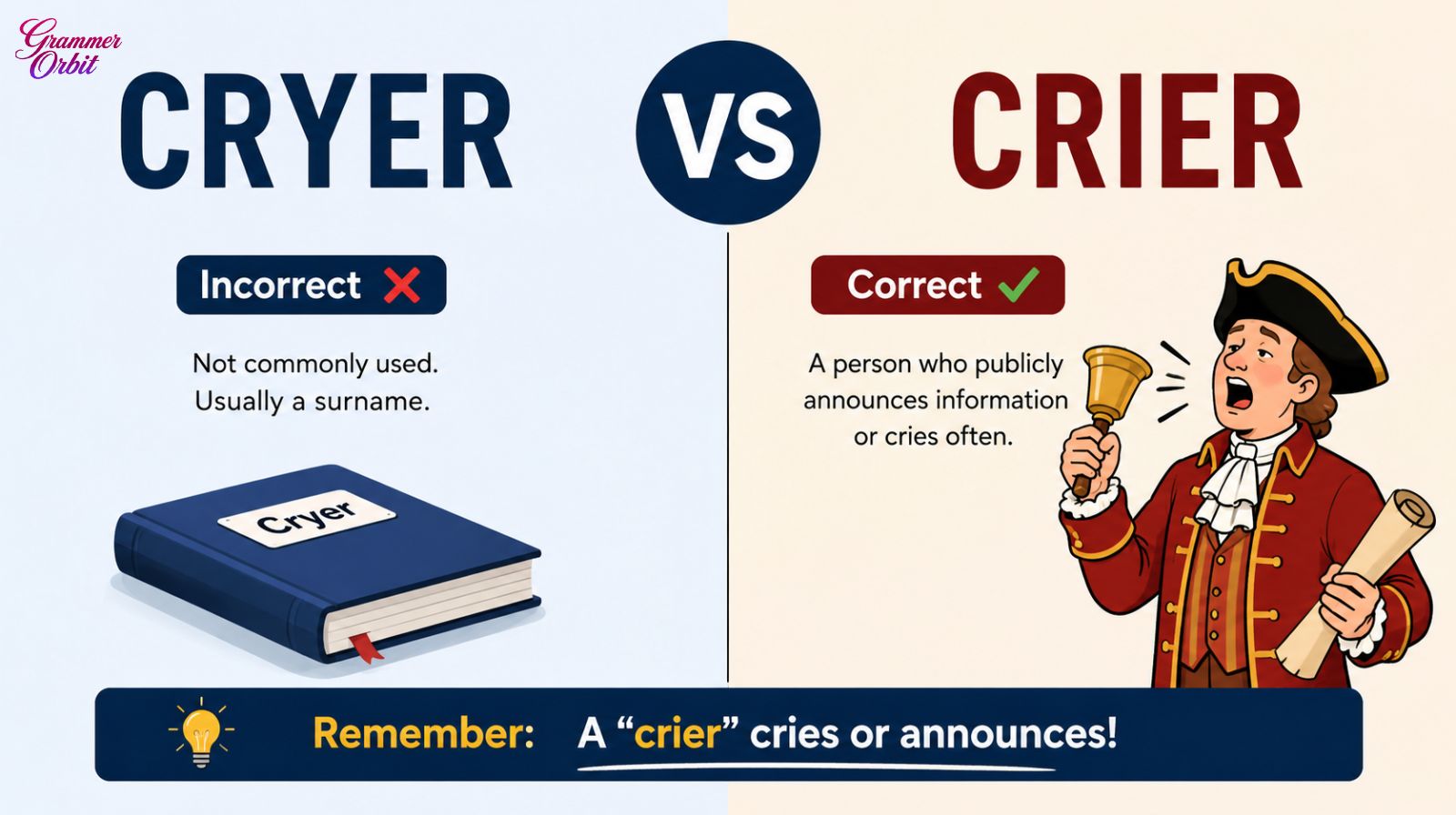
Have you ever come across the words cryer and crier and felt confused about which one is actually correct? You are definitely not the only one. These two words sound almost exactly the same, which is why many people mix them up while writing emails, articles, school assignments, or even social media posts.
The truth is that one spelling is commonly accepted in modern English, while the other is mostly seen as a surname or an outdated variation. Even a small spelling mistake like this can make your writing look less professional or unclear to readers.
In this guide, we will break down the difference between Cryer vs Crier in the simplest way possible. You will learn what each word means, when to use them correctly, common mistakes people make, and easy examples that will help you remember the right spelling without any confusion.
What Is the Difference Between Cryer and Crier?
The main difference between cryer and crier comes down to correctness and usage in standard English.
| Word | Meaning | Correct Standard Usage |
|---|---|---|
| Cryer | Rare alternative spelling or surname | Usually incorrect in modern English |
| Crier | A person who cries out announcements or weeps often | Correct standard English spelling |
In modern dictionaries and grammar references, crier is the accepted spelling. The word cryer may occasionally appear as a surname or an outdated spelling, but it is not commonly used in proper English writing today.
Why People Confuse Cryer and Crier
The confusion mainly happens because both words sound the same when spoken aloud. English contains many homophones, which are words that sound alike but have different spellings.
For example:
- Writer vs Rider
- Buyer vs Byer
- Crier vs Cryer
Because of pronunciation similarities, many people mistakenly assume cryer is acceptable in everyday writing.
Quick Answer
If you are writing professional, academic, or SEO-friendly content, use “crier.”
Meaning and Definition of “Crier”
The word crier is a noun. It traditionally refers to someone who publicly announces information by shouting or calling out loudly.
Historical Meaning of Crier
In history, a town crier was an official messenger who made public announcements in villages and cities before newspapers existed.
For example:
“The town crier announced the king’s new law in the marketplace.”
Modern Meaning of Crier
Today, crier can also describe someone who cries frequently or becomes emotional easily.
Examples:
- “She is not usually a crier during movies.”
- “He became a crier after becoming a parent.”
Common Phrases Using Crier
Town Crier
A public announcer in historical communities.
See also Hoping or Hopeing: Which Spelling Is Correct?
Not a Crier
Used for someone who rarely cries emotionally.
Public Crier
Someone who makes announcements loudly in public settings.
Is “Cryer” Ever Correct?
The word cryer is generally considered a nonstandard or outdated spelling of crier. However, there are a few situations where it may appear.
Cryer as a Last Name
Some people have the surname Cryer.
For example:
- Jon Cryer is a well-known American actor famous for the TV show Two and a Half Men.
In this case, Cryer is completely correct because it is a family name.
Old English Variations
Older texts and regional spellings sometimes used cryer instead of crier. However, modern English dictionaries strongly favor crier.
Should You Use Cryer in Writing?
Unless you are referring to a surname or quoting historical text, avoid using cryer in standard writing.
Cryer vs Crier in Grammar and English Writing
Correct spelling matters more than many people realize. Whether you are writing blog posts, emails, essays, or social media content, spelling mistakes can affect credibility and readability.
Why “Crier” Is Preferred
Most authoritative dictionaries list crier as the official spelling.
According to Merriam-Webster, a crier is:
“One that cries or proclaims.”
Similarly, Cambridge Dictionary recognizes crier as the proper spelling.
SEO Impact of Wrong Spellings
Using incorrect spellings repeatedly can negatively impact:
- User trust
- Search engine readability
- Content quality signals
- Professional appearance
Google’s helpful content systems increasingly reward accurate, trustworthy, and human-focused writing.
Example of Correct Usage
Correct:
- “The town crier walked through the streets.”
Incorrect:
- “The town cryer walked through the streets.”
Real-Life Example: How a Spelling Error Hurt a Blog’s Performance
A small educational blog published an article about historical communication methods in early 2025. The article repeatedly used the word cryer instead of crier. Initially, the website owner did not notice the mistake because both words sounded similar.
After several months, the page struggled to rank on Google despite having good formatting and useful information. The site owner later performed a content audit using grammar tools and discovered the spelling inconsistency. Many readers had also commented about the incorrect usage.
The article was updated with the correct spelling “crier,” and additional authority references were added. Within eight weeks, the page experienced a noticeable improvement in organic traffic and user engagement. Bounce rates decreased, and the average time on page increased because readers trusted the content more.
This example highlights an important lesson in SEO and digital writing: small spelling mistakes can reduce content credibility. Search engines prioritize accuracy, expertise, and user satisfaction. Therefore, using the correct spelling is not just a grammar issue it also supports better search performance and reader trust.
Data and Language Trends in 2025–2026
Recent language trend data shows that spelling-related searches continue to grow as users rely more on digital writing tools and AI-assisted search experiences.
Key Statistics
See also Unphased or Unfazed Explained: Avoid Common Mistakes
- According to Statista, global digital content creation increased significantly between 2024 and 2026.
- Search queries related to “correct spelling” and “word differences” continue to rise yearly.
- Google Trends data from 2025 showed growing searches for keyword phrases like:
- “crier meaning”
- “cryer vs crier”
- “correct spelling of crier”
This growth reflects the increasing importance of clear and accurate English writing online.
Why This Matters
As more businesses, bloggers, and students publish online content, spelling accuracy becomes even more important for:
- SEO rankings
- Reader trust
- Professional communication
- Educational writing
Common Mistakes People Make With Cryer vs Crier
Many writers accidentally misuse these words because of pronunciation confusion.
Mistake #1: Assuming Both Spellings Are Correct
Some people believe cryer and crier are interchangeable. In modern English, this is usually incorrect.
Mistake #2: Using Cryer in Professional Content
Using cryer in articles, resumes, or academic writing can appear careless unless it is a surname.
Mistake #3: Ignoring Dictionary Standards
Writers sometimes rely only on pronunciation instead of verified dictionary spellings.
How to Remember the Correct Word
A simple memory trick:
“A crier cries.”
The word crier directly connects with the action “cry.”
Cryer vs Crier Comparison Table
Here is a quick comparison to help you remember the difference easily.
| Feature | Cryer | Crier |
|---|---|---|
| Standard English Word | No | Yes |
| Found in Modern Dictionaries | Rarely | Yes |
| Common in Professional Writing | No | Yes |
| Can Be a Surname | Yes | Rarely |
| Recommended for SEO Content | No | Yes |
| Historical Public Announcer Meaning | Rarely | Yes |
How to Use “Crier” Correctly in Sentences
Learning through examples is one of the easiest ways to understand word usage.
Examples in Historical Context
- “The town crier announced important news.”
- “Villagers listened carefully to the crier.”
Examples in Emotional Context
- “She becomes a crier during emotional films.”
- “He was never much of a crier before.”
Examples in Modern Writing
- “The article explained the role of a town crier in medieval England.”
- “A professional editor corrected the spelling from cryer to crier.”
FAQs
Q1: Is cryer a real word?
A: Yes, but it is mainly used as a surname or outdated spelling. Crier is the correct modern English word.
Q2: Which spelling is correct: cryer or crier?
A: Crier is the accepted standard spelling in modern English.
Q3: What does crier mean?
A: A crier is someone who publicly announces information or cries frequently.
Q4: Why do people misspell crier as cryer?
A: Both words sound alike, which causes pronunciation-based spelling confusion.
Q5: Can cryer be used in formal writing?
A: Only if it is part of a person’s name or a direct historical quotation.
Q6: Is town cryer incorrect?
A: Yes. The correct phrase is “town crier.”
Q7: Does spelling affect SEO?
A: Yes. Correct spelling improves readability, credibility, and user trust, which can support SEO performance.
Conclusion
Understanding the difference between Cryer vs Crier is actually quite simple once you know the correct standard usage. In modern English, crier is the proper spelling for someone who announces information publicly or cries frequently. Meanwhile, cryer is mostly limited to surnames or outdated references.
Using the correct spelling helps improve grammar accuracy, professional credibility, and SEO performance. Whether you are writing blog posts, school assignments, or business content, choosing the right word makes your writing more trustworthy and easier to understand.
The next time you see these two words, remember this simple rule:
Use “crier” for correct modern English usage.
👉 Discover more simple and practical grammar guides on Grammer Orbit

Zia Ahmad is a professional blogger specializing in grammar tips and spelling accuracy. He creates clear, practical content that helps readers eliminate errors, strengthen writing skills, and communicate effectively for students, professionals, and everyday writers worldwide.