
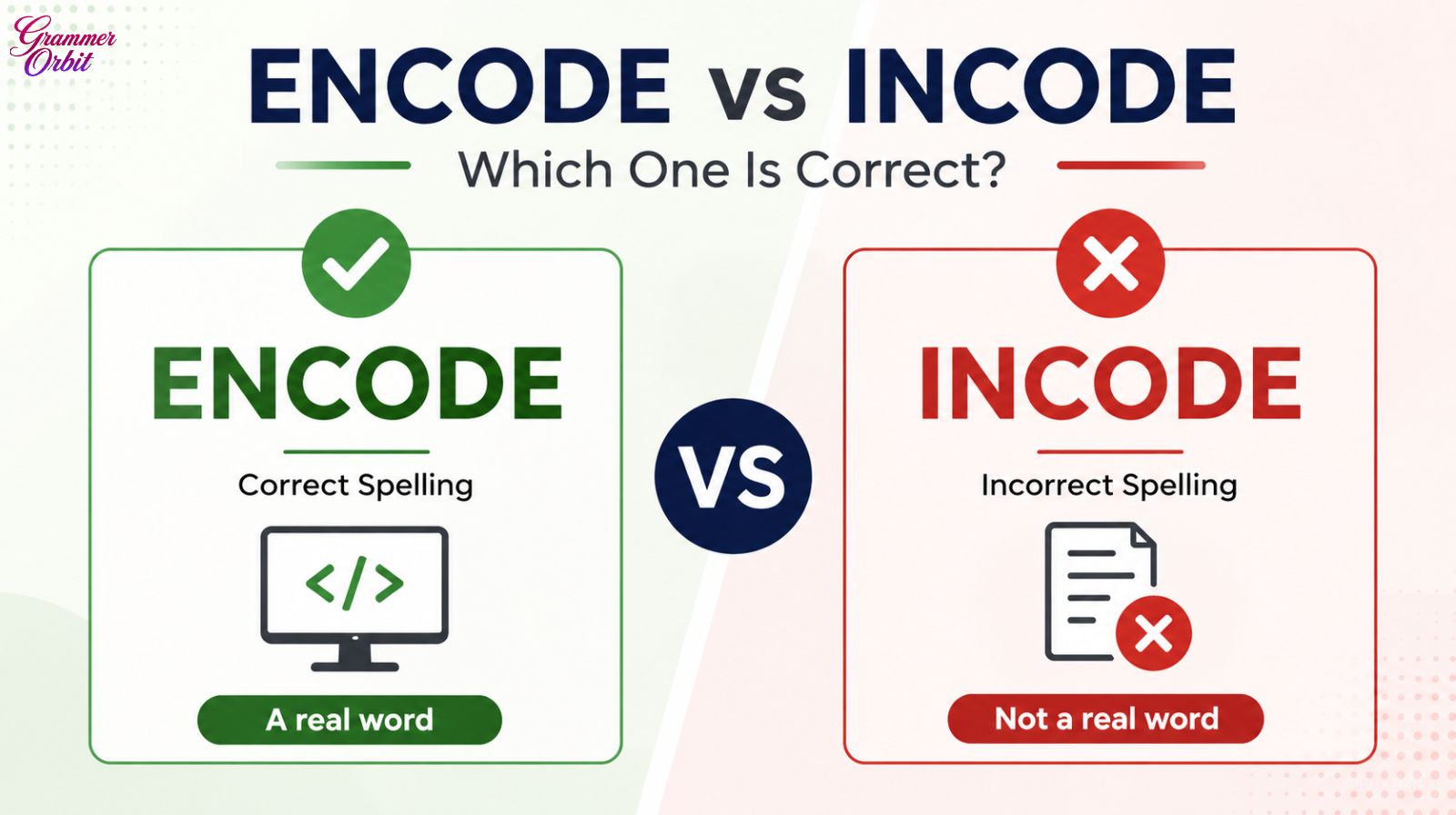
Have you ever typed “incode” and then stopped for a second thinking, “Wait… is this even a real word?” Don’t worry, you’re not the only one. A lot of people students, writers, and even people working in tech get confused between encode vs incode because they sound almost the same when spoken.
The simple truth is that one of these words is correct in proper English, and the other is usually just a spelling mistake that sneaks in without notice. But this small confusion can make your writing look less professional, especially in emails, assignments, or technical content.
In this article, we’ll break it down in a very simple way what encode actually means, why people accidentally write incode, and how you can easily remember the correct spelling forever. No complicated grammar talk, just clear and easy explanation so you never get stuck on this again.
What Does “Encode” Mean?
The word encode is a real and widely used English verb. It means to convert information, data, or messages into a specific code or format so that computers, systems, or people can process it.
The term is commonly used in:
- Technology
- Programming
- Communication systems
- Digital media
- Cryptography
- Data storage
Simple Definition of Encode
Encode = To convert information into a coded form
For example:
- A computer can encode data into binary format.
- Video software encodes files before uploading.
- Secret messages may be encoded for security.
Because of its importance in technology, the word has become extremely common online.
Examples of Encode in Sentences
Here are some natural examples of the word “encode” in everyday English:
Technology Examples
- The software will encode the video automatically.
- Developers encode sensitive data for security reasons.
- The app can encode images into smaller file sizes.
Everyday Usage Examples
- Humans encode memories differently.
- Scientists encode information into DNA sequences.
- The system encodes passwords before storing them.
In all these examples, “encode” refers to converting something into another format or code.
Is “Incode” a Real Word?
The short answer is: No, “incode” is not considered a standard English word.
See also Clutz or Klutz: Which Spelling Is Correct in English?
Most dictionaries do not recognize “incode” as a correct spelling. In nearly all situations, people actually mean encode when they write “incode.”
Why People Write “Incode”
There are several reasons why this spelling confusion happens.
Pronunciation Confusion
When spoken quickly, “encode” can sometimes sound like “incode,” especially in casual conversation or different accents.
Typing Mistakes
People often type words based on how they sound. Since “en” and “in” are both common prefixes in English, the brain can accidentally swap them.
Autocorrect and Informal Usage
Some users repeatedly type “incode” online, which can make others believe it is a valid alternative spelling. However, search engines and grammar tools still recognize “encode” as the proper form.
Encode vs Incode: Main Difference Explained
Here is the simplest way to understand the difference.
| Word | Correct? | Meaning |
|---|---|---|
| Encode | ✅ Yes | Convert information into code |
| Incode | ❌ No | Usually a misspelling of encode |
Quick Grammar Rule
If you are talking about:
- data conversion
- coding information
- media compression
- encryption
- digital formatting
…the correct word is always encode.
Why “Encode” Matters in Technology
The word “encode” is heavily connected to modern digital systems. As technology grows, the term appears more frequently in everyday life.
Common Areas Where Encode Is Used
Video and Audio
Streaming platforms encode media files so they can load faster online.
Programming
Developers encode information for storage and communication between systems.
Cybersecurity
Sensitive information is encoded or encrypted to improve protection.
Artificial Intelligence
AI systems often encode language, images, and patterns into machine-readable formats.
According to recent reports from tech education platforms in 2025, searches related to “data encoding,” “video encoding,” and “AI encoding systems” have increased significantly because more people are learning digital skills and content creation.
Common Mistakes People Make With Encode or Incode
Many writers accidentally use the wrong spelling because both words sound similar. However, understanding the common mistakes can help you avoid them permanently.
Mistake #1: Using Incode in Professional Writing
❌ Incorrect:
- The software can incode files quickly.
✅ Correct:
- The software can encode files quickly.
Professional documents, websites, and academic papers should always use “encode.”
Mistake #2: Confusing Encode With Encrypt
Some people think encode and encrypt mean exactly the same thing. They are related but different.
Encode
Changes information into another format for compatibility or storage.
Encrypt
Protects information using security algorithms.
For example:
- A video file may be encoded for streaming.
- A password may be encrypted for protection.
Mistake #3: Assuming Search Results Make Incode Correct
Sometimes people see “incode” online and assume it is acceptable. However, internet usage does not automatically make a word grammatically correct.
Search engines still strongly associate the intended meaning with “encode.”
Real-Life Example: How a Beginner Developer Fixed This Mistake
A freelance web developer named Amir started learning programming through online tutorials in 2025. While writing technical blog posts, he repeatedly used the word “incode” because that was how he heard instructors pronounce it during videos.
At first, he did not notice the issue. However, after publishing several articles, one of his readers pointed out that “incode” was incorrect. When Amir checked grammar tools and dictionaries, he discovered that the correct spelling was actually “encode.”
After updating his content, he noticed several improvements:
- His articles looked more professional.
- Readers trusted his tutorials more.
- Search engine rankings improved slightly because the keyword matched standard English usage.
- Grammar-checking tools stopped flagging the error.
See also Until or Untill: The Complete Grammar Guide
This example shows how small spelling mistakes can affect credibility online. Even a tiny grammar correction can improve user trust, SEO quality, and professional writing standards.
Encode in SEO and Digital Writing
Correct spelling matters more than many people realize, especially in SEO content writing.
Why Correct Keywords Matter
Search engines like Google understand user intent, but they still prioritize standard language patterns.
For example:
- “encode meaning” has strong search relevance.
- “incode meaning” is usually treated as a spelling variation or typo.
Using the correct word helps:
- Improve search visibility
- Increase readability
- Build authority
- Reduce confusion
Semantic Keywords Related to Encode
Here are some naturally related terms often used with “encode”:
- data encoding
- video encoding
- encode meaning
- encoded message
- digital encoding
- encoding software
- encoding process
Using semantic keywords naturally helps improve topical relevance without keyword stuffing.
Encode vs Incode Comparison Table
Quick Side-by-Side Comparison
| Feature | Encode | Incode |
|---|---|---|
| Standard English word | ✅ Yes | ❌ No |
| Recognized in dictionaries | ✅ Yes | ❌ Rarely |
| Used in technology | ✅ Commonly | ❌ Incorrect usage |
| Appropriate for formal writing | ✅ Yes | ❌ No |
| Recommended for SEO | ✅ Yes | ❌ No |
This simple comparison makes it clear that encode is the only correct choice in professional and grammatical English.
How to Remember the Correct Spelling
If you often confuse these words, these quick tricks can help.
Memory Tip #1
Think of:
ENcode = ENter into code
The “EN” can remind you of entering data into a coded system.
Memory Tip #2
Remember Common Tech Terms
You may already know words like:
- encryption
- encoder
- encoding
All of these connect naturally with “encode,” not “incode.”
Memory Tip #3
Use Grammar Tools
Modern writing tools like:
- Grammarly
- Google Docs
- Microsoft Editor
…automatically recognize “encode” as correct and usually flag “incode” as an error.
Data and Language Trends in 2025–2026
Language usage online continues to evolve rapidly, especially in technology-related searches.
Recent digital language trend reports show:
- Technical grammar searches increased significantly in 2025.
- More users are searching for spelling clarification terms like “encode or incode.”
- AI-generated and user-generated content has increased spelling confusion online.
- Search engines increasingly reward content with accurate terminology and clear intent matching.
This means using proper technical vocabulary is more important than ever for bloggers, businesses, and content creators.
How Professionals Use the Word Encode
The word appears across many industries today.
Software Developers
Developers encode information for applications and APIs.
Video Editors
Editors encode videos into formats like MP4 or MOV.
Cybersecurity Experts
Security professionals encode or encrypt sensitive information.
Content Creators
Online creators encode media files before uploading to platforms.
Because of this broad usage, learning the correct spelling helps improve communication in both technical and professional environments.
FAQs
Q1: Is incode ever correct?
A: In standard English, “incode” is generally considered incorrect. Most people actually mean “encode.”
Q2: What is the meaning of encode?
A: Encode means converting information into a coded or different format for processing, storage, or communication.
Q3: Why do people confuse encode and incode?
A: People confuse them because they sound similar when spoken quickly and because typing habits often follow pronunciation.
Q4: Is encode used in programming?
A: Yes. Encode is commonly used in programming, cybersecurity, data processing, and media technology.
Q5: Does Google recognize incode?
A: Google may understand it as a spelling variation, but “encode” is still the correct and preferred term.
Q6: What is the difference between encode and encrypt?
A: Encoding changes data format for usability, while encryption protects data for security purposes.
Q7: Which spelling should I use in professional writing?
A: You should always use encode in formal, academic, business, and technical writing.
Conclusion
The confusion between encode vs incode is very common, especially because both words sound alike in casual speech. However, the correct and standard English word is clearly encode.
Whether you are writing a blog post, working in programming, creating digital content, or studying English grammar, using the correct spelling improves professionalism, readability, and SEO performance.
Remember:
- ✅ Encode = Correct
- ❌ Incode = Incorrect in standard English
The next time you see “incode,” you will immediately know that “encode” is the right choice.
For better writing, stronger communication, and improved search visibility, always choose the correct spelling with confidence.
External References
👉 Discover more simple and practical grammar guides on Grammer Orbit

Zia Ahmad is a professional blogger specializing in grammar tips and spelling accuracy. He creates clear, practical content that helps readers eliminate errors, strengthen writing skills, and communicate effectively for students, professionals, and everyday writers worldwide.