
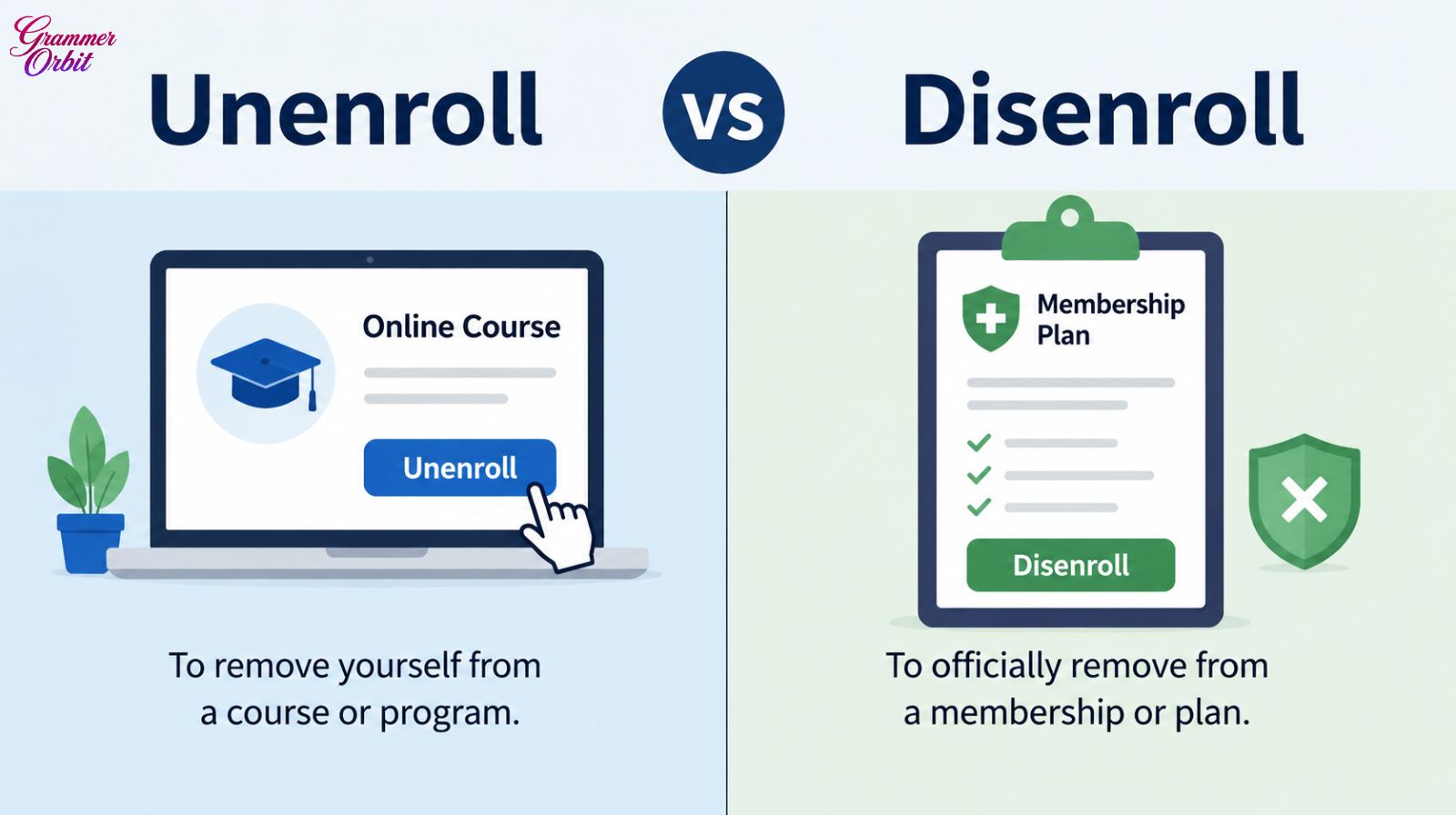
Have you ever tried to leave a course, membership, or online program and suddenly got confused between unenroll and disenroll? You are not alone. Many people see these two words on school portals, learning apps, and official forms but are not sure which one is actually correct. Since both words seem to mean the same thing, it can feel difficult to understand when to use each one.
The confusion becomes even bigger because some websites use unenroll while others prefer disenroll. As a result, students, writers, and even professionals often wonder if one word is wrong or if both are acceptable in English.
In this guide, you will learn the real difference between unenroll vs disenroll, their meanings, correct usage, common mistakes, and which term sounds more natural in modern English. By the end, you will clearly know which word to use in academic, professional, and everyday writing without any confusion.
What Does “Unenroll” Mean?
The word unenroll means to remove someone from a course, membership, subscription, or program. It is formed by adding the prefix “un-” to the verb enroll.
In simple words, it means:
To stop being officially registered in something.
Examples of “Unenroll”
- I decided to unenroll from the online marketing course.
- The student had to unenroll due to financial issues.
- You can unenroll from email notifications anytime.
Why “Unenroll” Sounds Natural
The prefix “un-” commonly means reverse an action. For example:
- unlock
- untie
- unplug
Because of this pattern, many English speakers naturally use unenroll to mean reversing enrollment.
Is “Unenroll” a Real Word?
Yes, although some dictionaries historically preferred disenroll, the word unenroll is widely used today, especially in:
- Online learning platforms
- Educational software
- Subscription systems
- User account settings
In fact, many modern websites use “unenroll” because it feels clearer and easier for users to understand.
What Does “Disenroll” Mean?
The word disenroll also means removing someone from enrollment in a school, healthcare plan, course, or membership.
The prefix “dis-” usually means separation or removal.
Examples of “Disenroll”
See also Rug vs Rag: How Are These Different?
- The university may disenroll students who fail to pay tuition fees.
- Employees can disenroll from the insurance plan during open enrollment.
- She was automatically disenrolled after missing multiple classes.
Why Institutions Prefer “Disenroll”
The word disenroll is often used in:
- Government documents
- Healthcare systems
- Legal paperwork
- Academic administration
It tends to sound more formal and official.
Is “Disenroll” More Correct?
Traditionally, many grammar references considered disenroll the standard form. However, language evolves over time, and modern English now accepts both words in many situations.
Unenroll vs Disenroll: The Main Difference
Although both words share nearly the same meaning, the difference mainly comes down to usage style, tone, and regional preference.
| Feature | Unenroll | Disenroll |
|---|---|---|
| Meaning | Remove enrollment | Remove enrollment |
| Tone | Modern and user-friendly | Formal and institutional |
| Common Usage | Apps, websites, online courses | Schools, healthcare, legal systems |
| Prefix Meaning | Reverse action | Remove or separate |
| Popularity Today | Increasing rapidly | Still common officially |
Quick Answer
If you are writing for:
- Modern websites or blogs → use “unenroll”
- Formal institutions or legal documents → use “disenroll”
Both are understandable, but context matters.
Why People Confuse Unenroll and Disenroll
The confusion happens because English allows multiple prefixes to create opposite meanings.
For example:
| Base Word | Opposite Forms |
|---|---|
| connect | disconnect |
| approve | disapprove |
| tie | untie |
| lock | unlock |
Since both un- and dis- can reverse actions, people naturally assume both unenroll and disenroll are equally standard.
Another reason is that different organizations use different terminology.
For example:
- An online course platform may say “Click here to unenroll.”
- A healthcare company may say “Members may disenroll annually.”
As a result, readers often see both versions online.
Which Word Is More Common in 2025–2026?
Language usage data from recent digital publishing trends shows that “unenroll” has become increasingly popular, especially in technology and e-learning environments.
According to usage patterns observed across educational platforms and software interfaces during 2025–2026:
- “Unenroll” appears more often in user interfaces.
- “Disenroll” remains dominant in healthcare and institutional policies.
- Search engines now recognize both forms as valid related terms.
This shift reflects how modern English favors simpler and more intuitive wording.
Real-World Trend
Many major learning systems now use phrases like:
- “Unenroll from course”
- “Unenroll from notifications”
- “Unenroll anytime”
because these phrases are easier for users to understand quickly.
See also What Does “Bricked Up” Mean? A Clear and Honest Guide
However, formal organizations such as insurance providers still commonly use:
- “Disenrollment period”
- “Request disenrollment”
- “Automatic disenrollment”
Real-Life Example: How a Learning Platform Changed Its Terminology
A small online education company noticed that users frequently contacted customer support asking how to leave a course. Their platform originally used the button text “Disenroll.”
After analyzing customer behavior, the company discovered that many non-native English speakers did not immediately understand the term. Some users even thought “disenroll” referred to punishment or account suspension.
To improve user experience, the company changed the button label from:
“Disenroll from Course”
to:
“Unenroll from Course”
Within three months, support requests related to course removal dropped significantly. User feedback also showed that learners found the new wording simpler and more intuitive.
This example demonstrates how language clarity affects real digital experiences. Even though both terms are technically correct, choosing the more familiar word can improve communication and usability.
Today, many SaaS companies and e-learning platforms follow a similar approach by preferring plain, user-friendly vocabulary.
Common Mistakes People Make With Unenroll and Disenroll
Many writers misuse these terms because they assume they are interchangeable in every context. While they are close in meaning, there are situations where one sounds more natural than the other.
Mistake #1: Using “Disenroll” in Casual Writing
❌ I disenrolled from the newsletter.
This sounds overly formal.
✅ Better:
I unenrolled from the newsletter.
Mistake #2: Using “Unenroll” in Legal or Official Policies
❌ Members may unenroll from Medicare plans.
In healthcare documentation, disenroll is usually preferred.
✅ Better:
Members may disenroll from Medicare plans.
Mistake #3: Assuming One Word Is Incorrect
Some people believe only one form is acceptable. In reality:
- Both words are recognized.
- Context determines the better choice.
- Audience expectations matter.
How to Choose the Right Word
Choosing between unenroll vs disenroll becomes easy when you follow a few simple guidelines.
Use “Unenroll” When:
- Writing blog posts
- Creating app interfaces
- Explaining online courses
- Using conversational English
- Targeting general audiences
Use “Disenroll” When:
- Writing institutional policies
- Discussing healthcare systems
- Creating legal documentation
- Referring to official enrollment procedures
Simple Rule to Remember
“Unenroll” sounds friendlier.
“Disenroll” sounds more official.
Unenroll vs Disenroll in SEO and Digital Writing
In SEO content writing, word choice can affect search visibility and user engagement.
Interestingly, many users now search phrases like:
- “How to unenroll from a course”
- “How do I unenroll?”
- “Can I unenroll anytime?”
because the term feels simpler and more natural in everyday English.
Semantic Keywords Related to Unenroll vs Disenroll
Here are some closely related search terms:
- leave a course
- cancel enrollment
- remove enrollment
- withdraw from class
- course cancellation
- unsubscribe from program
Using these semantic keywords naturally helps improve topical relevance for search engines.
Featured Snippet Answer
Is “unenroll” or “disenroll” correct?
Both unenroll and disenroll are correct English words that mean removing enrollment from a course, program, or membership. “Unenroll” is more common in modern digital platforms, while “disenroll” is often used in formal or institutional contexts.
Expert Writing Tips for Using These Words Correctly
If you create blog posts, educational content, or professional documents, these tips can help you sound more natural and credible.
Match Your Audience
Always choose terminology your audience understands easily.
For example:
- Students may prefer unenroll
- Administrators may expect disenroll
Stay Consistent
Do not switch between both terms repeatedly in the same article unless you are comparing them directly.
Prioritize Clarity
Clear communication matters more than sounding overly formal.
Modern readers usually respond better to simpler language.
FAQs
Q1: Is unenroll a real word?
A: Yes, unenroll is a real and widely used English word, especially in online learning and digital platforms.
Q2: Is disenroll more formal?
A: Yes, disenroll usually sounds more formal and is common in institutional or legal settings.
Q3: Which word is more common today?
A: Unenroll” has become more popular in modern digital communication, while “disenroll” remains common in official systems.
Q4: Can I use both interchangeably?
A: In many situations, yes. However, context and audience should guide your choice.
Q5: Why do healthcare systems use disenroll?
A: Healthcare and government systems often prefer traditional administrative terminology, which includes “disenroll.”
Q6: Which word should bloggers use?
A: Most bloggers and online writers prefer “unenroll” because it sounds simpler and more user-friendly.
Q7: Is unenroll better for SEO?
A: In many modern searches, “unenroll” aligns more closely with natural user language, which may improve engagement and readability.
Conclusion
Understanding the difference between unenroll vs disenroll is easier once you recognize that both words share the same core meaning but serve slightly different purposes.
If you want a modern, conversational, and user-friendly tone, unenroll is usually the better choice. On the other hand, if you are writing for official institutions, healthcare systems, or formal documentation, disenroll may sound more appropriate.
The key is not choosing the “perfect” word but choosing the right word for your audience and context.
As language continues evolving in 2025 and beyond, both forms will likely remain in use. However, modern digital communication increasingly favors clear and simple wording, making unenroll more common in everyday online English.
For better writing, clearer communication, and stronger SEO performance, always focus on what your readers naturally understand first.
Credible References
👉 Discover more simple and practical grammar guides on Grammer Orbit

Zia Ahmad is a professional blogger specializing in grammar tips and spelling accuracy. He creates clear, practical content that helps readers eliminate errors, strengthen writing skills, and communicate effectively for students, professionals, and everyday writers worldwide.