
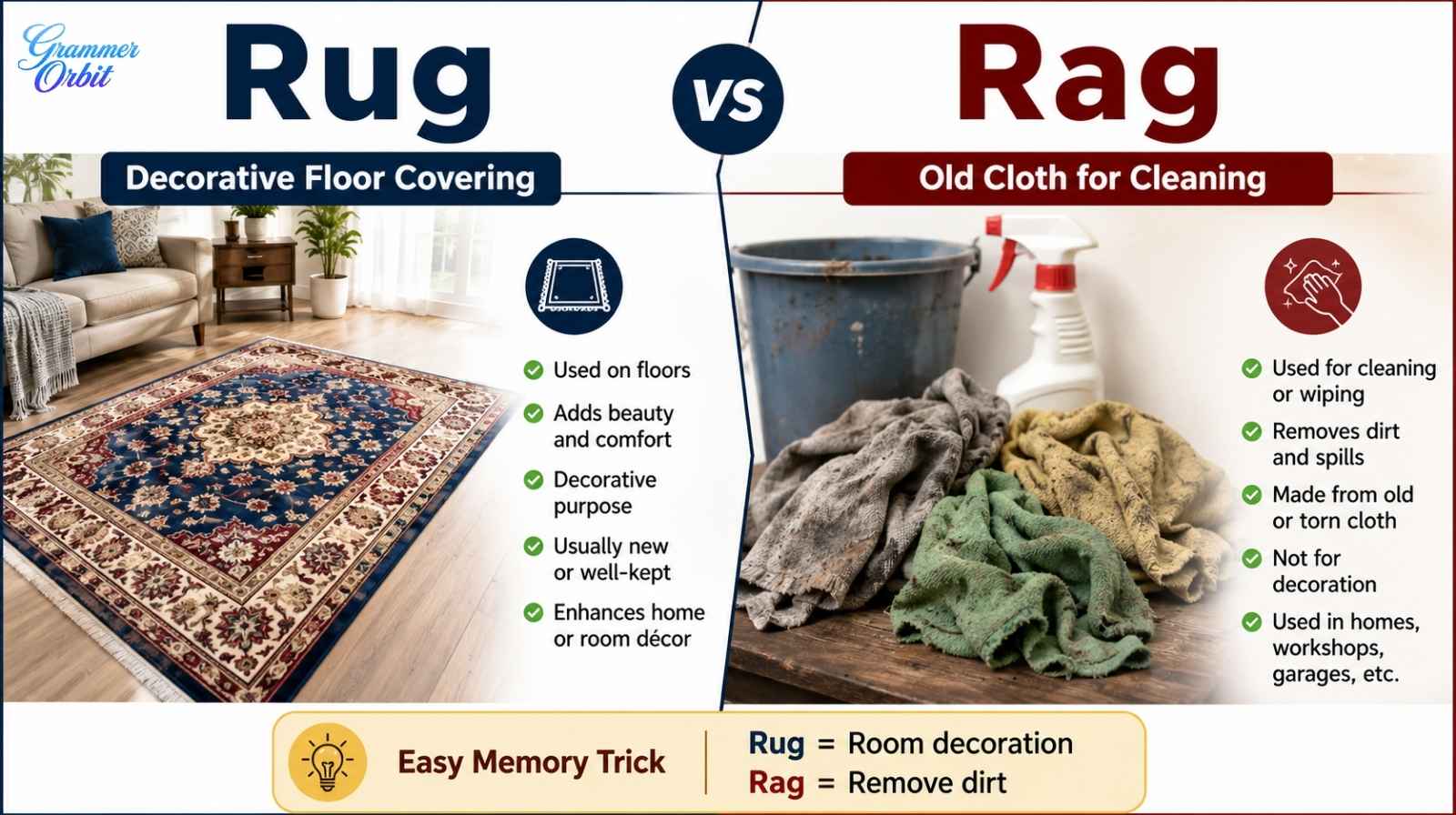
Have you ever heard someone say “rug” and “rag” and wondered if they meant the same thing? You are not alone. Many people confuse rug vs rag because the words sound similar and both are related to household items. However, their meanings are completely different.
A rug is something you place on the floor for comfort or decoration, while a rag is usually an old piece of cloth used for cleaning. Mixing them up can easily change the meaning of your sentence and create confusion in everyday English.
In this guide, you will learn the exact difference between rug and rag, how to use each word correctly, common mistakes people make, and simple tricks to remember them forever. By the end, you will confidently know which word fits naturally in your writing and conversations.
What Does “Rug” Mean?
The word “rug” refers to a thick piece of fabric used to cover part of a floor. Rugs are commonly used in homes, offices, hotels, and other indoor spaces for decoration, comfort, or warmth.
A rug is usually smaller than a carpet and can be moved easily from one place to another.
Common Uses of “Rug”
People use rugs for many purposes, including:
- Decorating rooms
- Adding warmth during winter
- Protecting floors
- Reducing noise
- Creating comfortable walking surfaces
Examples of “Rug” in Sentences
- She bought a beautiful Persian rug for her living room.
- The dog was sleeping on the soft rug near the fireplace.
- We placed a small rug under the coffee table.
Types of Rugs
There are many kinds of rugs available today, including:
| Type of Rug | Purpose |
|---|---|
| Area Rug | Covers a section of a room |
| Persian Rug | Decorative handmade rug |
| Outdoor Rug | Used on patios or balconies |
| Shag Rug | Thick and fluffy texture |
| Runner Rug | Long narrow rug for hallways |
The word rug is often associated with comfort, interior design, and home decoration.
What Does “Rag” Mean
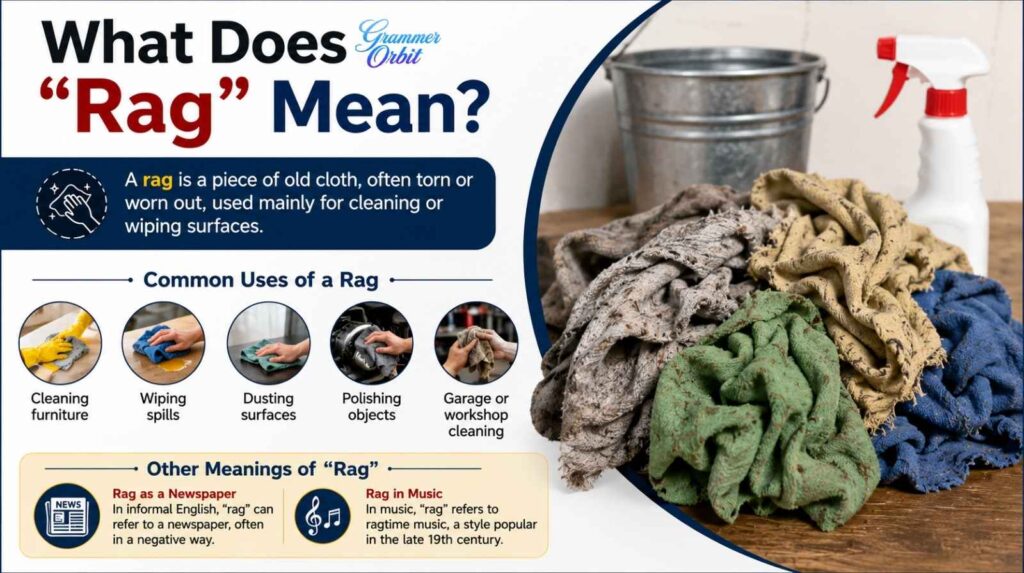
A “rag” is a piece of old cloth, often torn or worn out, used mainly for cleaning or wiping surfaces. Unlike rugs, rags are not decorative.
Rags are usually made from old clothes, towels, or fabric scraps that are reused for practical tasks.
Common Uses of “Rag”
A rag may be used for:
- Cleaning furniture
- Wiping spills
- Dusting surfaces
- Polishing objects
- Garage or workshop cleaning
Examples of “Rag” in Sentences
- He used a rag to clean the car engine.
- Please grab a rag and wipe the table.
- The mechanic kept oily rags in the toolbox.
Other Meanings of “Rag”
Interestingly, rag can also have informal meanings:
Rag as a Newspaper
In informal English, some people use “rag” to describe a newspaper, often negatively.
Example:
- That local rag publishes gossip every week.
Rag in Music
In music, “rag” can refer to ragtime music, a style popular in the late 19th century.
However, the cleaning-cloth meaning remains the most common everyday use.
Rug vs Rag: The Main Difference
Although rug and rag differ by only one letter, their meanings are entirely different.
Here is the easiest way to understand the difference.
| Feature | Rug | Rag |
|---|---|---|
| Meaning | Decorative floor covering | Old cloth for cleaning |
| Purpose | Comfort and decoration | Cleaning and wiping |
| Condition | Usually new or maintained | Often old or worn |
| Location | Floors | Cleaning areas, workshops |
| Example | Living room rug | Cleaning rag |
Simple Memory Trick
A useful trick is:
- Rug = Room decoration
- Rag = Remove dirt
This small reminder helps many English learners avoid confusion instantly.
Why Do People Confuse Rug and Rag?
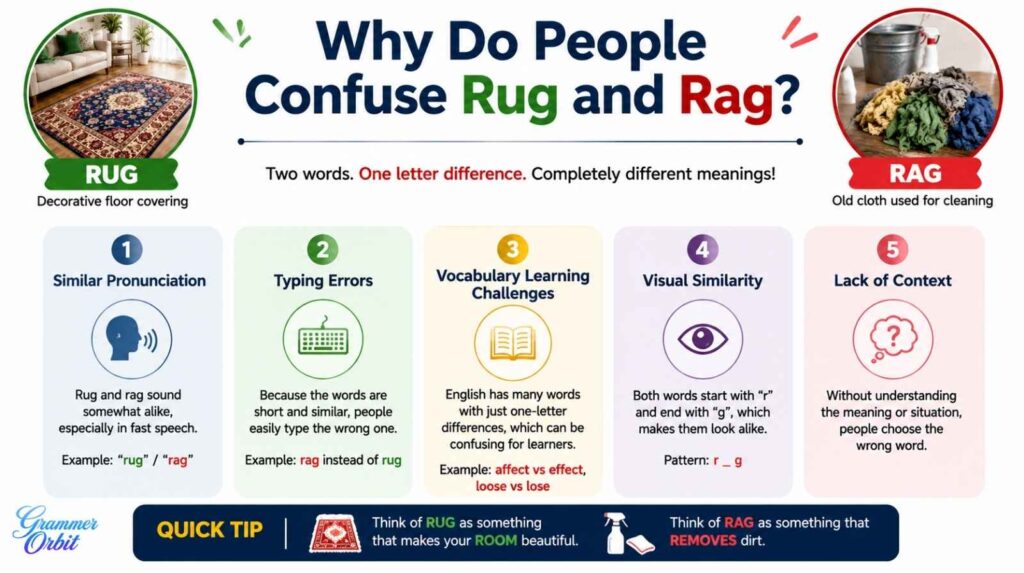
The confusion between rug vs rag happens for several reasons.
Similar Pronunciation
The words sound somewhat alike, especially for non-native speakers. Fast speech can make the vowel sounds harder to notice.
Typing Errors
Because the words are short, accidental spelling mistakes happen frequently during texting or online writing.
Vocabulary Learning Challenges
English contains many words with only one-letter differences, such as:
- affect vs effect
- loose vs lose
- desert vs dessert
Rug and rag belong to the same category of commonly mixed-up words.
Visual Similarity
Both words start and end with the same letters:
- r _ g
This visual similarity increases confusion, especially for beginner writers.
Real-Life Example: How a Small Word Mistake Created Confusion
A small home décor business in Texas shared a social media advertisement in early 2025 promoting its new “luxury living room rags.” The company intended to advertise decorative rugs, but the typo immediately confused customers.
Several users commented jokingly, asking why anyone would place dirty cleaning cloths in their living rooms. Others assumed the company sold recycled cleaning products instead of home décor items.
The mistake spread quickly online because screenshots of the ad were shared across multiple platforms. Within two days, the business corrected the error and updated all promotional material.
Interestingly, the company later stated in a customer interview that the accidental typo actually increased engagement on their page by nearly 40%. However, it also highlighted how important correct word usage can be in professional communication.
This example perfectly shows why understanding rug vs rag matters, especially in digital marketing, blogging, advertising, and business writing.
Rug vs Rag in Everyday English
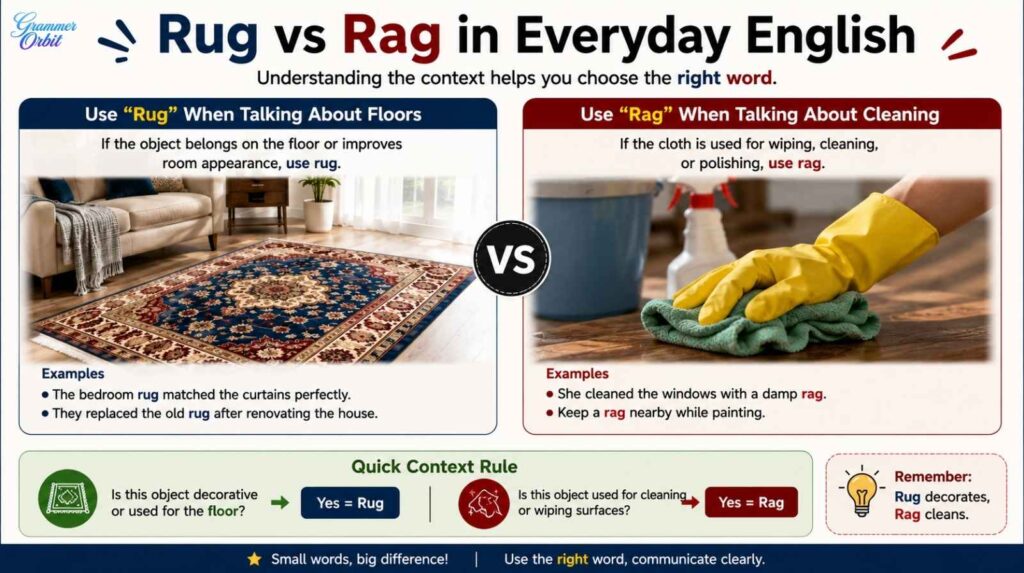
Understanding context is the easiest way to choose the correct word.
Use “Rug” When Talking About Floors
If the object belongs on the floor or improves room appearance, use rug.
Examples
- The bedroom rug matched the curtains perfectly.
- They replaced the old rug after renovating the house.
Use “Rag” When Talking About Cleaning
If the cloth is used for wiping, cleaning, or polishing, use rag.
Examples
- She cleaned the windows with a damp rag.
- Keep a rag nearby while painting.
Quick Context Rule
Ask yourself:
“Is this object decorative or used for cleaning?”
- Decorative → Rug
- Cleaning → Rag
This simple method works almost every time.
2025–2026 Language and Search Trend Data
Recent language-learning and search behavior data shows that word confusion articles are growing rapidly online.
According to language trend reports published in 2025:
- Google searches for “commonly confused English words” increased significantly during 2024–2025.
- Educational platforms reported higher engagement on vocabulary comparison content.
- Short-form language learning videos on social media gained millions of views globally.
Additionally, SEO research tools show that comparison-style keyword searches such as:
- “rug vs rag”
- “their vs there”
- “affect vs effect”
continue to attract consistent monthly traffic because users want fast, clear explanations.
This trend proves that simple language confusion topics remain highly valuable for bloggers, educators, and SEO-focused websites.
For more language insights, you can explore resources from:
Common Mistakes People Make With Rug and Rag
Many mistakes happen because people focus only on spelling instead of meaning.
Mistake #1: Using Rag for Decoration
❌ Incorrect:
- We bought a beautiful rag for the dining room.
✅ Correct:
- We bought a beautiful rug for the dining room.
Mistake #2: Using Rug for Cleaning
❌ Incorrect:
- Use this rug to wipe the counter.
✅ Correct:
- Use this rag to wipe the counter.
Mistake #3: Auto-Correct Problems
Modern phones sometimes replace words automatically, leading to embarrassing mistakes in messages or emails.
Therefore, proofreading remains important even for simple words.
How to Remember the Difference Forever
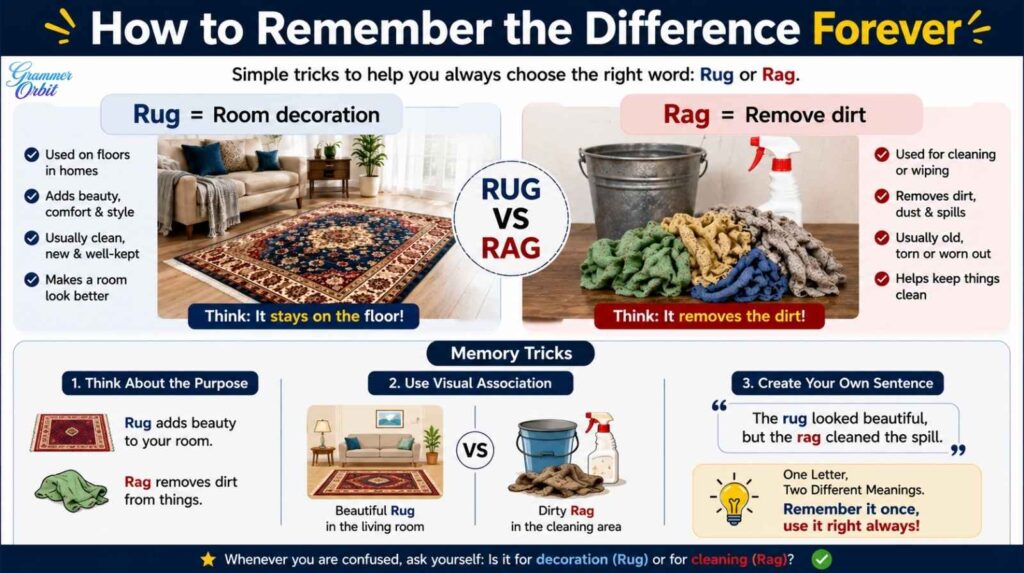
Learning memory tricks can make vocabulary easier.
Trick #1: Think About the Purpose
- Rugs stay on floors.
- Rags clean messes.
Trick #2: Use Visual Association
Imagine:
- A colorful rug in a living room
- A dirty rag in a garage
The contrast makes the meanings easier to remember.
Trick #3: Create Your Own Sentence
Practice using both words together:
“The rug looked beautiful, but the rag cleaned the spill.”
This method strengthens memory naturally.
FAQs
Q1: Is rug and rag the same thing?
A: No. A rug is a decorative floor covering, while a rag is an old cloth used for cleaning.
Q2: Can a rag become a rug?
A: Not usually. Rugs are designed for flooring, while rags are typically reused fabric pieces meant for wiping or cleaning.
Q3: Which word is more common in home décor?
A: Rug is much more common in home décor and interior design discussions.
Q4: Why do people confuse rug and rag?
A: People confuse them because they are short words with similar spelling and pronunciation.
Q5: Is “rag” considered offensive slang?
A: Sometimes. In certain contexts, “rag” can be used informally or negatively, especially when referring to newspapers. Context matters.
Q6: Are rugs always expensive?
A: No. Rugs can range from inexpensive small mats to luxury handmade Persian rugs costing thousands of dollars.
Q7: Can I use a rag for painting?
A: Yes. Rags are commonly used during painting projects to wipe brushes, clean spills, or remove excess paint.
Final Thoughts
Understanding rug vs rag is actually much simpler once you focus on the purpose of each item. A rug adds beauty, warmth, and comfort to a room, while a rag helps clean dirt, spills, and messes.
Although the words look similar, their meanings are completely different. Using the correct word improves your writing, prevents confusion, and helps you sound more natural in English.
The next time you see these words, remember:
- Rug = floor decoration
- Rag = cleaning cloth
Small vocabulary differences like this may seem minor, but they can make a huge impact on communication accuracy.
👉 Discover more simple and practical grammar guides on Grammer Orbit

Zia Ahmad is a professional blogger specializing in grammar tips and spelling accuracy. He creates clear, practical content that helps readers eliminate errors, strengthen writing skills, and communicate effectively for students, professionals, and everyday writers worldwide.