
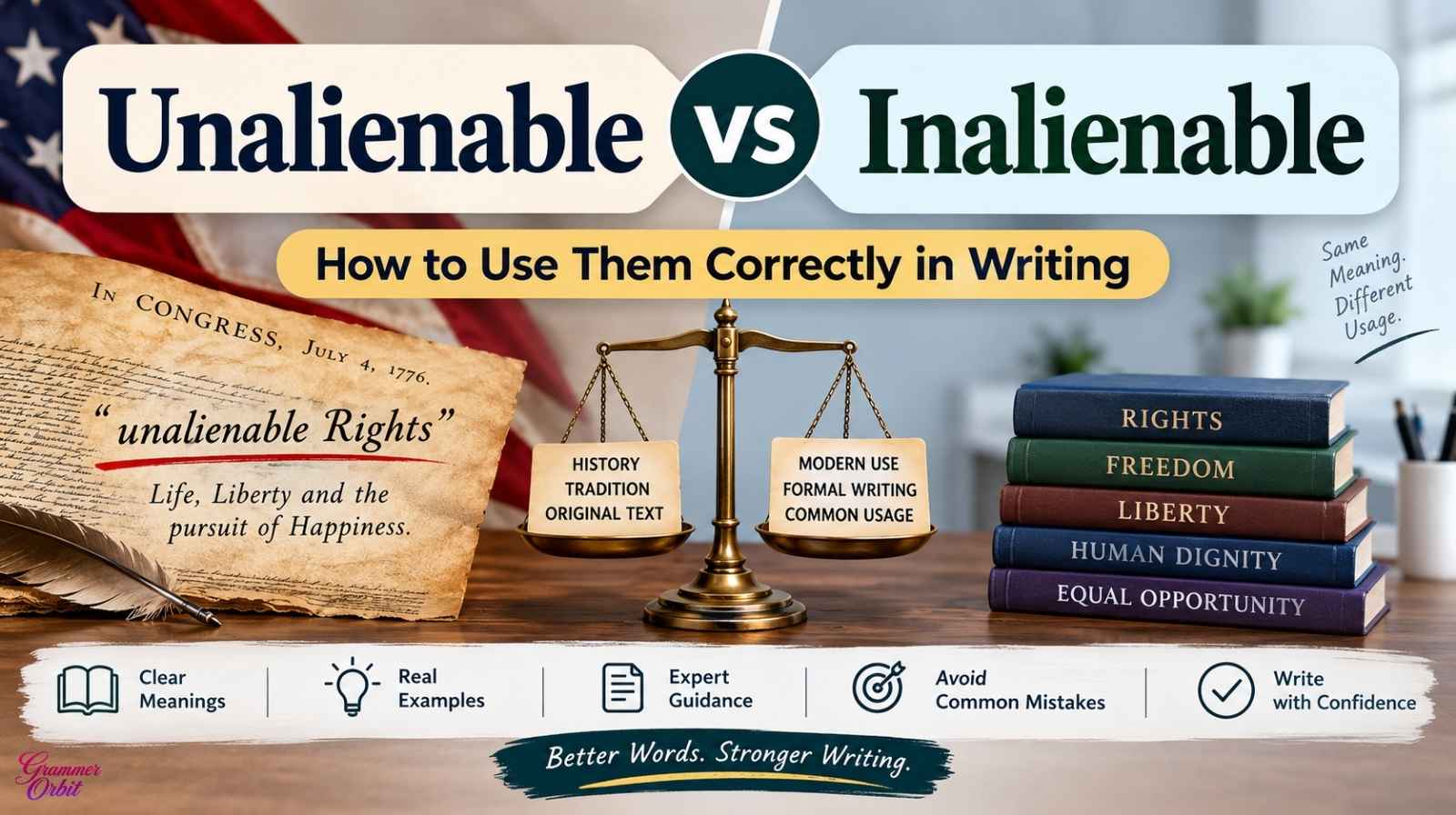
Have you ever wondered whether Unalienable vs Inalienable is the correct form? You’re not alone. Both words are legitimate English adjectives, and both describe something that cannot be taken away, surrendered, or transferred. However, one form is more common in modern English, while the other has a special historical connection to the Declaration of Independence.
In most contemporary writing, inalienable is the more common choice. However, unalienable is not incorrect. In fact, it is the exact word famously used in the Declaration of Independence when referring to fundamental rights.
Understanding this distinction can help you choose the right word for academic essays, legal or formal writing, historical discussions, and everyday English.
By the end of this guide, you’ll know exactly what unalienable vs inalienable mean, how they differ, when to use each one, and which form is usually the better choice today.
What Does “Unalienable” Mean?
Unalienable is an adjective meaning something that cannot be taken away, surrendered, transferred, or given up.
Merriam-Webster defines unalienable as meaning “not alienable” and gives inalienable as its equivalent. Its dictionary entry also dates the first known use of unalienable to around 1611.
Unalienable Meaning and Examples
The word is especially associated with rights, freedoms, and liberties that are considered inherent or impossible to surrender.
For example:
- Every person has unalienable rights.
- Freedom is considered an unalienable right by many political philosophers.
- The document recognizes the people’s unalienable liberties.
The word can also be used outside political language:
“She believed that human dignity was an unalienable part of every person’s identity.”
Why “Unalienable” Is Historically Important
The most famous use of unalienable appears in the United States Declaration of Independence.
The National Archives records the famous phrase describing people as being endowed with certain “unalienable Rights”, including life, liberty, and the pursuit of happiness.
This historical connection makes unalienable particularly appropriate when discussing American founding documents, historical quotations, or language associated with the Declaration.
What Does “Inalienable” Mean?
Inalienable has essentially the same core meaning: something that cannot be taken away, surrendered, or transferred.
Merriam-Webster defines inalienable as “incapable of being alienated, surrendered, or transferred.” It also notes that inalienable is the more common form today.
Inalienable Meaning in Modern English
In modern writing, inalienable is generally the safer and more familiar choice.
Examples include:
- Everyone should have inalienable rights.
- Freedom of speech is often described as an inalienable right.
- Human dignity is an inalienable part of a person’s identity.
- The constitution protects certain inalienable liberties.
Cambridge Dictionary similarly defines inalienable as something that cannot be removed or taken away and lists unalienable as a synonym.
Is “Inalienable” More Common?
Yes. Major dictionaries indicate that inalienable is the more frequent modern form.
Oxford lists unalienable as less frequent, while its entry for inalienable describes unalienable as the less frequent alternative.
Therefore, if you’re writing a modern essay, article, report, or professional document and don’t have a historical reason to use unalienable, inalienable is usually the better choice.
Unalienable vs Inalienable: What’s the Difference?

The simplest answer is that there is very little difference in meaning.
Both words describe something that cannot be alienated that is, transferred, surrendered, or taken away.
The main difference is usage, frequency, and historical association.
| Feature | Unalienable | Inalienable |
|---|---|---|
| Part of speech | Adjective | Adjective |
| Basic meaning | Cannot be taken away or transferred | Cannot be taken away or transferred |
| Correct English word? | Yes | Yes |
| Modern frequency | Less common | More common |
| Formal writing | Correct | Preferred in most modern contexts |
| Historical association | Strongly associated with the Declaration of Independence | Common in modern legal, academic, and general writing |
| Example | Unalienable rights | Inalienable rights |
Unalienable vs Inalienable: Which Is Correct?
Both are correct.
However, inalienable is generally the better choice for contemporary writing because it is more common today.
Use unalienable when you are:
- Quoting the Declaration of Independence.
- Discussing American history.
- Referring specifically to historical wording.
- Deliberately preserving the wording or style of a historical source.
Use inalienable when you are:
- Writing a modern essay.
- Discussing rights in general.
- Writing an article or report.
- Using contemporary legal or academic language.
- Choosing the most familiar modern form.
See also Moment vs Momment: Correct Spelling, Definition, And Usage Guide
A Simple Rule to Remember
Think of it this way:
Historical context → unalienable
Modern general writing → inalienable
This isn’t an absolute grammar rule, but it is a useful practical guideline.
How to Use Unalienable and Inalienable Correctly

Choosing between the two becomes much easier when you consider your audience and context.
Use “Unalienable” for Historical References
If you’re directly discussing the Declaration of Independence, unalienable is the natural choice because it preserves the original wording.
Correct:
The Declaration of Independence refers to certain “unalienable Rights.”
Using inalienable while paraphrasing the meaning would not be grammatically wrong, but it would no longer reproduce the historical wording exactly.
Use “Inalienable” in Modern Writing
For contemporary writing, inalienable will usually sound more natural.
Examples:
Human beings possess certain inalienable rights.
Freedom is an inalienable part of human dignity.
The author argues that education should be considered an inalienable right.
Avoid Confusing “Alienable” With “Inalienable”
The key to understanding both words is the base word alienable.
Something alienable can be transferred or given to someone else.
Something inalienable or unalienable cannot.
See also Finally or Finaly: The Simple Answer Fully Explained
For example:
- Alienable: Property that can legally be transferred.
- Inalienable: A right that cannot be surrendered or transferred.
- Unalienable: Another form meaning essentially the same thing.
This distinction is particularly useful in legal, philosophical, and academic writing.
Real-Life Case Study: The Declaration of Independence
One of the clearest real-world examples of the unalienable vs inalienable distinction comes from the Declaration of Independence.
In 1776, the Declaration stated that people were endowed with certain “unalienable Rights,” identifying life, liberty, and the pursuit of happiness. The National Archives continues to preserve the original Declaration and identifies it as one of America’s founding documents.
Imagine a student writing an essay about the Declaration of Independence. The student wants to explain the document’s philosophy and writes:
“The Declaration of Independence says that people have certain inalienable rights.”
The sentence is grammatically and conceptually understandable because inalienable and unalienable have essentially the same meaning. However, if the student is claiming to quote the original document, the wording needs to be preserved accurately:
“The Declaration of Independence refers to certain ‘unalienable Rights.’”
That small spelling difference matters because historical documents should be quoted exactly.
Now imagine a second situation. A student is writing a modern essay about human rights:
“Every individual should enjoy inalienable rights regardless of nationality.”
Here, inalienable is the stronger stylistic choice. The sentence is not trying to imitate eighteenth-century language; it is discussing a modern concept using contemporary English.
This example shows why the choice isn’t simply about one word being “right” and the other being “wrong.” Context determines which form is most appropriate. Historical writing may favor unalienable, while modern formal writing generally favors inalienable.
2025–2026 Usage and Historical Data
There is an interesting reason this distinction remains relevant today: 2026 marks the 250th anniversary of the Declaration of Independence, keeping its language especially visible in contemporary discussions of American history and political ideals. The National Archives’ 2026 Freedom 250 program specifically highlights the Declaration and its language about unalienable rights.
Here are several useful figures:
- 1776: The Declaration of Independence was adopted.
- 56: Delegates signed the Declaration.
- 13: The document represented the thirteen united colonies.
- 250 years: 2026 marks the 250th anniversary of American independence.
- About 200: Printer John Dunlap produced approximately 200 copies of the first printing, known as the Dunlap Broadsides.
- 26: The National Archives notes that 26 copies of the Dunlap Broadside are known to exist.
The continued attention to the Declaration in 2025 and 2026 helps explain why unalienable remains a recognizable word even though inalienable is more common in modern English.
Merriam-Webster’s current entries also show that both words remain established dictionary terms, while its inalienable entry explicitly notes that inalienable is the more common modern form.
Common Mistakes With Unalienable and Inalienable
Mistake 1: Thinking “Unalienable” Is Incorrect
It isn’t.
Unalienable is a legitimate English adjective and has a long history of use. Merriam-Webster lists it as meaning essentially the same thing as inalienable.
Mistake 2: Assuming They Have Completely Different Meanings
They don’t.
Both words communicate the idea that something cannot be taken away, surrendered, or transferred.
Mistake 3: Changing a Historical Quote
If you’re quoting a historical source, don’t modernize its spelling without clearly indicating that you’re paraphrasing.
The Declaration says “unalienable Rights,” so that exact wording should remain unchanged in a direct quotation.
Mistake 4: Using “Unalienable” Everywhere
Although unalienable is correct, it can sound more historical or less familiar in contemporary prose.
For most modern writing, inalienable is the more natural option.
Quick Checklist: Which Word Should You Use?
See also Cheer vs Chear: When to Use Each One Correctly
Before choosing the word, ask yourself:
- Am I quoting the Declaration of Independence? → Use unalienable.
- Am I discussing American founding history? → Unalienable may be preferable.
- Am I writing a modern article or essay? → Prefer inalienable.
- Am I discussing contemporary human rights? → Prefer inalienable.
- Am I describing something that cannot be surrendered or transferred? → Either word can work.
- Do I want the more common modern form? → Choose inalienable.
FAQs
Q1: Is “unalienable” a correct word?
A: Yes. Unalienable is a legitimate English adjective meaning something that cannot be taken away, surrendered, or transferred. It is also the form used in the Declaration of Independence.
Q2: Is “inalienable” the correct spelling?
A: Yes. Inalienable is correct and is generally the more common form in modern English. Merriam-Webster and Oxford both recognize it as a standard adjective.
Q3: Are unalienable and inalienable synonyms?
A: Yes. They have essentially the same meaning. Cambridge lists unalienable as a synonym of inalienable.
Q4: Which is more common: unalienable or inalienable?
A: Inalienable is more common in modern English. Oxford specifically describes unalienable as less frequent, while Merriam-Webster notes that inalienable is the more common form today.
Q5: Why does the Declaration of Independence say “unalienable”?
A: The Declaration uses the historical form “unalienable” in its description of certain rights. That wording is part of the document’s original text and should be preserved when quoting it directly
Q6: Should I use “inalienable rights” or “unalienable rights”?
A: For modern writing, inalienable rights is usually the better choice. For historical discussion or a direct quotation from the Declaration of Independence, unalienable rights is appropriate.
Q7: Can “unalienable” and “inalienable” be used interchangeably?
A: In most contexts, yes. Both describe something that cannot be taken away or transferred. However, context and style can make one form more appropriate than the other.
Q8: Is “inalienable” used in formal writing?
A: Yes. Inalienable is a formal adjective frequently associated with concepts such as rights, freedoms, dignity, liberty, and sovereignty. Oxford classifies it as a formal word usually used before a noun.
Conclusion:
So, unalienable vs inalienable is not a battle between a correct word and an incorrect one. Both are valid, and both express the idea of something that cannot be taken away, surrendered, or transferred.
The key difference is usage and context.
Unalienable has a particularly strong historical association with the Declaration of Independence and is the exact spelling used in that document. Inalienable, meanwhile, is the more common choice in modern English and is usually preferable for contemporary essays, articles, academic writing, and general formal communication.
When in doubt, remember this simple rule: use “inalienable” for modern writing and “unalienable” when historical wording or the Declaration of Independence is specifically relevant.
Now that you know the difference, choosing between unalienable and inalienable should be much easier. Use the context not just the spelling to make your final decision.
Want to avoid more confusing word pairs? Explore more practical word comparisons and improve your English writing one distinction at a time.
👉 Discover more simple and practical grammar guides on Grammer Orbit

Zia Ahmad is a professional blogger specializing in grammar tips and spelling accuracy. He creates clear, practical content that helps readers eliminate errors, strengthen writing skills, and communicate effectively for students, professionals, and everyday writers worldwide.