
Have you ever wondered whether you should say “Happy Holiday” or “Happy Holidays”? You’re not alone. Every holiday season, millions of people use these greetings in cards, emails, text messages, and conversations without knowing which one fits the situation best.
The truth is that both expressions are correct, but they are used in different contexts. Choosing the right one makes your greeting sound more natural, thoughtful, and grammatically accurate.
In this guide, you’ll learn the difference between Happy Holiday vs. Happy Holidays, when to use each phrase, common mistakes to avoid, and plenty of real-world examples.
Happy Holiday vs. Happy Holidays: What’s the Difference?
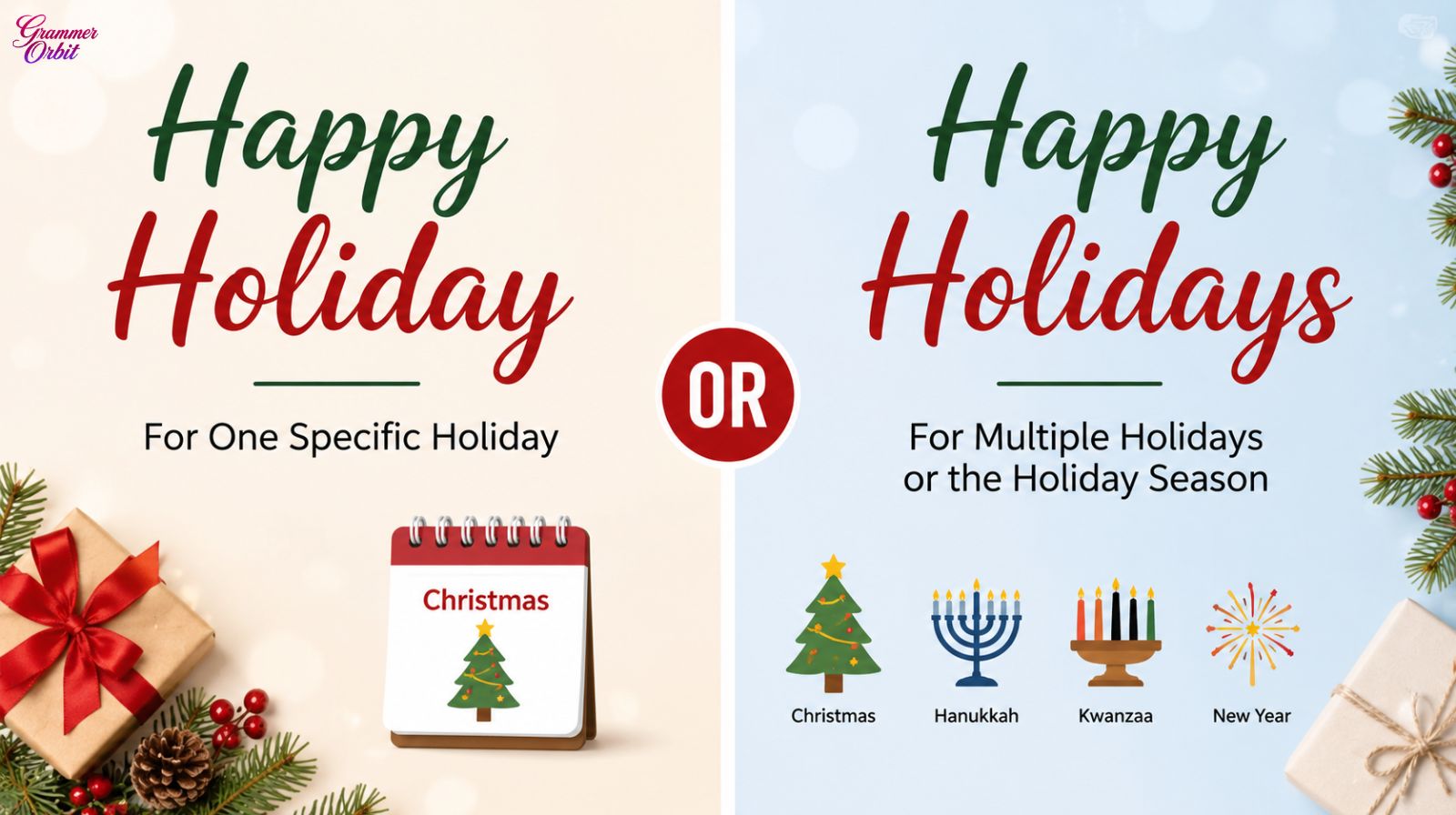
The biggest difference is the number of holidays being referenced.
| Phrase | Meaning | Best Used When |
|---|---|---|
| Happy Holiday | Refers to one specific holiday | Talking about a single celebration |
| Happy Holidays | Refers to multiple holidays or the entire holiday season | General seasonal greeting |
For example:
✅ Happy Holiday! Enjoy Thanksgiving.
✅ Happy Holidays! Wishing you joy throughout Christmas and New Year’s.
Although both are grammatically correct, Happy Holidays is far more common because many people celebrate several holidays during the same season.
See also Writen or Written? Which Form Is Correct?
Why “Happy Holidays” Is More Common
It Includes Multiple Celebrations
Many people celebrate more than one event during winter, including:
- Christmas
- Hanukkah
- Kwanzaa
- New Year’s Day
Instead of mentioning each celebration separately, people simply say:
Happy Holidays!
This greeting is friendly, inclusive, and suitable for almost everyone.
It Works in Professional Settings
Businesses often use Happy Holidays because customers may celebrate different traditions.
Examples include:
- Happy Holidays from our team!
- Wishing you Happy Holidays and a wonderful New Year.
- Happy Holidays to you and your family.
When Should You Say “Happy Holiday”?
When Referring to One Specific Holiday
If you’re only talking about one event, the singular version sounds natural.
Examples:
- Happy Holiday! Enjoy your Thanksgiving break.
- Happy Holiday to everyone celebrating Independence Day.
- Have a Happy Holiday this Labor Day.
In Specific Conversations
Imagine your friend celebrates only one holiday.
You could say:
“Happy Holiday! I hope you have an amazing Christmas.”
This focuses on that individual celebration.
See also Shakey or Shaky: The Complete Guide To The Correct Spelling
Real-Life Example: Choosing the Right Greeting at Work
Sarah manages customer emails for a nationwide online store. Every December, she sends thousands of holiday greetings to customers from different cultural and religious backgrounds.
A few years ago, her team used “Merry Christmas” in every promotional email. While many customers appreciated it, others felt it didn’t reflect the diversity of celebrations during the season. The marketing team decided to review customer feedback and found that a more inclusive greeting would better suit their audience.
The following year, Sarah changed the opening line to:
“Happy Holidays from all of us! We wish you peace, joy, and a wonderful New Year.”
The response was overwhelmingly positive. Customers from different backgrounds felt acknowledged, and the greeting worked whether they celebrated Christmas, Hanukkah, Kwanzaa, or simply enjoyed the festive season. Internally, the company also adopted “Happy Holidays” for greeting cards, social media posts, and customer support messages.
However, when Sarah wrote personal Christmas cards to close friends and family who specifically celebrated Christmas, she still used “Merry Christmas.” This illustrates an important point: the best greeting depends on your audience and the occasion. In broad or professional communication, Happy Holidays is often the safest and most inclusive choice, while personal greetings can be more specific when appropriate.
Happy Holiday vs. Happy Holidays Examples
Examples Using Happy Holiday
- Happy Holiday! Enjoy Thanksgiving.
- Have a Happy Holiday with your loved ones.
- Wishing you a Happy Holiday this Easter.
Examples Using Happy Holidays
- Happy Holidays and best wishes for the New Year.
- We wish you Happy Holidays from our family to yours.
- Happy Holidays! Stay safe and enjoy the season.
Common Mistakes to Avoid
Saying “Happy Holiday” When Referring to the Entire Season
❌ Happy Holiday and Happy New Year!
✅ Happy Holidays and Happy New Year!
Assuming “Happy Holidays” Is Incorrect
Many people think the plural form is grammatically wrong.
It isn’t.
Since the greeting refers to multiple holidays, using the plural is completely correct.
Forgetting Your Audience
If you’re greeting a wide audience, Happy Holidays is usually the better choice.
If you’re speaking about one holiday, use Happy Holiday.
See also Dought vs Doubt: Which Should You Use In Writing?
Data & Language Usage (2025–2026)
Language usage data and writing style guidance continue to show that “Happy Holidays” is the dominant greeting in business communications, retail marketing, and workplace messaging because it is inclusive and suitable for diverse audiences. Style guidance from major language references also notes that both expressions are grammatically correct, with the choice depending on whether you’re referring to one holiday or the broader holiday season. Search behavior during the 2025–2026 holiday season also indicates strong interest in questions about the difference between these greetings, reflecting ongoing curiosity about proper usage and inclusive language.
Happy Holiday vs. Happy Holidays Checklist
✔ Talking about one holiday? → Happy Holiday
✔ Talking about the holiday season? → Happy Holidays
✔ Writing business emails? → Happy Holidays
✔ Greeting a diverse audience? → Happy Holidays
✔ Referring to Christmas only? → Consider Merry Christmas if appropriate.
FAQs
Q1: Is “Happy Holiday” grammatically correct?
A: Yes. It is correct when referring to one specific holiday.
Q2: Is “Happy Holidays” more common?
A: Yes. It is widely used because many people celebrate multiple holidays during the season.
Q3: Which greeting is more professional?
A: Happy Holidays is generally considered more suitable for workplaces and businesses.
Q4: Can I say Happy Holiday to one person?
A: Absolutely. If you’re referring to a single celebration, it’s perfectly natural.
Q5: Why do companies prefer Happy Holidays?
A: Because it is inclusive and respectful of different traditions and celebrations.
Q6: Is Happy Holidays offensive?
A: No. It is intended as a friendly, inclusive greeting and is widely accepted.
Q7: Should I say Merry Christmas or Happy Holidays?
A: It depends on your audience. Use Merry Christmas when you know someone celebrates Christmas, and Happy Holidays when addressing a broader or diverse audience.
Conclusion
Understanding the difference between Happy Holiday and Happy Holidays is simple once you know the context. Happy Holiday refers to a single celebration, while Happy Holidays covers multiple celebrations or the entire festive season. Choosing the right phrase helps your message sound natural, respectful, and appropriate for your audience.
Whether you’re writing a greeting card, sending a business email, or posting on social media, using the correct expression leaves a positive impression. If this guide helped you, explore our other grammar and word comparison articles to improve your everyday English.
👉 Discover more simple and practical grammar guides on Grammer Orbit

Zia Ahmad is a professional blogger specializing in grammar tips and spelling accuracy. He creates clear, practical content that helps readers eliminate errors, strengthen writing skills, and communicate effectively for students, professionals, and everyday writers worldwide.