
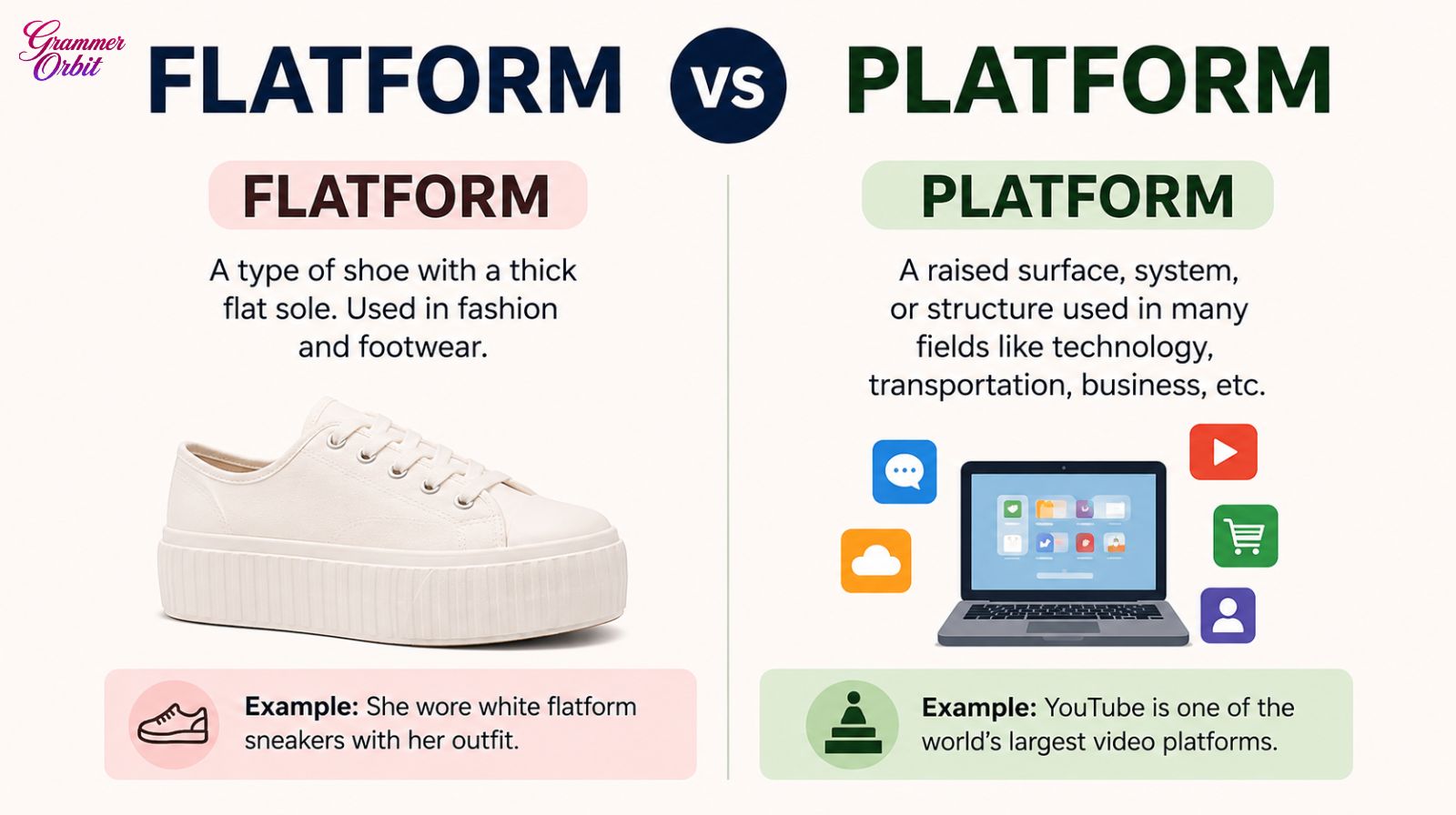
Have you ever seen the word “flatform” online and wondered if it was just a misspelling of “platform”? You are not alone. Many people confuse these two words because they look similar and are sometimes used in very different contexts.
However, the truth is that flatform and platform are both real words but they have completely different meanings. One is mainly used in fashion, while the other is common in technology, business, transportation, and everyday communication.
In this complete guide, you will learn the exact difference between Flatform vs Platform, how to use each word correctly, common mistakes people make, and real-life examples that make everything easy to understand.
What Does “Platform” Mean?
The word platform is one of the most commonly used English words today. Its meaning changes depending on the context.
In general, a platform refers to a raised surface, system, or structure used for support, communication, or operation.
Common Meanings of Platform
1. Platform in Technology
In technology, a platform is a digital system where applications, services, or interactions happen.
Examples include:
- Social media platforms
- Streaming platforms
- E-commerce platforms
- Learning platforms
For example:
“YouTube is one of the world’s largest video-sharing platforms.”
2. Platform in Transportation
A platform can also mean the area where passengers wait for trains or buses.
Example:
“The train will arrive at Platform 4.”
3. Platform in Politics or Business
In politics, a platform refers to a set of ideas, promises, or policies.
Example:
“The candidate explained her political platform during the debate.”
Examples of “Platform” in Sentences
- This software platform helps businesses manage customers.
- The speaker stood on the platform before addressing the crowd.
- Shopify is a popular e-commerce platform.
- We waited on the train platform for nearly an hour.
What Does “Flatform” Mean?
Unlike platform, the word flatform is mainly used in the fashion industry.
A flatform is a type of shoe with a thick sole that stays flat from heel to toe. It combines the words “flat” and “platform.”
What Makes Flatform Shoes Different?
Traditional platform shoes usually have elevated heels. However, flatform shoes keep the entire sole level, making them more comfortable for many people.
Examples of Flatform Usage
- She wore black flatform sandals with her summer dress.
- Flatform sneakers became a major fashion trend in 2025.
- Many designers now prefer flatform shoes for casual collections.
Why Flatform Shoes Became Popular
Flatform shoes became trendy because they offer:
- Extra height
- Better comfort
- Stylish appearance
- Everyday usability
Fashion brands continue introducing flatform sneakers, boots, and sandals due to rising demand among younger consumers.
Flatform vs Platform: Key Difference Explained
Although these words look alike, their meanings are entirely different.
| Feature | Flatform | Platform |
|---|---|---|
| Main Usage | Fashion | Technology, transportation, business, general English |
| Meaning | Flat thick-soled shoe | Raised surface or operating system |
| Industry | Footwear/Fashion | Multiple industries |
| Common Example | Flatform sandals | Social media platform |
| Popularity | Niche term | Extremely common term |
Simple Rule to Remember
- Flatform = Footwear
- Platform = System, Surface, or Structure
This simple trick helps many learners avoid confusion.
Why People Confuse Flatform and Platform
The confusion mainly happens because the two words are visually similar. In fact, flatform contains the word “platform” inside it.
However, there are several other reasons too.
Similar Spelling
Only one letter changes between the words:
- Flatform
- Platform
This small difference can easily lead to typing or reading mistakes.
Auto-Correct Problems
Sometimes mobile keyboards automatically replace “flatform” with “platform” because platform is much more commonly used.
Lack of Familiarity
Many people know the word platform but have never heard of flatform before. Therefore, they assume flatform is simply a spelling mistake.
SEO and Search Engine Confusion
According to recent search behavior studies, users often search fashion-related terms incorrectly because predictive search systems favor more popular words. This means people searching for “flatform sandals” may accidentally type “platform sandals.”
Real-Life Example: How a Fashion Store Lost Traffic Due to Keyword Confusion
In early 2025, a small online footwear brand launched a collection of modern flatform sandals for women. The company invested heavily in social media marketing and product photography. However, after three months, the website traffic remained extremely low.
After conducting an SEO audit, the marketing team discovered a major issue.
The product pages were optimized for the keyword “platform sandals” instead of “flatform sandals.” While the products actually had flat elevated soles, the website repeatedly used the wrong term in titles, descriptions, and image tags.
As a result:
- Search engines misunderstood the products
- Buyers searching specifically for flatform shoes could not find the pages
- Bounce rates increased because users expected different shoe styles
The company later corrected all product descriptions and optimized the pages for the right keywords. Within two months, organic traffic increased by nearly 48%.
This example shows how understanding the difference between similar words can directly impact SEO performance, user experience, and online visibility.
Flatform vs Platform in SEO and Digital Writing
Correct word usage matters a lot in SEO.
Search engines now focus heavily on user intent and semantic understanding. Therefore, using the wrong keyword may hurt rankings.
Why Correct Usage Matters
If your article talks about fashion shoes but repeatedly uses “platform” instead of “flatform,” search engines may misunderstand your content topic.
Similarly, using “flatform” when discussing software systems would confuse readers and reduce content quality.
Best SEO Practices
Use Keywords Naturally
Avoid forcing either term unnecessarily.
Match Search Intent
Understand what users actually want.
Examples:
- “Best flatform sandals for summer” → Fashion intent
- “Best e-commerce platform” → Technology intent
Optimize Headings
Place the correct keyword in:
- H1
- Meta title
- Meta description
- URL slug
- Image alt text
2025–2026 SEO Data and Trends
Recent SEO reports show that search intent optimization continues to dominate rankings in 2025.
According to industry studies:
- Google now prioritizes semantic relevance more than exact keyword repetition
- User-focused content performs better than keyword-heavy articles
- Search engines increasingly detect contextual meaning between similar words
Content creators who focus on clarity and intent generally achieve stronger long-term rankings.
Useful resources for SEO learning include:
Common Mistakes People Make With Flatform and Platform
Many English learners and even native speakers misuse these words.
Here are the most common mistakes.
Mistake #1: Using Platform Instead of Flatform
Incorrect:
“She bought beautiful platform sneakers.”
This may not always be wrong, but if the shoes have a completely flat elevated sole, “flatform” is more accurate.
Correct:
“She bought beautiful flatform sneakers.”
Mistake #2: Assuming Flatform Is a Typo
Many people incorrectly think flatform is not a real word.
However, it is officially recognized in fashion vocabulary.
Mistake #3: Mixing Fashion and Technology Contexts
Incorrect:
“This app is a great flatform for creators.”
Correct:
“This app is a great platform for creators.”
How to Remember the Difference Easily
A quick memory trick can help.
Think About the First Letters
F = Fashion
Flatform relates to footwear and fashion.
P = Programs or Platforms
Platform relates to systems, structures, software, or surfaces.
Visual Memory Trick
Imagine:
- Flatform → Flat shoe
- Platform → Raised stage or digital system
This simple association works surprisingly well for learners.
When Should You Use “Flatform” or “Platform”?
Here is a quick checklist.
Use “Flatform” When Talking About:
- Shoes
- Sandals
- Sneakers
- Fashion trends
- Footwear styles
Use “Platform” When Talking About:
- Software
- Social media
- Train stations
- Politics
- Business systems
- Public speaking stages
Using the correct word improves both clarity and professionalism.
FAQs
Q1: Is flatform a real word?
A: Yes. Flatform is a legitimate fashion term used to describe shoes with thick flat soles.
Q2: What is the difference between flatform and platform shoes?
A: Platform shoes usually have raised heels, while flatform shoes remain level from front to back.
Q3: Is platform more common than flatform?
A: Yes. Platform is used in many industries, making it far more common in everyday English.
Q4: Can flatform be used outside fashion?
A: Rarely. The word is almost always related to footwear and fashion.
Q5: Why do people confuse flatform with platform?
A: The words look very similar, and many people are unfamiliar with the fashion term flatform.
Q6: Which word should bloggers use for SEO?
A: Use the word that correctly matches user intent and content context.
Q7: Are flatform sandals still popular in 2026?
A: Yes. Flatform footwear continues to appear in modern casual and streetwear fashion collections.
Conclusion
Understanding the difference between Flatform vs Platform is easier once you know the context behind each word.
A flatform is a fashion-related shoe style with a thick flat sole, while a platform refers to a system, raised surface, or structure used in technology, transportation, business, and many other fields.
Although the words are similar in spelling, using the correct one matters for communication, SEO, readability, and professionalism.
Whether you are writing blog posts, product descriptions, or social media content, choosing the right term helps your audience understand your message clearly.
👉 Discover more simple and practical grammar guides on Grammer Orbit

Zia Ahmad is a professional blogger specializing in grammar tips and spelling accuracy. He creates clear, practical content that helps readers eliminate errors, strengthen writing skills, and communicate effectively for students, professionals, and everyday writers worldwide.